
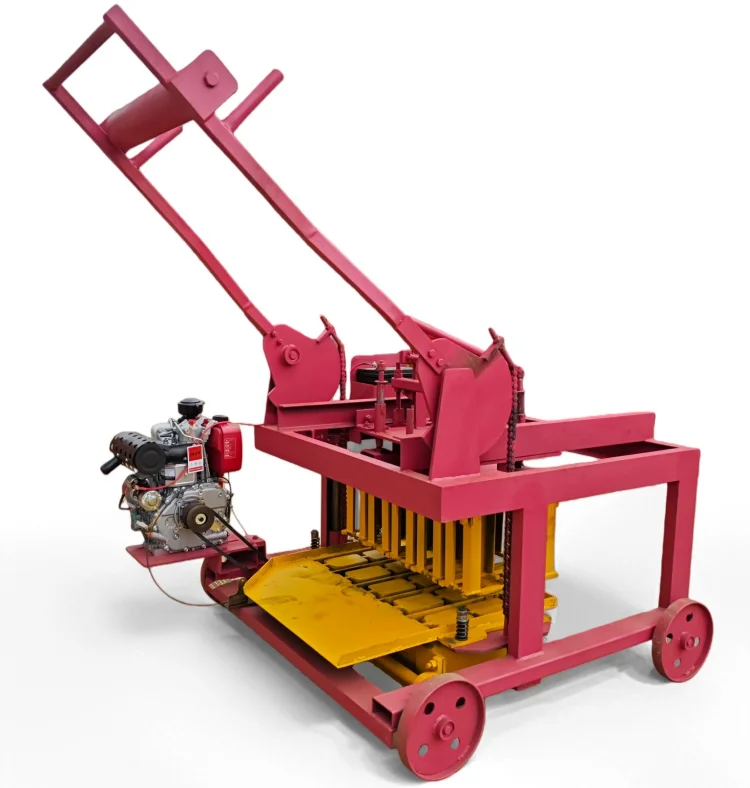
Matched line pacing — every mixer, feeder and curing logistics step is timed to the QMR4-45 egg laying cycle so the press never waits for material or space.
Technical Specifications
| Parameter | Value |
|---|---|
| Product Type | Mobile Concrete Block Making Machine |
| Model | QMR4-45 |
| Overall Dimensions (L×W×H) | 2420 × 1320 × 1650 mm |
| Net Weight | 810 kg |
| Rated Power | 6 kW |
| Diesel Engine Option | 6 kW or 6–8 HP |
| Voltage | 220V / 380V / configurable to site supply |
| Moulding Cycle | 40–45 s |
| Pallet Requirement | None (egg laying) |
| Output (400×200×200 mm hollow, 4 cavities) | 3000 pcs / 8 h shift |
| Output (400×150×200 mm hollow, 5 cavities) | 3500 pcs / 8 h shift |
| Output (400×120×200 mm hollow, 6 cavities) | 4500 pcs / 8 h shift |
| Assembly State | Skid-mounted mobile unit |
| Automation Level | Manual / egg laying |
| Warranty | One year for the whole machine |
Application Suitability
| Application | Material or Output |
|---|---|
| On-site housing project block production | Hollow blocks from crushed stone, sand and cement |
| Remote or off-grid construction sites | Diesel-driven operation without grid connection |
| First block plant with limited yard space | Pallet-free egg laying on prepared ground |
| Small contractor producing multiple hollow formats | Interchangeable moulds for 120 / 150 / 200 mm widths |
What "3000 Pieces per Day" Actually Means on a Mobile Block Machine Production Line
Daily output only holds when the mixer, material feed and curing area keep pace with a 40–45 second moulding cycle.
I once stood on a site in West Africa watching a mobile block machine production line stall every few minutes because a pan mixer two sizes too small could not feed the press fast enough. The operator kept waiting for the next batch while the machine sat idle. Capacity sheets that quote a single daily number without naming the block format, mould cavity count and upstream mixer size set buyers up for that exact frustration [NEED_CITE: line pacing and cycle time dependency in mobile block production]. When the QMR4-45 is fed on time and the curing ground is cleared ahead of the next pass, the 3000-piece figure for 400×200×200 mm hollow blocks is achievable; switch the mould to 400×120×200 mm and six cavities drop per cycle, pushing the same shift toward 4500 pieces.
Mixer Sizing and Feed Rhythm Around the Press
A 40–45 second cycle means the QMR4-45 demands a fresh batch roughly every three quarters of a minute. On a mobile block machine production line the mixer must deliver that volume without over-mixing or leaving dry pockets. A pan mixer or small twin-shaft unit rated for the same batch weight as one mould charge plus a margin keeps the rhythm steady. If the mixer is undersized, the press idles and daily output drops below the figures stated above.
Curing Ground Logistics and the Egg Laying Pattern
Because no pallets are used, each block is laid directly on a prepared concrete floor and the machine walks forward. The curing area must be long enough for a full shift of output and wide enough for the operator to move the machine in straight passes. Blocks need undisturbed setting time before they can be stacked for water curing. Planning the ground area before the machine arrives prevents the situation where fresh blocks are stepped on or the press runs out of runway mid-shift [NEED_CITE: egg laying curing area planning guidelines].
Reading the Core Specifications
The 810 kg net weight and skid-mounted assembly mean the QMR4-45 can be relocated with a site forklift or crane between project phases, which matters for contractors moving between housing sites. The 6 kW electric motor or 6–8 HP diesel engine option lets the same machine platform serve grid-connected yards and remote locations where only a generator or no electricity at all is available. A moulding cycle of 40–45 seconds is typical for manual egg laying machines in this class; vibration force and the operator’s feed rhythm together determine whether blocks reach the density needed for load-bearing walls. Voltage configurability across 220V and 380V avoids the commissioning delay that happens when a machine wired for the wrong frequency arrives on site.
When the Supporting Equipment Is an Afterthought
A mobile block machine production line that is quoted as just the press, with no mixer specification, no feeder sizing and no curing layout, leaves the buyer to source those pieces alone. The result is usually a mismatch: the mixer delivers half the needed batch weight, material is wheelbarrowed to the hopper by hand, and blocks are stacked before they have set. Daily output then falls well short of the quoted capacity, and block breakage during handling erodes whatever margin the project carried [NEED_CITE: common causes of output shortfall in small-scale block plants].
Why Source the Full Line from One Configuration Point
Block machinery is the single focus here, so the QMR4-45 is specified together with its mixer, feeder and curing logistics as one system rather than assembled from separate suppliers. Configuration starts from the buyer’s actual mix design and local aggregate, not a catalogue default. Mould drawings for every hollow format the buyer’s market sells are supplied, with custom sizes available from buyer sketches. Automation can remain manual at the start and a batching or pallet-based system can be added later as volume grows. Installation support includes on-site commissioning and operator training so the first week of production is not spent troubleshooting feed timing.
Documentation & Verification
- Line layout with capacity stated per hollow block format and mould cavity count
- Voltage and diesel engine confirmation sheet matched to site power before dispatch
- Mould drawing and format list showing included sizes and optional extras
- Factory test record covering cycle time and block density on a representative mix
- Operation and maintenance manual with wear parts list and mould change steps
- CE declaration documentation where applicable to destination market
Installation, Commissioning & Support
- Skid-mounted QMR4-45 requires a level concrete strip, no bolted foundation
- 6 kW motor needs a dedicated 380V circuit; diesel variant needs only fuel supply
- Machine arrives fully assembled; only mould mounting and hopper check on site
- First shift covers cycle timing, mix consistency and block density verification
- Operator training on mould change between 120, 150 and 200 mm hollow formats
- Wear parts list with hydraulic and vibration component replacement intervals
What to Prepare Before Requesting a Quote
Send the hollow block sizes your market moves, the daily volume you need to hit, and whether your site has grid power or requires the diesel engine option. Note the raw materials available locally — sand type, aggregate grading, cement supply — so the mixer and feed configuration match what you can actually source. If you already own a mixer or curing yard, share the dimensions and model so the line is paced around existing equipment rather than specified from scratch.
Frequently Asked Questions
Q: How is daily capacity calculated and which block format does each figure assume?
A: Each output figure ties to a specific hollow block size and mould cavity count on the QMR4-45. At a 40–45 second cycle across an eight-hour shift, 400×200×200 mm blocks yield around 3000 pieces from four cavities, 400×150×200 mm yields 3500 from five cavities, and 400×120×200 mm reaches 4500 from six cavities. These assume uninterrupted mixer feed and curing space.
Q: What supporting equipment keeps the QMR4-45 running at its stated cycle time?
A: A mixer sized to deliver one mould charge every 40–45 seconds, a consistent material feed method to the hopper, and enough prepared curing ground for a full shift of blocks. Without these, the press idles between cycles and daily output drops below the figures listed for each hollow block format.
Q: Can I choose between diesel and electric drive for my site conditions?
A: Yes. The QMR4-45 is available with a 6 kW electric motor configurable to 220V or 380V, or a 6–8 HP diesel engine for sites without reliable grid power. The drive type is confirmed before production so the machine arrives ready for the energy source actually available on your project site.
Q: How does egg laying affect curing area planning after the press moves forward?
A: Blocks are laid directly on a prepared floor with no pallets, so the curing area must be long enough for continuous straight passes and wide enough to hold a full shift of output. Blocks need undisturbed setting time before stacking for water curing. Ground area is calculated during line layout based on your chosen block format and target daily volume.
Q: Which block formats work on the same machine and what does a mould change involve?
A: The QMR4-45 platform accepts moulds for 400×200×200, 400×150×200 and 400×120×200 mm hollow blocks, plus other formats via additional mould orders. A mould change involves unbolting the current mould, fitting the new one, and adjusting the feed height. The time this takes is covered in the operation manual and operator training session.


