
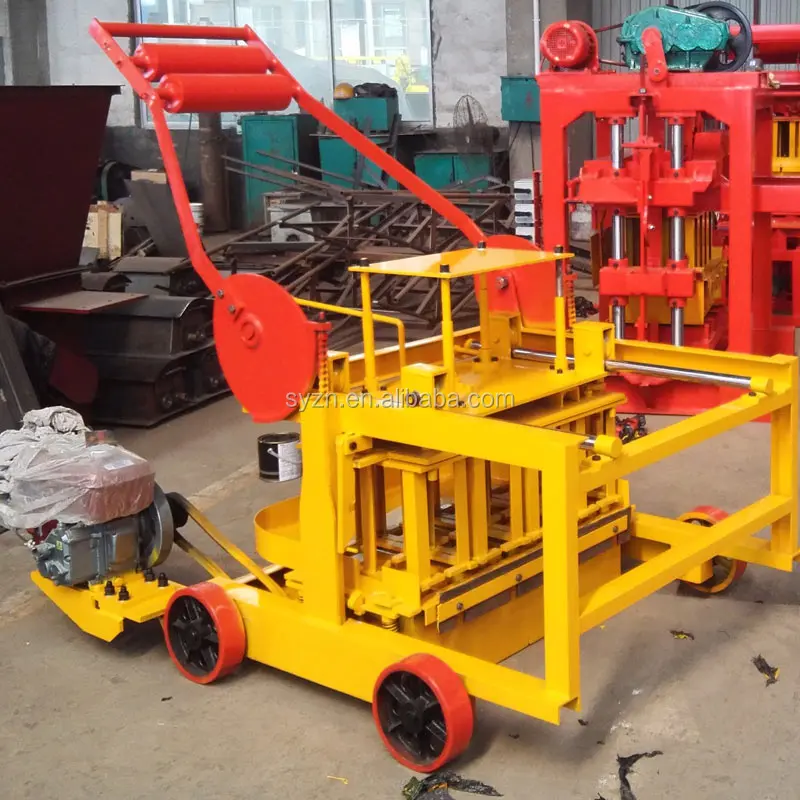
Line-First Configuration — The QMR4-45 mobile block machine production line pairs press, mixer and trolley as one matched system, so on-site cycle times align from batching through to laying without the press standing idle.
Technical Specifications
| Parameter | Value |
|---|---|
| Model | QMR4-45 |
| Product Type | Mobile Concrete Block Making Machine |
| Power Source | Diesel / Petrol Engine / Electric (basis to be confirmed) |
| Overall Dimensions (L×W×H) | 1100 × 950 × 2100 mm |
| Net Weight | 810 kg |
| Molding Cycle | 30–45 s (basis not stated in source) |
| Output Capacity | 2560 pcs/day (basis not stated in source) |
| Pallet Requirement | None — egg-laying / mobile type |
| Mobility | Mobile, movable on-site |
| Included Support Equipment | JZC350 Diesel Concrete Mixer or JQ350 Diesel Concrete Mixer (Electric Generating Unit); Trolley |
| Brick Formats | Paver brick, hollow block, concrete block, solid brick, fly ash brick |
| Automation Level | Manual / basic operation |
| Warranty | 1 Year |
Application Suitability
| Application | Material or Output |
|---|---|
| On-site housing project block production | Hollow blocks and solid bricks from crushed stone, sand and cement |
| Remote infrastructure site supply | Concrete blocks using locally available aggregates with diesel power |
| Small-scale entrepreneur block plant | Fly ash bricks and pavers from fly ash, sand and cement blends |
| Contractor-produced kerb and paving | Paver bricks laid directly on prepared ground without pallet handling |
What "2560 Pieces per Day" Leaves Out About Mobile Block Production
Capacity figures only hold when the mixer, trolley and press run as one mobile block machine production line — not as separate items sourced independently.
Quotations that list the press alone leave buyers to match a mixer and trolley on their own. I once saw a contractor pair a fast-cycle press with an undersized mixer; the press sat idle while waiting for the next batch, and daily output dropped to roughly half the quoted number. The QMR4-45 ships with a JZC350 or JQ350 mixer and a dedicated trolley so the upstream feed rate actually meets the 30–45 second molding cycle. [NEED_CITE: on-site concrete batching cycle time alignment]
Matching the Mixer to the Press Cycle
The JZC350 and JQ350 mixers included with this mobile block machine production line batch enough material per charge to feed the press continuously. A drum that is too small forces the operator to stop the press between batches, while an oversized drum wastes fuel and space on a compact site. The trolley bridges the gap between mixer discharge and press hopper, keeping material flow steady across an eight-hour shift.
Egg-Laying Operation Without Pallets
Because the QMR4-45 lays blocks directly onto a leveled ground bed, the line eliminates pallet investment, pallet return conveyors and curing rack handling entirely. This shrinks the site footprint to the press travel path plus a curing area. For contractors moving between project sites, that means fewer items to load, transport and reassemble each time the machine relocates. [NEED_CITE: egg-laying block machine site layout requirements]
How Power Source Choice Shapes the Line
The QMR4-45 is available with diesel, petrol or electric drive. On a remote site without stable grid supply, a diesel engine keeps both the mixer and the press running independently of local utilities. Where grid power is available, an electric motor reduces fuel cost and noise. Confirming the site voltage, frequency and engine serviceability before production avoids commissioning delays once the machine arrives.
Reading the Specs That Matter On-Site
The 1100 × 950 × 2100 mm footprint and 810 kg mass determine how easily the press can be relocated across a building site or loaded onto a flatbed for the next project. The 30–45 second molding cycle governs how many blocks the line can lay per hour — but only when the mixer discharges fast enough to keep the hopper full. Brick formats ranging from hollow blocks to pavers each demand a different vibration duration and mix consistency; a cycle that works for a lightweight fly ash brick may not achieve target density for a load-bearing hollow block without adjustment. The manual automation level means the operator controls feed, press and travel, which keeps capital cost low but requires trained hands to maintain consistent block density across a shift.
When Line Components Are Mismatched
If the mixer is sourced separately and its batch weight does not match the press hopper capacity, operators either overfill and spill or underfill and lose cycles. A trolley that is too heavy for one worker to push slows the feed rhythm, and a power source that cannot sustain both mixer and press simultaneously forces the crew to alternate — effectively halving the line’s running hours. These mismatches rarely appear in the quotation but show up on the first production day. [NEED_CITE: block production line bottleneck case studies]
Why Buyers Source This Line Here
Block machinery is our single focus, so the QMR4-45 press, JZC350/JQ350 mixer and trolley are specified together rather than assembled from separate suppliers. Configuration is set against the buyer’s local aggregate and target block format, not a catalogue default. Mould design covers the formats the buyer’s market actually sells, including custom drawings when standard shapes do not match local demand. The automation level can be selected so a contractor can start with manual operation and move to a semi-automatic line later. Installation and commissioning support with operator training ensures the crew understands cycle timing from day one.
Documentation & Verification
- Line layout and capacity calculation stating the block format assumed for the 2560 pcs/day figure
- Machine specification sheet covering press, mixer model and trolley dimensions
- Mould drawing and format list for hollow, solid, paver and fly ash brick
- Voltage and power source confirmation matching the buyer’s site conditions
- Factory test record showing cycle time with the buyer’s chosen block format
- Operation and maintenance manual plus wear parts list for press and mixer
Installation, Commissioning & Support
- Level a compacted ground bed before first run to ensure the 810 kg press travels without tilting
- Confirm diesel engine oil grade or electric motor voltage matches site supply before commissioning
- Assemble mixer drum and trolley from shipped modules — no heavy crane required at 810 kg press weight
- Run a test batch at 30–45 s cycle with your local aggregate to validate block density
- Train operators on hopper feed timing so the JZC350/JQ350 mixer discharge keeps pace with the press
- Stock mould wear strips and mixer blade sets for first replacement during the 1-year warranty
Preparing Your Inquiry
Share the block format you intend to produce, your target daily output and the aggregate materials available locally. Let us know whether your site has grid power or requires diesel or petrol engine drive, and confirm the voltage and frequency if electric. Include the curing area dimensions you have available so we can advise on daily laying path and spacing.
Frequently Asked Questions
Q: How is the 2560 pcs/day capacity calculated and which block format does it assume?
A: The figure is based on a specific block format, wall thickness and mix design that must be confirmed for your project. Hollow blocks, solid bricks and pavers each require different molding cycle times within the 30–45 second range. We provide a format-specific capacity calculation once the target block drawing and local aggregate are agreed, so the daily output you plan against reflects the product you will actually sell.
Q: Which power source should I choose for my site?
A: Diesel or petrol engines suit remote sites without grid access and allow both the mixer and press to operate independently. Electric motors reduce running cost where stable voltage and frequency are available. The choice affects the included generating unit specification and the commissioning checklist, so confirming site power conditions before production avoids delays when the QMR4-45 arrives on your project.
Q: Does the line include everything needed to start production?
A: The QMR4-45 package includes the press, a JZC350 or JQ350 concrete mixer and a material trolley. You will still need a water supply for mixing, a leveled ground bed for egg-laying and curing covers if blocks are exposed to direct sun or rain. We list these site-prepared items in the line layout document so you can arrange them before the machine is commissioned.
Q: How does the mixer output match the press cycle?
A: The included JZC350 or JQ350 mixer is sized so each batch discharges enough material to keep the press hopper fed through consecutive 30–45 second molding cycles. The trolley bridges the distance between mixer and press, maintaining a steady material flow. If your target block format demands a shorter cycle, we confirm whether a larger drum or faster discharge is needed to prevent the press from standing idle.


