
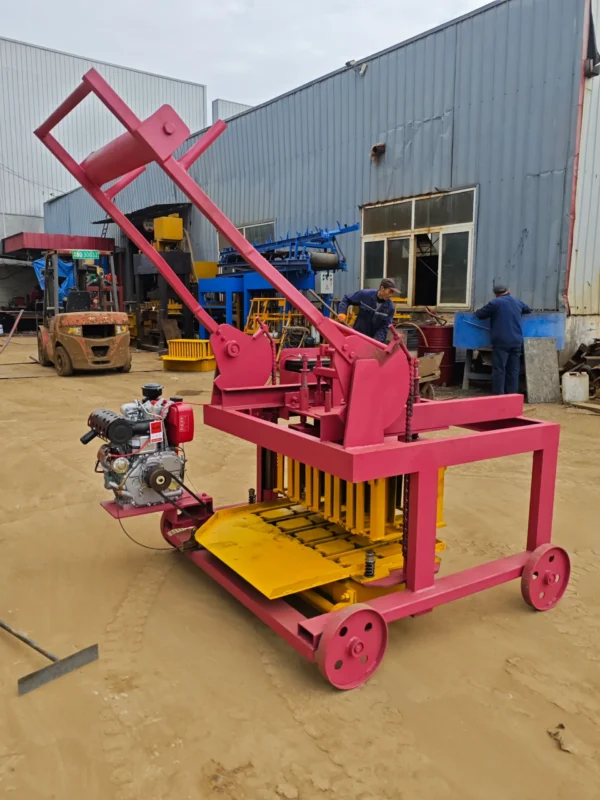
Matched System Sizing — every QMR4-45 block machine, diesel mixer, and trolley leaves as one validated line, not separate units assembled from different suppliers.
Technical Specifications
| Parameter | Value |
|---|---|
| Model | QMR4-45 |
| Product Type | Mobile Diesel Block Making Machine |
| Power Source | Diesel Engine |
| Rated Power | 8 hp |
| Molding Cycle | 45 s |
| Molding Form | Vibration and Pressure |
| Vibration Force | 60 kN |
| Total Weight | 800 kg |
| Overall Dimensions (L×W×H) | 2420 × 1320 × 1650 mm |
| Pallet Required | No (egg-laying operation) |
| Mobility | Mobile, no fixed foundation required |
| Block Formats Supported | Paver brick, hollow block, concrete block, solid brick, fly ash brick |
| Automation Level | Semi-automatic / manual operation |
| Basic Equipment Included | JZC350 or JQ350 Diesel Concrete Mixer (with Electric Generating Unit); Trolley |
| Voltage & Frequency | (basis to be confirmed) |
| Control System | (basis to be confirmed) |
| Hydraulic Pressure | (basis to be confirmed) |
| Output Capacity | (basis to be confirmed) |
Application Suitability
| Application | Material or Output |
|---|---|
| Remote housing projects | Hollow blocks from local crushed stone and cement without grid power |
| On-site contractor production | Solid bricks and concrete blocks laid directly on prepared ground |
| First-time block plant startups | Paver bricks and fly ash bricks with minimal infrastructure investment |
| Rural road and compound paving | Interlocking and paving formats using locally available aggregates |
What "45-Second Cycle" Really Means on a Dusty Job Site
A molding cycle only translates to daily output when the mixer keeps pace and the ground is ready for the next drop.
Buyers often see a cycle time on a spec sheet and multiply it out to an eight-hour shift, assuming every second produces a block. On real sites I have walked across in West Africa and South Asia, the mobile block machine production line supporting equipment around the press — the mixer, the trolley, the curing space — determines whether that cycle time holds or collapses. If the diesel mixer cannot batch fast enough, the press sits idle. If the ground is uneven or still wet from yesterday’s curing, the operator waits. [NEED_CITE: on-site block production logistics and cycle time variables]
How the Egg-Laying Design Removes Pallet Bottlenecks
The QMR4-45 deposits blocks directly onto the ground, which eliminates the need for pallets, pallet return conveyors, and pallet storage racks that a stationary plant requires. For a contractor who moves the mobile block machine production line supporting equipment from one project to the next, fewer components mean less to load, transport, and set up. The trade-off is that you need a flat, cleared area large enough to hold a full day’s output while it cures.
Mixer-to-Press Synchronization on Diesel Power
The included JZC350 or JQ350 diesel mixer must finish a batch before the press completes its current round of molds. With a 45-second molding cycle, the diesel engine driving both the mixer and the generating unit must sustain continuous load without overheating in high-ambient temperatures. When I have seen lines stall, it is almost always because the mixer output was assumed rather than measured against the press appetite under actual site conditions. [NEED_CITE: diesel engine continuous load rating in tropical climates]
Reading the Specs That Decide Block Density
The 60 kN vibration force works together with the mechanical pressure applied during the molding stroke to compact the mix into a dense, consistent block. Too little vibration on a stiff, low-slump mix leaves voids and weak corners; too much vibration on a wetter mix causes the block to slump before it sets. The 800 kg machine weight provides the reaction mass that keeps the unit stable during each cycle, so the vibration energy goes into the mold rather than shaking the frame. Block formats like hollow blocks with thin webs need a different balance of vibration and pressure than a thick solid paver brick, which is why confirming the mix design against the target format matters before the machine ships.
When the Supporting Line Is an Afterthought
I once watched a contractor in a South Asian housing project lose most of a shift because the trolley wheel gauge did not match the track he had welded on-site, so workers hand-carried wet mix to the press. The mobile block machine production line supporting equipment — mixer, trolley, generating unit — must be specified and checked as a set. When any single component is sourced separately or swapped for a cheaper local substitute, the mismatch surfaces only after the machine is running and the daily tally falls short. [NEED_CITE: material handling mismatches in small-scale block production]
Why This Machine Is Sourced as One Line, Not Separate Orders
Block machinery is our single focus, so the QMR4-45, its diesel mixer, and the trolley are configured as a matched system with output capacity calculated per block format rather than quoted as a generic cycle figure. Moulds are designed for the specific hollow, solid, paver, or fly ash formats the buyer’s market actually sells, and custom drawings are available when local demand calls for a non-standard size. The automation level stays selectable, meaning a buyer can start with manual pallet-free operation and add handling stations later as production volume grows. Installation support covers first startup and operator training at the site, not just a manual left in the crate. Every line configuration is validated against the buyer’s local aggregate and mix design before production begins, which is how I avoid repeating the mix-mismatch failures I have seen shut down sites.
Documentation & Verification
- Line layout and capacity calculation stating the block format assumed for each output figure
- Mould drawing and format list confirming included block types before dispatch
- Diesel engine and generating unit specification matched to site voltage and frequency
- Factory test record on buyer’s target mix and block format before shipment
- Wear parts and mould list with availability timeline for first replacement cycle
Installation, Commissioning & Support
- Ground preparation for 2420 × 1320 mm footprint, requiring a leveled surface without a poured foundation
- Diesel fuel supply and generating unit connection verified for local voltage and frequency before first run
- Machine arrives as one skid-mounted unit at 800 kg, movable by site forklift or crane to the production area
- First commissioning includes mold fitting, vibration calibration, and cycle timing against the actual mix
- Operator training covers mold change procedure, daily greasing points, and diesel engine maintenance schedule
- Spare wear parts list provided with lead times so replacements arrive before the first mold or vibration pad wears out
What We Need From You to Quote Accurately
Tell us which block format you plan to produce most days — hollow, solid, paver, or fly ash — and the target daily quantity so the capacity calculation reflects real output, not a theoretical maximum. Share your local aggregate type and any available mix proportions so the vibration and pressure settings can be matched before the machine is built. Confirm your site voltage and frequency if the electric generating unit will power any auxiliary equipment, and let us know the curing area dimensions so we can plan the egg-laying layout.
Frequently Asked Questions
Q: How does daily output differ between hollow blocks and solid bricks on the QMR4-45?
A: Output depends entirely on the block format assumed in the cycle calculation. A hollow block with larger cavities requires a longer fill and vibration sequence than a thin solid brick, so daily counts vary. We provide a per-format capacity sheet so you see the realistic number for the product you will actually sell, not a single headline figure.
Q: Should I choose the diesel mixer or the electric generating unit configuration?
A: That depends on grid reliability at your site. Where electricity is unstable or absent, the diesel mixer keeps production running independently. If you have a dependable grid connection, the generating unit can still serve as backup. We confirm your site power conditions before recommending one configuration over the other.
Q: Can I add more mould formats to the QMR4-45 later?
A: Yes. Moulds are interchangeable on the same machine frame, and custom drawings are available for non-standard block sizes your market may require. We supply a format list at purchase and keep mould tooling available for reorder so you can expand your product range without replacing the press.
Q: What supporting equipment is included beyond the press itself?
A: The basic package includes a JZC350 or JQ350 diesel concrete mixer and a trolley for moving mixed material to the press. Additional mobile block machine production line supporting equipment such as raw material feeders or curing rack systems can be added based on your site layout and daily volume targets.


