
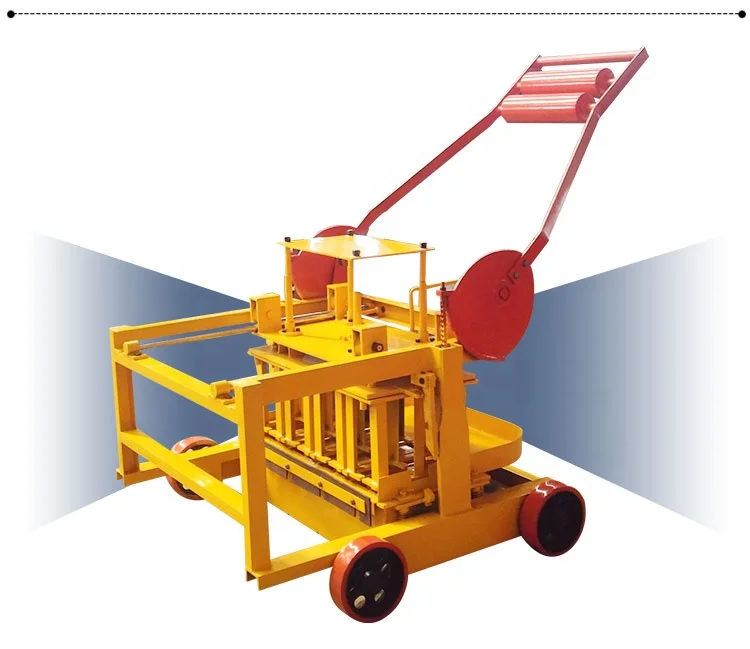
Integrated Line Matching — every station from the mixer to the curing yard is sized against the QMR4-45 egg-laying cycle so the press never waits for material and the daily output holds steady across an eight-hour shift.
Technical Specifications
| Parameter | Value |
|---|---|
| Model | QMR4-45 |
| Product Type | Mobile Egg-Laying Block Making Machine |
| Overall Dimensions (L×W×H) | 2420×1320×1650 mm |
| Net Weight | 810 kg |
| Rated Power | 6 kW |
| Diesel Engine Option | 6 kW or 6-8 HP |
| Voltage & Frequency | 220V / 380V or custom (frequency to be confirmed) |
| Control System | Manual / mechanical |
| Pallet Requirement | None (egg-laying on ground) |
| Moulding Cycle | 40-45 s (basis to be confirmed) |
| Output — 400×200×200 mm Hollow Block | 3000 pcs/day (4 pcs/mould, 8-hour shift) |
| Output — 400×150×200 mm Hollow Block | 3500 pcs/day (5 pcs/mould, 8-hour shift) |
| Output — 400×120×200 mm Hollow Block | 4500 pcs/day (6 pcs/mould, 8-hour shift) |
| Compatible Mould Formats | 400×200×200 / 400×150×200 / 400×120×200 mm |
| Assembly State | Fully assembled, mobile on wheels |
| Warranty | One year for the whole machine |
Application Suitability
| Application | Material or Output |
|---|---|
| On-site hollow block production for building contractors | Cement, crushed stone, sand — no fixed plant required |
| Housing project supply in areas with limited grid power | Diesel-driven pressing with locally sourced aggregate |
| Small-scale block yard for entrepreneurs | Hollow blocks in three wall-thickness formats from a single machine |
| Remote construction camps | Egg-laying on compacted ground, pallet-free workflow |
What "3000 Blocks per Day" Actually Requires Around the Press
The number holds only when the mixer batch size, feeding rate, and ground-curing footprint are all scaled to the 40-45 second cycle of the QMR4-45.
A mobile block machine production line stalls more often from upstream mismatches than from the press itself. I have watched a contractor lose two hours every morning because the pan mixer batch was too small to cover the cycle, so the operator stood idle waiting for the next mix. The curing area is another silent bottleneck — if the yard is not long enough to absorb a full shift of wet blocks before the machine loops back over fresh output, production slows to a crawl by mid-afternoon [NEED_CITE: on-site curing layout planning for egg-laying block machines]. Sizing every station around the press is the only way the quoted output survives contact with a real job site.
Sizing the Feeder and Mixer to the Press Cycle
The QMR4-45 completes a moulding cycle in roughly 40-45 seconds, which means the mixer must deliver a fresh batch to the hopper within that window to avoid idle time. A pan mixer or small compulsory mixer rated to match the hopper volume keeps material flowing without over-mixing, which can cause slump loss in hot climates. When planning a mobile block machine production line, the feeding belt or screw conveyor must also bridge the distance between the mixer discharge and the press hopper without spillage, because every kilogram lost on the ground is material paid for twice.
Ground Curing Layout and Daily Throughput
Since the QMR4-45 lays blocks directly on compacted ground, the curing strip length determines how far the machine travels before turning back. An eight-hour shift producing 3000 pcs of 400×200×200 mm hollow blocks requires a curing yard long enough to absorb that linear footprint with clearance between rows for walking and quality checks. If the yard is undersized, the operator must pause production until earlier blocks are dry enough to move — a problem that compounds in humid or cold weather where setting time extends [NEED_CITE: concrete curing time variation by ambient temperature and humidity]. Planning the curing area before the machine arrives prevents this mid-shift bottleneck.
Reading the Specs That Shape Line Design
The 6 kW rated power and optional 6-8 HP diesel engine define where this machine can operate. On sites without stable grid electricity, the diesel option removes the dependency on a generator or transformer, but it also means fuel supply and engine maintenance become part of the daily routine. The 810 kg net weight and wheel-mounted assembly allow a small loader or several workers to reposition the press as the curing strip extends, which is essential when the yard is linear rather than circular. Mould interchangeability across three hollow block formats (400×200×200, 400×150×200, and 400×120×200 mm) means the same machine can serve different wall-thickness requirements on one project, provided the mould change procedure is rehearsed before the first format switch so the downtime window is understood.
When the Line Is Built Backwards
Quoting a press without specifying the mixer output, feeding method, or curing area dimensions leaves the buyer to improvise those stations locally. The result is a line where the fastest component — the press — is governed by the slowest improvised station, and the daily count never approaches the brochure figure [NEED_CITE: production line bottleneck analysis in small-scale concrete plants]. Contractors who discover this on day one end up purchasing a larger mixer or renting extra curing space under time pressure, paying a premium they did not budget for.
Why Line Planning Starts Here
Block machinery as a single focus means the QMR4-45 is specified alongside its mixer, feeder, and curing layout rather than sourced as a standalone press. Configuration is set against the buyer’s local aggregate and target block format, so the mix design entering the hopper matches the vibration and pressure characteristics of the machine. Mould supply covers the three hollow block formats this machine accepts, with custom drawings available if the project requires a non-standard wall thickness. Automation level is selectable across the broader range, so a buyer who starts with the semi-manual QMR4-45 can move to a pallet-based automatic line later without changing suppliers. Installation support includes operator training on the actual job site, where curing conditions and aggregate variability are present in real time.
Documentation & Verification
- Line layout drawing showing mixer, feeder, and curing strip dimensions matched to cycle time
- Capacity calculation sheet stating the block format behind each daily output figure
- Machine specification sheet with voltage and frequency confirmation for your site
- Mould drawing and format list for all three hollow block sizes
- Factory test record before dispatch documenting cycle timing on the configured format
- Operation and maintenance manual covering diesel engine and mechanical control upkeep
Installation, Commissioning & Support
- Compacted ground strip leveled to tolerance before the 810 kg machine is wheeled into position
- 220V or 380V supply confirmed with local frequency; diesel engine option eliminates grid dependency
- Machine arrives fully assembled on wheels — no foundation bolts or structural base required
- First-run commissioning with operator training on mould change and cycle pacing
- Wear parts list covering mould liners and mechanical linkages with reorder lead times
Planning Your Line Inquiry
To size the supporting equipment around the QMR4-45, share the hollow block format you need most, the daily output target on that format, and the aggregate available near your site. Let us know whether grid power at your voltage and frequency is reliable or if the diesel engine option fits your conditions better. If you already have a mixer or a curing area in place, describe its capacity so the line layout accounts for what is already on the ground.
Frequently Asked Questions
Q: How is the 3000 pcs/day capacity calculated and which block format does it assume?
A: The 3000 pcs/day figure assumes the 400×200×200 mm hollow block format with four cavities per mould, running an eight-hour shift at the stated 40-45 second moulding cycle. Thinner wall formats yield higher counts per day because more cavities fit the same mould area. Actual throughput depends on the mixer, feeder, and curing layout keeping pace with the press throughout the shift.
Q: What supporting equipment is needed to keep the QMR4-45 running without idle time?
A: A mixer with batch volume matched to the hopper, a feeding method that bridges mixer discharge to press without spillage, and a ground curing strip long enough to absorb a full shift of output. When any of these stations is undersized, the press cycle slows and daily output drops below the calculated figure.
Q: Can the diesel engine and electric motor be configured for my site’s power conditions?
A: The QMR4-45 is available with a 6 kW electric motor or a 6-8 HP diesel engine. Voltage and frequency must be confirmed before production so the electrical components match your local supply. On sites with unstable grid power or no grid connection, the diesel option removes the dependency on external electricity.
Q: How does the on-ground curing layout affect daily output?
A: The curing strip must be long enough to hold a full shift of blocks before the machine loops back over the earliest output. If the strip is too short, production pauses until blocks set sufficiently to move. Ambient temperature and humidity influence setting time, so the required strip length varies by climate and season.
Q: What is included in the line quotation versus what the buyer sources locally?
A: The quotation covers the QMR4-45 press, selected moulds, and recommended supporting equipment such as the mixer and feeder. Ground preparation, curing area leveling, and raw materials are sourced by the buyer locally. A line layout document clarifies which items are supplied and which remain the buyer’s responsibility.


