
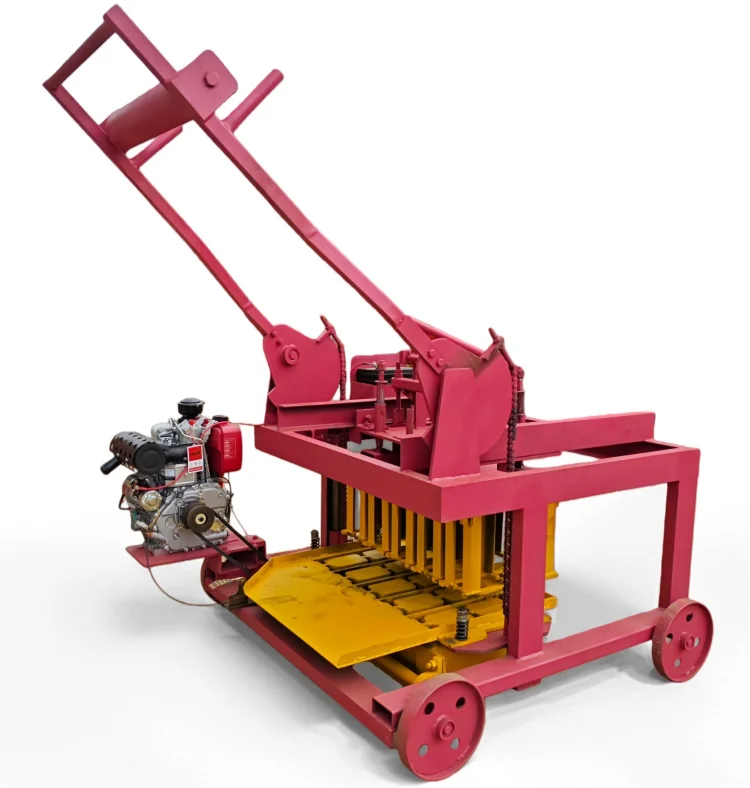
Mobile Line Focus — Every station around the press, from diesel mixer to trolley routing, is timed to the QMR4-45’s molding cycle so the operator never waits on material.
Technical Specifications
| Parameter | Value |
|---|---|
| Model | QMR4-45 |
| Product Type | Diesel/Electric Mobile Block Making Machine |
| Overall Dimensions (L×W×H) | 1100 x 950 x 2100 mm |
| Total Mass | 810 kgs |
| Molding Cycle | 30–45 s |
| Power Source | Diesel / Petrol Engine / Electric (selectable) |
| Output Capacity | 2560 pcs/day (basis not stated in source — confirm block format / material / thickness) |
| Basic Equipment | JZC350 Diesel Concrete Mixer or JQ350 Diesel Concrete Mixer (Electric Generating Unit); Trolley |
| Pallet Requirement | No pallet required |
| Mould Format Options | Paver brick, hollow block, concrete block, solid brick, fly ash brick |
| Structure | Linear type, simple structure |
| Automation Level | Semi-manual, mobile operation |
| Warranty | 1 Year |
Application Suitability
| Application | Material or Output |
|---|---|
| On-site housing project block production | Hollow blocks and solid bricks from locally sourced crushed stone, river sand and cement |
| Remote development site without grid power | Fly ash bricks and concrete blocks using diesel-driven mixer and press |
| Small-scale paver manufacturing | Paver bricks and interlocking formats from fine aggregate mixes |
| First block plant with minimal infrastructure | Concrete blocks and hollow blocks in a non-fixed, mobile layout |
What "2560 Pieces per Day" Actually Means for Your Site
The daily output figure only holds when the mixer batch interval, trolley return time and moulding cycle stay in sync around the block format assumed.
Many buyers see a capacity number and plan their entire project timeline around it. On a real construction site, the mixer takes a set number of minutes per batch, the trolley covers a fixed distance, and the operator needs time to strip the previous block. If any one of those intervals runs longer than the molding cycle, the press sits idle. I have watched a mobile block machine production line lose half its afternoon output because the diesel mixer could not keep up with the press cycle when the operator switched from a small solid brick to a larger hollow block format [NEED_CITE: block format impact on cycle timing in mobile operations]. The number on the spec sheet assumes a specific block size, material consistency and workflow rhythm — and all three must be confirmed before that figure is used for project scheduling.
How the Mixer and Press Stay in Rhythm
The QMR4-45 completes a molding cycle in 30 to 45 seconds. That window sets the pace for everything upstream. The JZC350 diesel mixer bundled in the basic equipment package must deliver a fresh batch to the trolley within that same window, or the press operator is left waiting with an empty hopper. Planning the mobile block machine production line means mapping the distance from the mixer station to the press, the trolley travel speed, and the batch volume per mix — then confirming that the sum of those intervals does not exceed 45 seconds under normal working conditions.
Why No-Pallet Design Changes the Entire Line Layout
An egg-laying machine that deposits blocks directly on the ground removes the pallet feeding station, the pallet return conveyor and the pallet storage rack from the line entirely. That simplification cuts the equipment list and the footprint, but it shifts the planning burden to the curing area. The ground surface must be level and clean, the curing zone must be sized for the daily output, and the trolley routing must allow the operator to move away from freshly laid blocks without running over them [NEED_CITE: ground preparation standards for egg-laying block machines]. The surrounding workflow, not the press itself, determines whether the mobile block machine production line runs without interruption.
Reading the Specs That Matter on a Mobile Press
The total mass of 810 kgs keeps the machine within the range that two workers can reposition on a prepared floor, which is the defining advantage of a mobile unit over a stationary press. The linear structure means the material feed enters from one side and the finished block exits from the other, so the trolley path and the operator standing position are fixed by the machine geometry rather than adjustable. Power source flexibility — diesel, petrol or electric — determines whether the line needs a generator, a grid connection, or can run on fuel alone. For sites in regions with unreliable electricity, the diesel configuration pairs the QMR4-45 with the JZC350 mixer on a single fuel supply, eliminating the need for separate electrical infrastructure [NEED_CITE: diesel versus electric power selection for remote construction sites]. The semi-manual automation level means one operator manages the feed, the cycle start and the trolley movement, so labor planning must account for that single-person pace across an entire shift.
What Happens When Line Timing Is Ignored
When the mixer batch interval is not matched to the press cycle, the consequences show up as idle time that nobody records. The operator stands by the hopper waiting for the next batch, the partially mixed material in the trolley begins to lose workability, and the blocks produced late in the shift show lower density because the mix sat too long before molding. On a construction site running against a deadline, that lost rhythm compounds across the day. The blocks stacked by hand at the end of the line may meet the count, but the strength consistency from first block to last will vary [NEED_CITE: effect of mix dwell time on block compressive strength]. The cost is not visible on a quotation — it appears only when the site engineer tests a random sample and gets a result below the project specification.
Why Buyers Source This Line Here
Block machinery is the single focus, so the QMR4-45, its diesel mixer, the trolley and the moulds are specified as one matched set rather than assembled from separate suppliers who have never tested their equipment together. The line layout and capacity calculation state which block format the output figure assumes, removing the guesswork that leads to project shortfalls. Mould design covers the formats the buyer’s local market actually sells — paver, hollow, solid, fly ash — and custom drawings are available when a project calls for a non-standard size. Automation level is selectable within the mobile range, so a buyer can begin with semi-manual operation and add stations later without replacing the press. The basic equipment bundle ships with the mixer and trolley included, meaning the line arrives as a coordinated system rather than a list of separate purchase orders.
Documentation & Verification
- Line layout drawing showing mixer-to-press distance and trolley routing for the QMR4-45
- Capacity calculation sheet stating the exact block format behind the daily output figure
- Mould drawing and format list confirming which sizes ship in the base supply
- Voltage and power source confirmation sheet for the electric variant before production
- Factory test record run on the buyer’s specified block format before dispatch
Installation, Commissioning & Support
- Ground leveling within tolerance across the full 1100 mm machine length and trolley path
- Diesel fuel supply point positioned to serve both the QMR4-45 engine and the JZC350 mixer
- Mould change procedure walked through on-site with the operator using the supplied format set
- Trolley routing dry-run completed before first production batch to confirm cycle timing
- Wear parts list provided with reorder intervals specific to the 810 kg class mobile press
What to Share Before Requesting a Quote
Provide the block format and dimensions you plan to produce, along with the daily output target for that specific size. Include the raw materials available locally — type of aggregate, sand source and cement grade — so the mixer batch time can be matched to the press cycle. Confirm whether the site has grid electricity or requires full diesel operation, and describe the available ground area for the curing zone. With those details, the line layout and capacity calculation can be prepared against your actual conditions rather than a catalogue default.
Frequently Asked Questions
Q: How is the 2560 pcs/day capacity calculated and which block format does it assume?
A: The figure is based on a specific block size and molding cycle within the 30–45 second range, running for a defined shift length. The exact format behind that number must be confirmed with the supplier before using it for project planning. Request the capacity calculation sheet that names the block dimensions and shift hours assumed.
Q: How does the mixer batch cycle time align with the 30–45 s moulding cycle to avoid idle time?
A: The JZC350 diesel mixer must complete a batch, discharge into the trolley, and have the trolley reach the press within the same 30–45 second window. The line layout maps each of these intervals so the total does not exceed the press cycle, keeping the operator working continuously rather than waiting for material.
Q: What supporting equipment is needed around the mobile press for a complete setup?
A: The basic equipment covers the mixer and trolley. The buyer must prepare a level ground surface for egg-laying, a curing area sized for the daily output, and a water supply for curing. Trolley routing must allow the operator to move clear of freshly laid blocks without crossing the production path.
Q: Diesel versus electric power source — which configuration fits my site conditions?
A: Sites without reliable grid power should select the diesel configuration, which pairs the QMR4-45 engine with the JZC350 diesel mixer on a single fuel supply. Where grid electricity is available and stable, the electric variant reduces operating noise and fuel logistics. Confirm the local voltage and frequency before ordering the electric version.
Q: What mould formats ship with the machine and how are additional custom moulds ordered?
A: The base supply includes moulds for the formats specified at inquiry — chosen from paver brick, hollow block, concrete block, solid brick and fly ash brick. Custom moulds are produced to buyer drawings and added to the order before production. The format list in the documentation confirms exactly which sizes are included before shipment.


