
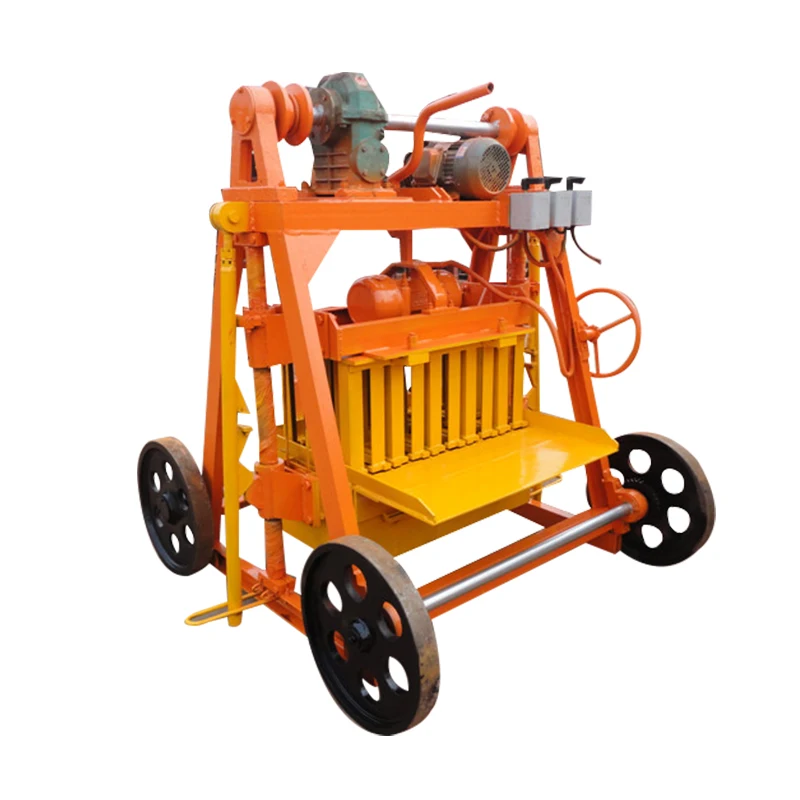
Matched Mixer Capacity — We calculate raw material feed rate against the 30-45s molding cycle so the QMJ4-45 press never idles waiting for concrete.
Technical Specifications
| Parameter | Value |
|---|---|
| Model | QMJ4-45 |
| Product Type | Movable Manual Egg Layer Block Making Machine |
| Vibration Type | Twice vibrations of molding core |
| Molding Cycle | 30–45 seconds |
| Block Format Capacity | 400×200×200mm: 4 pcs/mould, 320 pcs/hour, 2,600 pcs/8hr shift |
| Block Format Capacity | 400×150×200mm: 5 pcs/mould, 400 pcs/hour, 3,200 pcs/8hr shift |
| Block Format Capacity | 400×100×200mm: 7 pcs/mould, 560 pcs/hour, 4,480 pcs/8hr shift |
| Control System | Manual operation |
| Stacking Method | On-site ground laying (egg layer) |
| Pallet Requirement | Not applicable |
| Mould Formats Supported | Hollow block, solid block |
| Certification | ISO9001:2000, CE |
Application Suitability
| Application Scenario | Material and Output Context |
|---|---|
| Multi-site construction contractors | Concrete mixed from local crushed stone, sand, and cement; machine relocated between job sites |
| Housing project on-site production | Hollow and solid blocks laid directly on prepared ground; output matched to daily build rate |
| First-time block plant operators | Low-capital entry with manual operation; no fixed power infrastructure required beyond basic supply |
| Remote area building projects | Egg-layer mobility eliminates need for pallets, curing racks, and fixed plant footprint |
What the "Pieces Per Hour" Figure Actually Means on a Job Site
Capacity only holds when the mixer, material feed, and operator rhythm match the 30-45s cycle.
When a mobile block machine production line runs at stated output, it assumes someone is feeding concrete into the hopper at a rate that keeps the press working continuously. In reality, I have seen contractors lose nearly half their shift to material shortages because the mixer was too small or placed too far from the press. The QMJ4-45 completes a cycle every 30 to 45 seconds, which means the supporting mixer must deliver a fresh batch within that window. If it cannot, the press sits idle, and the daily count drops well below the published 2,600-piece figure for 400×200×200mm blocks [NEED_CITE: typical output loss from mismatched mixer capacity in mobile block operations].
Synchronizing the Mixer to the Egg Layer Cycle
The entire mobile block machine production line lives or dies on material flow timing. A QMJ4-45 pressing 400×100×200mm blocks consumes seven units per cycle, demanding a steady concrete supply to hit 560 pieces per hour. If the mixer takes 90 seconds to prepare a batch, the press waits through every other cycle, cutting realistic output sharply. We size the mixer drum volume and discharge rate so that fresh concrete reaches the hopper before the mold closes.
Ground Preparation and the Laying Path
Since the QMJ4-45 is an egg-layer type, it deposits blocks directly onto the ground. This means the laying surface must be level, compacted, and long enough to accommodate the day’s output before the machine loops back. For a shift producing 3,200 units of 400×150×200mm blocks, the ground path extends considerably [NEED_CITE: ground area calculation per block format for egg layer machines]. Contractors who skip this preparation find blocks cracking or tilting on uneven soil, negating the density advantage of the twice-vibration core.
Reading the Specs That Actually Matter
The twice-vibration molding core applies vibration in two phases to settle the concrete mix evenly across the mold cavity. This matters for block density consistency, particularly when local aggregate varies in particle size. The 30-45s cycle range reflects the reality that denser mixes with higher cement content may need the full 45 seconds, while leaner mixes can release faster. Manual operation means the operator controls each step — feed, vibrate, move — which keeps the machine viable in locations without reliable three-phase power or PLC infrastructure. The absence of pallets reduces both capital outlay and logistics complexity on remote sites.
When Supporting Equipment Gets Overlooked
Buying the press alone and sourcing a mixer locally seems cost-effective until the rhythm breaks down on day one. A contractor in the Yangtze River region purchased multiple egg-layer units but paired them with undersized mixers, resulting in actual daily output dropping to roughly half the expected volume. The press was never the bottleneck — the material supply was [NEED_CITE: field reports on mixer-press mismatch in mobile block production]. We specify the mixer, feed chute, and operator workflow as one system before quoting the line.
Why Procurement Starts with the Line Layout
Block machinery as a single focus means the QMJ4-45, its mold options, and the supporting mixer are specified together based on your target format and local aggregate. We calculate capacity per block size rather than quoting a single headline number. Configuration accounts for your actual mix design and curing area dimensions, not a catalog default. Mould design covers the hollow and solid formats your market demands, with custom drawings available. Documentation includes a line layout showing material flow from mixer to press, so the installation team knows the spacing before the machine arrives.
Documentation & Verification
- Line layout diagram showing mixer placement and material feed path to QMJ4-45
- Capacity calculation sheet stating cycle time assumption per block format
- Mould drawing and format list for hollow and solid block options
- Factory test record on your specified block size before dispatch
- Voltage and frequency confirmation document for your local power grid
- Operation manual covering manual cycle sequence and maintenance intervals
Installation, Commissioning & Support
- Ground leveling requirements specified for egg-layer block path length
- Power supply confirmed for your site voltage before machine configuration
- Machine arrives assembled with mould fitted; ready for first-cycle test
- On-site commissioning includes operator training on 30-45s manual rhythm
- Wear parts list provided for vibration core components and mould surfaces
- Daily and weekly maintenance schedule tied to manual operation checkpoints
Starting the Conversation with the Right Details
Tell us the block format your market sells — hollow or solid, and the exact dimensions. We need your local aggregate type and cement availability to match the mixer to your mix design. Share your site power specifications (voltage and frequency) so we configure accordingly. If you have a target daily output and available ground area, we calculate whether the QMJ4-45 fits or whether a higher-tier unit serves you better.
Frequently Asked Questions
Q: How do I calculate realistic daily output for my specific block format?
A: Daily output depends on the block size you produce, the actual cycle time your mix requires within the 30-45 second range, and whether the mixer can sustain continuous feed. We provide a capacity calculation sheet stating output per format — for example, 2,600 pieces per 8-hour shift based on 400×200×200mm hollow blocks — so you can plan against your real product mix.
Q: What mixer capacity keeps the QMJ4-45 running without idle time?
A: The mixer must deliver a concrete batch within the 30-45 second molding window. We size the drum volume and discharge rate against your chosen block format and mix design, so the press never waits for material. Undersized mixers are the most common cause of output shortfall on mobile block machine production line setups.
Q: Can I run this machine on different aggregate types available locally?
A: Yes, but the mix design and cycle time may shift depending on aggregate particle size and shape. We configure the vibration duration and feed rate around your local crushed stone or sand characteristics to maintain block density. This is confirmed during commissioning rather than assumed from a default setting.
Q: What voltage and frequency do I need to confirm before ordering?
A: The QMJ4-45 requires confirmation of your site’s voltage and frequency before production. We document this in the pre-order checklist to avoid commissioning delays on arrival. Three-phase supply is typical, but exact specifications vary by export market and must be verified against your local grid.
Q: How are spare parts handled for the vibration core and moulds?
A: We provide a wear parts list identifying components for the twice-vibration molding core and mould surfaces. Replacement moulds are manufactured to the same drawings as the originals. We confirm availability and lead times during the quotation phase so you can plan your first reorder before the initial parts reach end of life.


