
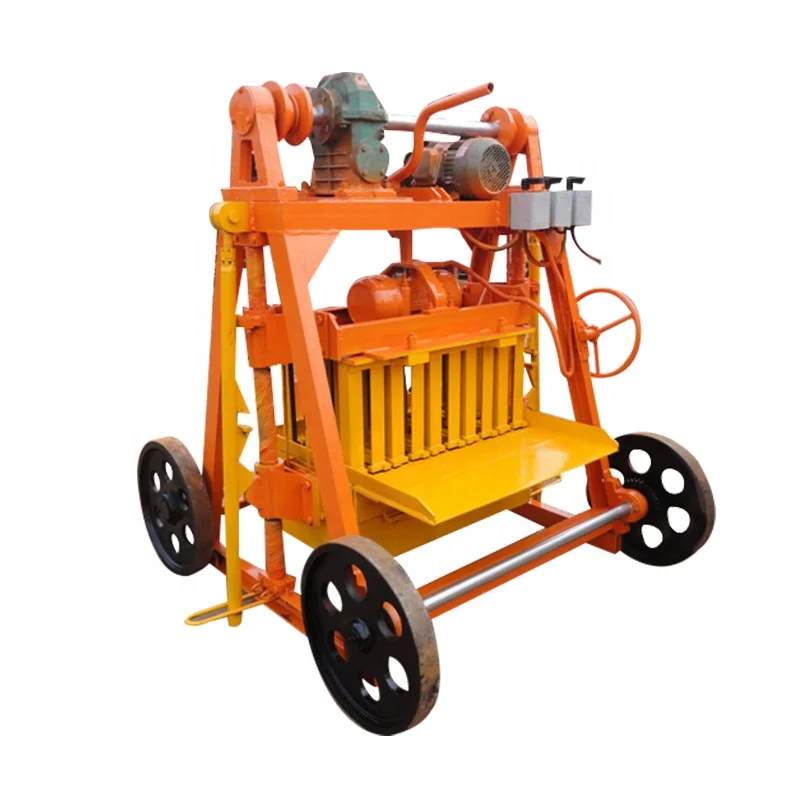
Single-focus line planning — every feed rate, mixer batch and curing bay is sized around the QMJ4-45 cycle so the press never sits idle waiting on upstream or downstream stations.
Technical Specifications
| Parameter | Value |
|---|---|
| Model | QMJ4-45 |
| Product Type | Manual Egg-Laying Block Making Machine |
| Molding Capacity | 4 pcs/mould (basis to be confirmed) |
| Vibration Frequency | 2400 r/m |
| Productivity | 2600–4000 pcs/day (basis to be confirmed) |
| Vibration Method | Mold vibration |
| Demold Method | Manual |
| Turning Method | Manual |
| Total Power | 6 kW |
| Power Source | Diesel / Petrol engine |
| Molding Cycle | 45 s (basis to be confirmed) |
| Hollow Block Productivity (400×200×200 mm, 4 pcs/mould) | 3000 pcs/day (8 hours) |
| Hollow Block Productivity (400×150×200 mm, 5 pcs/mould) | 3500 pcs/day (8 hours) |
| Hollow Block Productivity (400×120×200 mm, 6 pcs/mould) | 4500 pcs/day (8 hours) |
| Automation Level | Manual (egg-laying / mobile) |
| Pallet Requirement | Not required (egg-laying type, blocks laid directly on ground) |
| Control System | Manual operation |
| Warranty | One year for the whole machine (source value — verify against manufacturer catalog) |
| Key Features | Twice-vibration molding core, engine-powered operation, no pallets required, ground-laid curing |
Application Suitability
| Application | Material or Output |
|---|---|
| Small-scale hollow block production on existing cement sites | Crushed stone, sand, cement, fly ash |
| On-site block manufacturing for building contractors | Local aggregate blends without fixed batching plant |
| First block plant for entrepreneurs | Low-investment hollow block startup with engine drive |
| Garden and small construction projects | Lightweight aggregate and standard cement mixes |
| Housing developments without grid power | Diesel-driven production directly on plot |
What "3000 Blocks per Day" Actually Means on Site
Capacity figures only matter when the mixer, feed hopper and curing area can all keep pace with the press.
A mobile egg-laying block machine production line quoted at 3000 pieces per day assumes a 400×200×200 mm hollow block format running eight hours straight. In practice I have watched the same machine produce closer to half that figure because the mixer batch size was too small, the operator had to wheelbarrow concrete to the hopper, or the curing ground was already full by mid-morning. [NEED_CITE: line balance requirements for mobile block machines] The honest conversation starts with which block format you actually sell, what your local aggregate allows, and how much flat curing space you can prepare before the first shift begins.
Sizing the Line Around a Moving Press
The QMJ4-45 lays blocks directly on the ground and walks forward every cycle, so the supporting stations must travel with it or feed it along a fixed route. Raw material batching, mixing and concrete delivery have to be positioned so that the machine never waits for the next barrow-load. When we plan a mobile egg-laying block machine production line we map the walk path, set mixer batch timing to match the 45-second molding rhythm, and confirm that workers can rotate between feeding, operating and troweling without bottlenecks forming at any single station.
Ground Curing Space as Part of the Line
Because egg-laying machines deposit blocks straight onto the ground, the curing area is effectively the third station of the line. Flat, swept concrete or compacted earth must extend far enough to hold a full day’s output at the chosen block format before the area can be cleared and reused. [NEED_CITE: curing space planning for egg-laying block machines] We calculate the square-meter footprint per shift against your target format so you know exactly how much ground to prepare before the QMJ4-45 arrives.
Reading the Specs That Matter
The 2400 r/m vibration frequency paired with mold vibration compacts concrete into the cavities of hollow blocks while the operator handles demold and turning manually. Six kilowatts of total power is delivered through a diesel or petrol engine, which means the mobile egg-laying block machine production line can run on sites where grid electricity has not yet been connected — a common situation for housing developments and remote contractor yards. The 45-second molding cycle is the heartbeat of the line: mixer output, raw material feed intervals and ground-clearing schedules all derive from it. Choosing between 4-piece, 5-piece and 6-piece moulds shifts daily productivity from 3000 to 4500 pieces per eight-hour day (based on the hollow block dimensions stated above), which in turn changes how much aggregate you must stockpile and how much curing ground you must allocate.
The Hidden Cost of Treating the Press as a Standalone Purchase
Buying the egg-laying machine on its own and bolting on a random mixer is the fastest route to idle time. I once visited a site in West Africa where the customer had paired a QMJ4-45 with an undersized pan mixer; the press finished a mould every 45 seconds but the mixer needed nearly two minutes per batch, so the operator spent most of the day waiting. [NEED_CITE: idle time losses from mismatched line equipment] Workers ended up transferring semi-dry concrete by hand just to keep the hopper charged, and daily output fell well short of the quoted figure. When the supporting equipment is not planned as part of the line, the machine’s capacity rating becomes a theoretical number rather than a reliable planning figure.
Why Line-Level Specification Matters Here
Every machine we configure starts from your target block format and daily output requirement, not from a catalogue default, so the QMJ4-45 is paired with a mixer, feeder and curing plan that match its cycle. Block machinery is our single focus, which means mould, engine specification and supporting equipment are specified as one matched system rather than assembled from separate suppliers. The automation level is selectable — a buyer can begin with manual egg-laying operation and add mechanized feeding or stacking later as volume grows. Installation includes on-site commissioning where the full line is walked through with your operators, covering feed timing, mould change and engine maintenance. Documentation covers the block format assumed in the capacity calculation so there is no ambiguity about what the line is designed to produce.
Documentation & Verification
- Line layout with capacity calculation stated per hollow block format
- Machine specification sheet confirming vibration frequency and engine type
- Mould drawing and format list for each block size ordered
- Operation and maintenance manual with wear parts catalogue
- Factory test record run on your chosen block format before dispatch
- Fuel specification and engine service schedule documented at delivery
Installation, Commissioning & Support
- Flat compacted ground prepared to the curing footprint calculated for your target format
- Diesel or petrol fuel supply arranged on site before first run of the 6 kW engine
- Machine delivered assembled and test-run on your block format prior to dispatch
- On-site commissioning covering feed timing, molding cycle and mould change procedure
- Operator training on manual demold, turning and engine maintenance routines
- Wear parts and mould list supplied with recommended replacement intervals
Before You Request a Quote
Tell us which hollow block dimensions your market actually buys, the daily output you need to hit, and whether your site has grid power or requires engine-driven operation. Share the local aggregate type and any existing mixing or feeding equipment already on site so we can determine what the line still needs. If you have a project deadline, flag the date so lead time and container loading can be planned around it.
Frequently Asked Questions
Q: How is daily output calculated and which block format does the capacity figure assume?
A: The figures in our specification table state output per specific hollow block dimension — for example 3000 pieces per eight-hour day for 400×200×200 mm blocks using the 4-piece mould. Each format has its own calculation based on the 45-second molding cycle and mould cavity count, so your planning number always matches the block you actually produce.
Q: How do mixing and curing area need to match the press cycle time?
A: The mixer must deliver a fresh batch within or before the 45-second cycle so the hopper never runs empty, and the curing ground must hold a full shift’s output at your chosen format before the area can be cleared. We calculate both against your target block so the line runs continuously.
Q: What supporting equipment keeps the egg-laying machine running without idle time?
A: A correctly sized mixer, a raw material feeder matched to batch intervals, and sufficient flat curing ground are the minimum. We specify each station’s capacity against the QMJ4-45 cycle so no single point holds the line back during production.
Q: How does engine-powered operation affect site layout and fuel planning?
A: Diesel or petrol drive removes the need for grid connection, but it requires on-site fuel storage and engine servicing routines. We document the engine specification and fuel type at order stage so the right supply chain is in place before the machine arrives.
Q: What mould formats are available and how does format choice change productivity?
A: Hollow block moulds from 400×200×200 mm to 400×120×200 mm are available, with daily output ranging from 3000 to 4500 pieces per eight-hour day based on the dimensions stated above. Narrower blocks use more cavities per mould, raising output but also increasing aggregate consumption and curing space requirements.


