
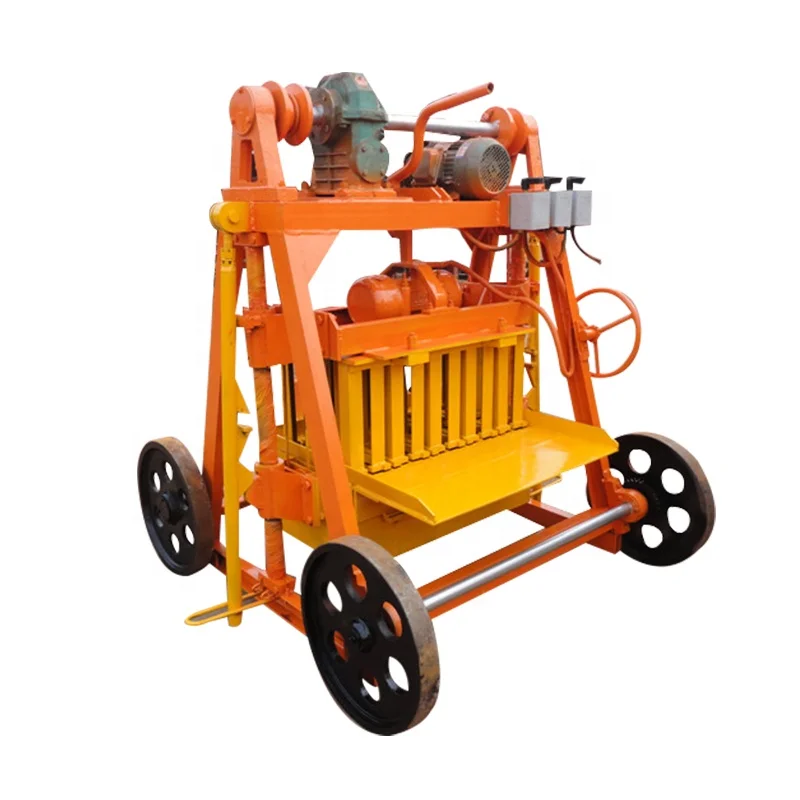
Line Rhythm First — a QMJ4-45 egg laying block machine will sit idle half a shift if the mixer upstream cannot match its 40–45 s cycle, so the supporting equipment around the press is where the real output is decided.
Technical Specifications
| Parameter | Value |
|---|---|
| Product Type | Mobile Egg Laying Block Making Machine |
| Model | QMJ4-45 |
| Molding Capacity | 4 pcs/mould for 400×200×200 mm hollow block (basis not stated in source for other formats) |
| Molding Cycle | 40–45 s |
| Vibration Frequency | 2400 r/m |
| Vibration Method | Mould vibration |
| Demould Method | Manual |
| Turning Method | Manual |
| Total Power | 6 kW |
| Power Source | Diesel / petrol engine |
| Automation Level | Manual mobile egg-laying |
| Pallet Requirement | Pallet-free egg-laying operation |
| Output Capacity | approx. 3000 pcs/day on 400×200×200 mm hollow block, 8-hour shift (basis not stated in source for general 2600–4000 range) |
| Warranty | One year for the whole machine |
Application Suitability
| Application | Material or Output |
|---|---|
| On-site hollow block production for housing projects | Crushed stone, sand, cement and water mixed locally |
| Garden path and small infrastructure block laying | Solid and hollow concrete blocks laid directly on compacted ground |
| Remote job sites without grid electricity | Engine-driven operation independent of local power supply |
| First small-scale block operation for entrepreneurs | Low fixed-infrastructure start with manual material handling |
| Contractor self-supply at build location | Hollow blocks in 200 mm, 150 mm and 120 mm widths produced and cured on-site |
What "2600–4000 Pieces per Day" Actually Means on Site
The daily output figure is meaningless until you name the block format it assumes.
I have stood on sites where a mobile block machine production line was quoted at the top of its output range, only to find the crew was making 200 mm hollow blocks — the format that yields the fewest pieces per mould. The QMJ4-45 produces 4 pcs per cycle at 400×200×200 mm, 5 pcs at 150 mm width and 6 pcs at 120 mm width, each within the same 40–45 s cycle. That spread accounts for the entire gap between the low and high output claims. Before a buyer signs off on a daily tonnage of cement, the exact block format must be locked into the capacity calculation. [NEED_CITE: concrete block format and cycle time relationship in small-scale production]
Feeding the Press Without Making It Wait
The egg laying block machine supporting equipment upstream of the QMJ4-45 determines whether the press runs continuously or idles between cycles. A 40–45 s mould cycle means the mixer must discharge a fresh batch at least every two cycles, or the operator is standing still watching an empty hopper. For a small mobile line, a pan mixer or single-shaft mixer sized to discharge into a wheelbarrow or belt conveyor within 60–90 s keeps the rhythm intact. The mobile block machine production line does not end at the press — it ends at the last cured block moved off the ground.
Where the Line Breaks Down After the Block Is Laid
An egg-laying machine eliminates production pallets at the press, which removes one handling cost but shifts the planning burden to the curing area. The freshly laid blocks need a flat, compacted surface with enough space to hold at least one full day’s output before they are moved. If the curing area is undersized, the operator has to stop laying blocks and start moving cured ones — and the mobile block machine production line loses its rhythm. [NEED_CITE: curing area layout requirements for egg laying block operations] Forklift access, block transport trolleys and stacking height limits all need to be defined before the machine arrives, because none of these are included in the press quotation.
Reading the Numbers That Matter on This Machine
The 2400 r/m vibration frequency is applied directly to the mould rather than through a pallet, which is how egg-laying machines achieve block density without a hydraulic press. This mould vibration method means the mix design must be relatively dry — a wet mix will slump when the machine lifts and walks forward. The 6 kW total power drawn from a diesel or petrol engine keeps the machine independent of local grid voltage and frequency, but it also means fuel type, engine brand and spare part availability must be confirmed before order, because these vary by export market. The manual demould and manual turning keep the machine mechanically simple and the initial investment low, but they also fix the labour requirement at two operators minimum: one feeding material and one controlling the press movement and block release.
When the Supporting Equipment Is an Afterthought
A mobile block machine production line quoted as just the press arrives on site and immediately reveals what was missing. No mixer matched to the cycle time means the crew is hand-mixing in a wheelbarrow and producing a fraction of the rated output. No curing area plan means blocks are laid on uneven ground and crack during the first days of hydration. No transport equipment means cured blocks are carried by hand to the stacking area, which caps the practical daily output well below what the press can produce. [NEED_CITE: common line imbalance issues in small-scale block plants] These gaps are not machine defects — they are specification gaps that appear when the egg laying block machine supporting equipment is left to the buyer to figure out after delivery.
Why Sourcing the Whole Line from One Supplier Matters Here
The QMJ4-45 is a single-focus product: block machine, mould and handling specified as one matched system rather than assembled from separate vendors. The line layout and capacity calculation state the exact block format assumed, so the buyer knows the real daily output before committing. Mould design covers the formats the buyer’s local market actually sells, including custom drawings if the standard range does not fit. The automation level is selectable, so a buyer starting with manual egg-laying today can move to a semi-automatic fixed line later without replacing the entire material preparation system. Installation and commissioning support includes operator training on the specific mix design and local aggregate the buyer will use, not a generic manual.
Documentation & Verification
- Line layout drawing showing mixer, press path and curing area dimensions for your block format
- Capacity calculation sheet stating output per block width from 200 mm down to 120 mm
- Mould drawing and format list matching your local market block dimensions
- Engine specification sheet confirming fuel type, brand and spare part part numbers
- Factory test record on your target block format before dispatch
- Operation manual with mould change procedure and daily maintenance checklist
Installation, Commissioning & Support
- Compacted flat ground required across the press travel path and curing area, no concrete foundation needed
- Diesel or petrol engine fuel type confirmed before production to match local supply and spare availability
- Machine arrives fully assembled; operator training covers mix ratio, cycle timing and mould change on your block format
- One-year warranty on the whole machine including vibration motor and mould assembly
- Wear parts list with mould liner and vibration spring part numbers for first reorder
- Curing area layout guidance covering stacking height limits and transport access for your site dimensions
What to Include in Your Inquiry
Tell us the exact block format your market sells — dimensions, wall thickness and whether hollow or solid — so the capacity calculation is built on your real product. Confirm the local aggregate type and cement grade available to you, because the mix design affects block strength and the vibration setting on the QMJ4-45. Let us know your site dimensions and curing area layout so the egg laying block machine supporting equipment can be specified to keep the press running without bottlenecks downstream.
Frequently Asked Questions
Q: How is the daily output of the QMJ4-45 calculated and which block format does it assume?
A: The source quotes 2600–4000 pcs/day without a single basis format. In practice, 400×200×200 mm hollow blocks yield about 3000 pcs per 8-hour shift at 4 pcs per mould and a 40–45 s cycle, while 120 mm wide blocks yield more because the mould holds 6 pcs. Always ask which format the capacity figure is built on before comparing machines.
Q: What supporting equipment is needed around an egg laying block machine?
A: A mixer sized to discharge within the press cycle time, a compacted curing area large enough for one day’s output, block transport trolleys or a forklift for moving cured stock, and raw material storage with a batching method. None of these are part of the press itself, but all determine whether the mobile block machine production line actually reaches its rated output.
Q: Does the 40–45 s cycle time change when switching block widths?
A: The mould cycle stays within 40–45 s across the standard hollow block widths. What changes is the number of pieces per cycle — 4 for 200 mm, 5 for 150 mm, 6 for 120 mm — so the hourly and daily output rises as the block gets narrower. Mould change itself is manual and takes additional time that should be factored into shift planning.
Q: Diesel or petrol engine — how should a buyer choose?
A: Diesel engines typically offer better fuel economy under continuous load and longer service intervals, which suits a block production shift. Petrol engines can be easier to source and maintain in markets where small-engine repair shops are common. The decision should be based on local fuel cost and the availability of engine spare parts rather than the press specification alone.
Q: How does a buyer move from this mobile machine to a semi-automatic fixed line later?
A: The material preparation side — mixer, batching and raw material feed — can often be retained and connected to a stationary press. The egg-laying press itself is replaced by a fixed machine with pallet handling and automatic stacking. Starting with a line layout that leaves room for this transition avoids rebuilding the entire material flow when output demand grows.


