
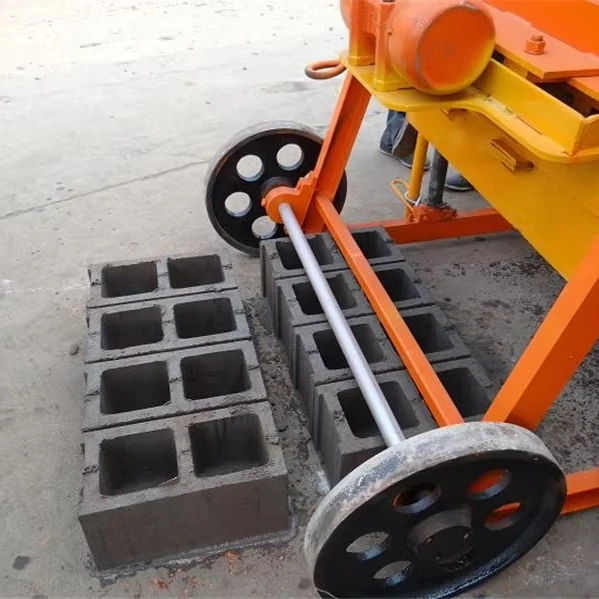
Matched System Design — The QMJ4-45 mobile block machine, its engine-driven power source, and the upstream mixing and downstream curing workflow are specified together so the line produces consistently at the quoted rate per format.
Technical Specifications
| Parameter | Value |
|---|---|
| Model | QMJ4-45 |
| Product Type | Mobile Egg-Laying Block Making Machine |
| Molding Method | Twice-vibration of molding core (egg-laying) |
| Molding Capacity | 4 pcs/mould (400×200×200 mm hollow block) |
| Vibration Frequency | 2400 r/min |
| Molding Cycle | 40–45 s |
| Output Capacity | 3000 pcs/day (basis: 400×200×200 mm, 4 pcs/mould, 8 h shift) |
| Output Capacity | 3500 pcs/day (basis: 400×150×200 mm, 5 pcs/mould, 8 h shift) |
| Output Capacity | 4500 pcs/day (basis: 400×120×200 mm, 6 pcs/mould, 8 h shift) |
| Total Power | 6 kW |
| Power Source | Diesel / petrol engine |
| Demold Method | Manual |
| Turning / Travel Method | Manual |
| Pallet Requirement | None — egg-laying directly on ground |
| Control System | Manual operation (no PLC) |
| Automation Level | Manual |
| Certification | CE |
Application Suitability
| Application | Material or Output |
|---|---|
| On-site hollow block production at housing projects | Crushed stone, river sand, cement |
| Small-scale block yard with unstable grid power | Local aggregate with diesel-driven operation |
| Contractor producing at remote infrastructure sites | 400×200×200 mm and 400×150×200 mm hollow blocks |
| Start-up cement yard adding mobile capability | 400×120×200 mm hollow blocks at lower investment |
What "3000 Blocks a Day" Actually Means on a Real Job Site
The daily figure only holds when the mixer, material feed, and curing area keep pace with the machine’s 40–45 second cycle.
A mobile block machine production line that quotes output without naming the block format leaves buyers guessing what they will actually produce. On a site where the mixer batch size is too small or the curing ground is not cleared fast enough, the press sits idle between cycles. I have watched contractors lose entire shifts because the material feed could not match the egg-laying rhythm, turning a quoted capacity into a fraction of the expected volume [NEED_CITE: common causes of output shortfall on mobile block sites].
Keeping the Mixer and the Machine in Step
A mobile block machine production line lives or dies by what arrives at the hopper. The QMJ4-45 completes a molding cycle every 40–45 seconds, which means the upstream mixer must deliver a fresh batch within that same window. When the mixer cycle is longer than the press cycle, the operator waits, and daily output drops below the figures stated for each hollow block format. Sizing the pan mixer or drum mixer to the machine’s consumption rate is the first line-design decision that must be made before the press arrives on site.
Designing the Curing Area Around a Moving Machine
Because the QMJ4-45 lays blocks directly on the ground and travels forward after each mold release, the curing area is not a fixed rack system but a linear stretch of prepared concrete floor. The ground must be level, swept, and lightly dampened before each pass. Blocks remain in place until they gain enough green strength to be manually stacked, usually after 24 hours depending on ambient temperature and cement content. Planning the travel path and the stacking zones prevents the machine from running out of clear ground mid-shift [NEED_CITE: ground preparation standards for egg-laying block production].
How Vibration Frequency and Molding Cycle Shape Block Density
The twice-vibration molding core at 2400 r/min compacts the concrete mix in two stages rather than one, which improves consistency across the block cross-section. At 40–45 seconds per cycle, the vibration has enough duration to settle fine aggregate into voids without over-vibrating and causing segregation. Since this machine uses vibration-only forming with no hydraulic pressure, block strength depends heavily on the mix design and the aggregate grading available locally. A mix that works on the factory test floor may not produce the same density with high-salt or high-clay sand at the project site.
What Happens When the Line Around the Press Is an Afterthought
Buyers who treat the mobile press as a standalone purchase often discover that material batching, block transport, and curing layout were never discussed before shipment. The result is a machine that technically works but produces well below the stated capacity per format because the supporting stations bottleneck the cycle. Manual demolding and manual travel already demand operator stamina; adding improvised material handling on top of that introduces delays that compound across every hour of the shift [NEED_CITE: productivity losses from unplanned line support on mobile block sites].
Why Buyers Source the Full Line Here
Block machinery is the single focus of this operation, so the QMJ4-45 is not quoted as a standalone press but as part of a workflow that includes mixer sizing, raw material feed arrangement, and curing ground planning. Configuration is set against the buyer’s actual aggregate and target hollow block format rather than a catalogue default. Mould design covers every format the buyer’s market requires, and custom mould drawings are available. The automation level is selectable, allowing a buyer to start with manual egg-laying and add stationary line equipment later. Installation support includes operator training on site so the crew understands the cycle rhythm from day one.
Documentation & Verification
- Line layout drawing showing mixer, feed path, and curing ground relative to the machine travel route
- Capacity calculation sheet stating the block format and shift hours assumed for each output figure
- Mould drawing and format list for every hollow block size included in the order
- Engine specification sheet confirming fuel type and power rating matched to site conditions
- Factory test record on the buyer’s specified block format before dispatch
- Operation and maintenance manual covering daily greasing and vibration core inspection
Installation, Commissioning & Support
- Level concrete ground required along the full travel path before the QMJ4-45 begins production
- Diesel or petrol fuel supply confirmed to match the 6 kW engine specification on arrival
- First-day commissioning includes test cycles on local aggregate to verify block density
- Operator training covers the 40–45 second cycle rhythm, manual demolding, and mold change procedure
- Wear parts list provided for vibration core bearings and mold liners with recommended replacement intervals
- Curing area layout guidance included so stacking zones do not block the machine travel path
What to Send with Your Inquiry
To size the supporting line correctly, share the hollow block formats your market demands and the daily volume you need per format. Provide a sample or description of the local aggregate and sand, including any salt or clay content concerns. Confirm whether diesel or petrol is the more reliable fuel source on your site, and describe the available curing ground area so the travel path can be planned before the machine ships.
Frequently Asked Questions
Q: How is the daily output figure verified, and which block format does each number assume?
A: Each output figure is tied to a specific hollow block format, mould cavity count, and an eight-hour shift. The 3000-piece figure assumes 400×200×200 mm blocks at four per mould, while the 4500-piece figure assumes 400×120×200 mm blocks at six per mould. No single blanket number is quoted without the format stated alongside it.
Q: What mixing and batching stations are needed upstream to keep the 40–45 second cycle fed?
A: A pan mixer or drum mixer sized to deliver a full batch within the molding cycle is essential. The raw material feed — whether a wheel loader feeding a hopper or a manual batching setup — must keep the mixer charged without pauses. If the mixer cycle exceeds the press cycle, the operator waits and daily output falls short.
Q: How should the ground curing area and manual stacking workflow be arranged?
A: The curing ground should be a long, level concrete strip aligned with the machine’s forward travel direction. Freshly laid blocks stay in place for roughly 24 hours before manual stacking. The strip must be long enough to hold a full shift’s output without the machine running out of clear ground or crossing paths with stacked blocks from the previous day.
Q: Which raw material feed configuration works when the machine moves across a site?
A: Because the QMJ4-45 travels forward after each mold release, a fixed conveyor feed is impractical. Most sites use a wheel loader to drop mixed material into the machine hopper at intervals, or a small mobile batching cart that follows the machine. The feed method must keep pace with the 40–45 second cycle to avoid idle time.
Q: When should a buyer move from a manual mobile line to a stationary press with pallet handling?
A: When daily volume requirements grow beyond what a single operator can sustain with manual demolding and manual travel, or when the market demands block formats that need hydraulic pressure for adequate strength. A stationary press with pallet circulation and stacking equipment reduces labor per block and increases format flexibility, but requires a fixed plant footprint and stable grid power.


