
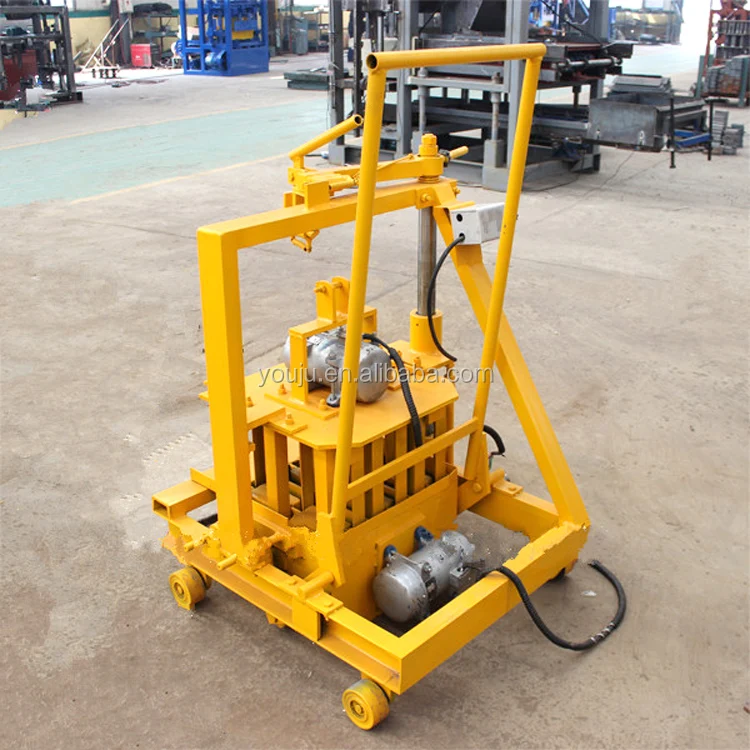
Complete line workflow — every station around the QMJ2-45 press, from mixer output to manual curing area, is mapped so the mobile unit never waits for material or space.
Technical Specifications
| Parameter | Value |
|---|---|
| Model | QMJ2-45 |
| Product Type | Mobile Egg-Laying Block Making Machine |
| Machine Type | Mobile egg-laying (palletless) |
| Automation Level | Manual / semi-manual operation |
| Power Source | Electric engine (detailed kW rating — confirm with supplier) |
| Voltage & Frequency | Not stated in source — confirm target market standard |
| Control System | Basic electric control (PLC not indicated) |
| Mould Change | Manual mould swap for different hollow brick formats |
| Supported Format 1 | Hollow brick 400×200×200 mm — 2 pcs/mould, cycle 25–30 s, 1,280 pcs/8 hr |
| Supported Format 2 | Hollow brick 400×150×200 mm — 3 pcs/mould, cycle 25–30 s, 4,800 pcs/8 hr (basis not stated in source) |
| Supported Format 3 | Hollow brick 400×100×200 mm — 4 pcs/mould, cycle 25–30 s, 2,560 pcs/8 hr |
| Pallet Requirement | None (egg-laying, lays blocks directly on ground) |
| Labor Requirement | 1–3 operators |
| Mobility | Free-moving on site, no fixed foundation |
| Mould Heat Treatment | Carburization technology |
| Standards | ISO 9001:2000, CE |
Application Suitability
| Application | Material or Output |
|---|---|
| Small-scale on-site hollow block production | Crushed stone, sand, cement and water mix for construction contractors |
| Remote or space-constrained building sites | No fixed plant infrastructure required; blocks laid directly on compacted ground |
| Entrepreneurial first block plant | Low initial investment setup with mixer, mobile press and manual curing area |
| Local housing and development projects | Hollow bricks in 400×200×200, 400×150×200 and 400×100×200 mm formats |
What "Per-Cycle Output" Leaves Out About a mobile block making machine production line
The press is only as fast as the slowest station feeding or clearing it.
When a mobile block making machine production line is quoted, the number that catches a buyer’s eye is pieces per mould or cycles per hour. But on a real job site, the QMJ2-45 lays wet blocks directly on the ground with no pallets to buffer output. If the mixer cannot deliver fresh material at the pace the press consumes it, the operator stands idle. If the curing area is not cleared and marked out ahead of time, fresh blocks get stacked on top of each other and collapse under their own weight [NEED_CITE: on-site curing footprint planning for palletless block machines]. The capacity figure on the spec sheet assumes every upstream and downstream station keeps up — and that assumption rarely survives the first week without deliberate line design.
Mixer-to-Press Throughput Matching
The QMJ2-45 completes a mould cycle every 25 to 30 seconds, which means the mixer must deliver a consistent batch within that same window. A mixer that takes longer to discharge forces the press operator to wait, cutting real hourly output below the stated rate. Planning the mixer discharge height and position relative to the press feed hopper removes the bottleneck before the first block is laid.
Curing Area Footprint and Workflow Design
Because this mobile block making machine production line uses an egg-laying design, blocks are deposited directly onto the ground as the chassis moves forward. The curing area must be a flat, compacted surface long enough to hold a full day’s output without overlapping rows. Operators walk behind the machine to mark lanes and manage spacing, and this manual curing arrangement defines how far the press can travel in a single shift [NEED_CITE: palletless block machine curing area layout standards].
Mould Heat Treatment and Format Durability
The carburization technology applied to the QMJ2-45 moulds increases surface hardness, which matters when local aggregate contains abrasive particles like crushed river gravel. A harder mould surface maintains dimensional accuracy over more production cycles before replacement is needed. This is relevant for contractors who plan to run the same format daily across an entire housing project without interruption.
Spec Interpretation: What the Numbers Mean on Site
The three supported hollow brick formats — 400×200×200, 400×150×200, and 400×100×200 mm — each produce a different number of pieces per mould, which changes how the daily output target is planned. The 25–30 second cycle time is consistent across formats, so the difference in total output comes entirely from the piece count per cycle. Manual mould swap means format changes require the operator to physically unbolt and reseat the mould, which takes the press offline for a period that should be factored into the production schedule. The basic electric control system without PLC keeps the operator interface simple and field-serviceable, but it also means there is no automated batching or cycle counting — output tracking is manual. The 1–3 operator requirement reflects one person feeding material, one operating the press controls, and one managing the curing lane behind the machine.
The Cost of Ignoring Line Continuity
A mobile block making machine production line that is not planned as a chain of connected stations will stall repeatedly throughout the day. When the mixer is undersized, the press sits idle while waiting for the next batch, and the operator wages are spent standing still [NEED_CITE: production line bottleneck impact on labor cost in small block plants]. When the curing area runs out of flat ground, the operator either stops the press or stacks wet blocks too close together, and collapsed blocks mean wasted material and rework. These gaps do not show up on a quotation but they consume the margin the buyer expected from the machine’s rated output.
Why Procurement Through This Channel Works
Block machinery is the single focus here, so the QMJ2-45 is specified alongside its mixer, material feed arrangement and curing workflow as one matched system. Configuration is set against the buyer’s actual local aggregate and target block format rather than a catalogue default. Mould supply covers the three standard hollow brick formats plus custom drawings if the buyer’s market requires a non-standard size. The automation level is selectable, so a buyer who starts with this manual mobile press can move to a semi-automatic or fully automatic stationary line later without changing suppliers. Installation and commissioning support includes operator training so the crew understands how mixer pace, press cycle and curing lane spacing connect into one continuous workflow.
Documentation & Verification
- Line layout drawing showing mixer, QMJ2-45 press and curing area positions relative to each other
- Capacity calculation sheet stating output per hollow brick format with cycle time assumption
- Mould drawing with dimensions for each supported 400-series hollow brick format
- Voltage and frequency confirmation document signed before production begins
- Factory test record on the buyer’s specified block format before dispatch
- Wear parts and mould replacement list with lead times for first order
Installation, Commissioning & Support
- Flat compacted ground required as curing surface — no fixed foundation for the QMJ2-45 chassis
- Power supply circuit sized for the electric engine rating confirmed before shipment
- Machine ships assembled; mould swap and control check completed on site within first shift
- Voltage and frequency verified against local grid before first energization to prevent motor damage
- Operator training covers mixer-to-press feed timing and curing lane marking workflow
- Carburized mould wear parts list provided with recommended first replacement interval
What to Include in Your Inquiry
To size the line around the QMJ2-45 correctly, share your target hollow brick format, the daily output you need, and the local aggregate you plan to use. Confirm your site voltage, frequency and whether you already have a mixer or need one included. Let us know the available flat ground area for curing so the line layout accounts for a full day’s output without overlap.
Frequently Asked Questions
Q: How should mixer output rate be matched to the QMJ2-45 cycle time?
A: The press cycles every 25 to 30 seconds, so the mixer must discharge a full batch within that same window. If the mixer takes longer, the press operator waits and hourly output drops below the stated rate. Positioning the mixer discharge directly above or adjacent to the press feed hopper minimizes transfer time and keeps the cycle continuous.
Q: What curing area does a palletless mobile machine require?
A: Since the QMJ2-45 lays blocks directly on the ground, the curing area must be a flat, compacted surface large enough to hold an entire shift’s output in single rows without overlap. The machine moves forward as it produces, so the available ground length determines how far the press can travel before it must loop back or stop.
Q: Can the QMJ2-45 integrate with an existing batching setup?
A: Yes, provided the existing mixer discharge rate and height are compatible with the QMJ2-45 feed hopper position. The basic electric control system operates independently, so there is no PLC handshake required between the mixer and the press. The key variable is material delivery timing, not electronic integration.
Q: What supporting equipment completes the line around this press?
A: A pan mixer sized to match the press cycle, a water supply hose or tank near the mixing station, and a manual cart or wheelbarrow for moving raw materials to the mixer are the minimum additions. No pallets, curing racks or stacking equipment are needed because the egg-laying design eliminates those stations entirely.
Q: How do I verify stated output against my actual site conditions?
A: Request the capacity calculation sheet that states output per block format with the cycle time assumption documented. Then run a timed test on site with your local aggregate and mix design to compare actual pieces per hour against the stated figure. Differences usually trace back to mixer discharge speed or operator pace rather than the press itself.


