
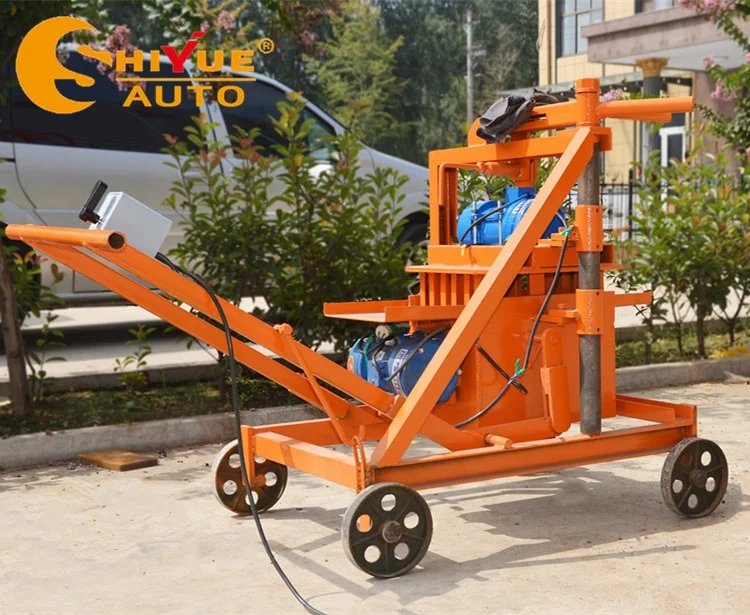
Integrated Line Configuration — A mobile block machine and its upstream mixing stations are specified together so the press is never left waiting for material on site.
Technical Specifications
| Parameter | Value |
|---|---|
| Model | QMJ2-45 |
| Product Type | Mobile Concrete Block Making Machine |
| Machine Operation | Manual mobile (egg-laying) |
| Pallet Requirement | None (pallet-free egg-laying) |
| Mould Format Options | 400×200×200 mm, 400×150×200 mm, 400×100×200 mm hollow brick |
| Pieces per Mould | 2 pcs (400×200×200), 3 pcs (400×150×200), 4 pcs (400×100×200) |
| Cycle Time | 25–30 seconds per mould |
| Output Capacity | 160 pcs/h based on 400×200×200 mm hollow brick |
| Output Capacity | 240 pcs/h based on 400×150×200 mm hollow brick |
| Output Capacity | 320 pcs/h based on 400×100×200 mm hollow brick |
| Shift Output (8 hr) | 1280 pcs (400×200×200 mm); 2560 pcs (400×100×200 mm) |
| Power Source | Engine-driven |
| Automation Level | Manual |
| Labor Requirement | 1 to 3 workers |
| Mobility | Free-moving on-site |
| Mould Change | Interchangeable moulds |
Application Suitability
| Application | Material or Output |
|---|---|
| On-site hollow brick production for housing projects | Crushed stone, sand, cement, local aggregate |
| Remote construction sites without grid power | Engine-driven operation on volcanic ash or river sand |
| Startup block plant with minimal investment | Multiple hollow brick formats from a single machine |
| Building material distributors producing locally | Concrete mix matched to regional market demand |
| Infrastructure contractors casting on location | Free-moving production across large project footprints |
What the Cycle Time Figure Does Not Tell You About Daily Output
A 25–30 second cycle only translates to real daily volume when the mixer, material feed and ground conditions keep pace with the press.
I have watched a mobile block machine production line sit idle for half a shift because the pan mixer could not discharge fast enough, and the crew was still wheeling material in by hand. The operator kept pulling the lever, but the hopper was empty more often than full. When a buyer evaluates the QMJ2-45, the question is not how many seconds one mould takes — it is whether the upstream stations can sustain that rhythm across an entire day [NEED_CITE: material feed rate matching press cycle time in small block plants].
How the Upstream Mixer Sets the Real Pace
A mobile block machine production line lives or dies by the batch cycle of its mixer. If the pan mixer takes four minutes to produce a batch that the QMJ2-45 burns through in ninety seconds, the press spends most of its day waiting. We size the mixer batch volume and discharge height to match the machine hopper so the operator is never standing idle. For the 1 to 3 worker crew typical of this setup, a mixer that discharges directly into a wheelbarrow or small conveyor keeps the rhythm steady without adding headcount.
Ground Preparation and Curing Area Layout
Because the QMJ2-45 lays blocks directly on the ground, the production surface becomes part of the line. Uneven ground causes blocks to crack before they leave the mould, and soft soil absorbs moisture from the fresh concrete too quickly. We specify a compacted, level casting area with a minimum width that allows the machine to travel in a straight pass while workers follow behind with curing covers. The curing area must be planned before the first block is laid — once blocks are on the ground, they cannot be moved until initial set is reached [NEED_CITE: ground preparation standards for egg-laying block production].
Reading the Specification Sheet Against Your Local Mix
The vibration and manual compaction built into the QMJ2-45 were tuned around standard concrete mixes, but local aggregates change everything. When a buyer sends us a sample of their volcanic ash or river sand, we run trial batches before dispatch and adjust the water-to-cement guidance in the operator manual. An engine-driven machine that cannot rely on stable grid power also cannot rely on electric batching scales, so we recommend mechanical volume batching frames matched to the buyer’s specific aggregate density. This step prevents the common failure where blocks crumble at the edges after the first week of production.
What Happens When Line Stations Are Specified Separately
I once visited a site where the buyer had purchased a mobile block machine from one supplier and a mixer from another, with no one checking whether the discharge height of the mixer matched the hopper inlet of the press. The crew spent every cycle lifting wet concrete above shoulder level. Over an eight-hour shift, fatigue slowed the feed rate and the machine cycle stretched well past the quoted 25–30 seconds. When upstream and downstream stations are not specified as one line, the weakest link absorbs the cost in lost output and worker turnover [NEED_CITE: ergonomic impact of mismatched station heights in manual block lines].
Why the Supporting Equipment Matters Here
The QMJ2-45 is a manual-tier press, but the stations around it determine whether it produces at its stated capacity or falls short. Raw material feeding — whether by wheelbarrow, belt conveyor or skid steer — must deliver aggregate and cement to the mixer at a rate that keeps batches flowing. After casting, blocks laid on the ground need water curing, which means a hose and pump station within reach of the casting area. Specifying these supporting stations together with the press prevents the situation where the machine arrives and the buyer discovers half the line is still missing.
Documentation and Verification
- Line layout drawing showing mixer placement, material feed path and casting area dimensions
- Capacity calculation per hollow brick format with stated cycle time assumptions
- Mould format list with dimensional drawings for each cavity
- Engine specification sheet with fuel type and maintenance intervals
- Operator manual covering mix ratios, ground preparation and curing procedure
- Factory test record on buyer-supplied aggregate sample before dispatch
Installation, Commissioning & Support
- Compacted and level casting area prepared to minimum dimensions before machine arrival
- Engine fuel supply and spare filter kit staged on site for continuous operation
- Mould change procedure trained on site with all three hollow brick formats
- First production run supervised until cycle time stabilizes at 25–30 seconds per mould
- Mechanical volume batching frames supplied to match local aggregate density
- Wear parts list provided with recommended reorder intervals for mould liners and vibration springs
Preparing Your Inquiry
To size a complete mobile block machine production line around the QMJ2-45, we need to know the hollow brick formats your market actually sells, the aggregate available within hauling distance of your site, and whether grid power exists for the mixer even if the press itself is engine-driven. Share your site dimensions and daily volume target so we can balance the mixer batch size against the press cycle and specify the supporting stations accordingly.
Frequently Asked Questions
Q: How is realistic daily output calculated for each hollow brick format?
A: We multiply the pieces per mould by the number of cycles achievable in an eight-hour shift, assuming a sustained 25–30 second cycle and no upstream delays. For the 400×200×200 mm format at 2 pieces per mould, this gives 1280 blocks. The calculation changes for each format because the cavity count differs.
Q: What mixer setup prevents the QMJ2-45 from waiting for material?
A: A pan mixer with a batch volume that covers roughly two minutes of press operation and a discharge height matched to the machine hopper keeps the cycle continuous. We specify the mixer and feed method together with the press so the crew is never lifting or waiting.
Q: What site conditions does a pallet-free mobile line require?
A: The casting surface must be compacted, level and wide enough for straight-line passes. A water source for curing must reach every block within the first hours after laying. We include ground preparation dimensions in the line layout before dispatch.
Q: Can the QMJ2-45 be upgraded into a semi-automatic line later?
A: The QMJ2-45 itself is a manual egg-laying press and does not accept pallet feeding or automatic stacking. A buyer planning to scale typically adds a separate semi-automatic press while keeping the QMJ2-45 for on-site contract work, rather than converting the same machine.


