
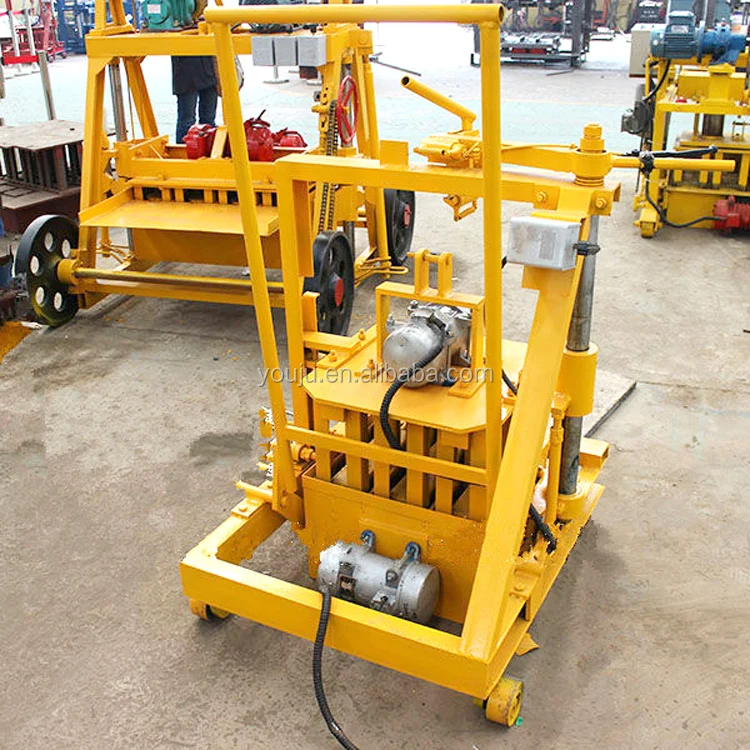
Integrated Line Pacing — we treat this hand-pushed egg-laying station as one node in a feeding-mixing-curing chain, not a stand-alone press.
Technical Specifications
| Parameter | Value |
|---|---|
| Model | QMJ2-45 |
| Product Type | Mobile Concrete Block Making Machine |
| Machine Type | Manual mobile egg-laying block machine |
| Mould Format | Hollow brick, multiple sizes supported via mould change |
| Mould Change | Manual, by replacing mould |
| Cycle Time | 25–30 s (basis not stated in source — confirm block format, material and thickness) |
| Output Capacity | 160 pcs/h based on 400×200×200 mm hollow brick, 2 pcs/mould |
| Output Capacity | 240 pcs/h based on 400×150×200 mm hollow brick, 3 pcs/mould |
| Output Capacity | 320 pcs/h based on 400×100×200 mm hollow brick, 4 pcs/mould |
| Daily Output (8 h) | 1,280 pcs based on 400×200×200 mm hollow brick |
| Daily Output (8 h) | 4,800 pcs based on 400×150×200 mm hollow brick |
| Daily Output (8 h) | 2,560 pcs based on 400×100×200 mm hollow brick |
| Pallet Requirement | No pallets required (egg-laying type) |
| Power Source | No diesel or external power required (source value — verify against manufacturer catalog) |
| Labor Requirement | 1 to 3 workers |
| Mobility | Hand-pushed, free movement on-site |
| Automation Level | Manual |
| Control System | None (manual operation) |
| Stacking Method | On-ground egg-laying, no pallet |
| Standards | ISO 9001:2000, CE |
Application Suitability
| Application | Material or Output |
|---|---|
| Small-scale on-site hollow block production | Crushed stone, sand, cement and water mixes laid directly on compacted ground |
| Housing or infrastructure project sites without fixed plant | Hollow bricks in 400×200×200, 400×150×200 and 400×100×200 mm formats |
| Entrepreneurs launching a first block operation with low capital | Single-operator or three-worker crews producing where the build is happening |
| Remote or off-grid locations | Sites where diesel generators and fixed curing racks are unavailable |
Why "Pieces per Hour" Misleads Mobile Block Buyers
The headline capacity figure only holds for one specific hollow brick size, and most quotations do not say which one.
When a mobile block making machine production line is quoted at a single hourly number, buyers often assume that figure applies across every format they plan to run. On the QMJ2-45, the spread between the largest and smallest hollow brick is significant — the cycle stays in the same 25–30 s window, but pieces per mould change with format, so daily totals shift accordingly. I have watched contractors order a machine on the strength of the highest quoted number, then discover on site that the block their market actually buys is the format that yields the lowest output. [NEED_CITE: block format assumptions in capacity quotations]
Removing the Pallet Bottleneck From the Line Layout
The most common upstream-downstream mismatch I see on mobile setups is not the press itself — it is the pallet loop. Pallets cost money, require a curing rack system, and demand a forklift to move them back to the press. Because the QMJ2-45 is an egg-laying unit, it places each hollow brick directly on the ground and moves forward, so no pallets enter the mobile block making machine production line at all. That single design choice eliminates the curing rack station and the return conveyor from your layout.
Synchronising the Mixer Feed With a Hand-Pushed Cycle
A manual egg-laying press only produces when the operator has wet mix ready in the hopper. If the upstream pan mixer batches slower than the 25–30 s cycle, the press sits idle and your real output drops below the table figure. If the mixer batches faster than the crew can push and position, mix slumps in the wheelbarrow and block strength suffers. I now size the mixer batch volume and the number of feeding workers to the same cycle window before I finalise the line. [NEED_CITE: manual feed pacing for egg-laying block machines]
Reading the Specs That Actually Matter on Site
Cycle time on this machine is listed at 25–30 s, but that figure depends on the operator’s rhythm, the stiffness of the mix, and the thickness of the block wall. Thinner-walled hollow bricks release faster from the mould, which is partly why the 400×100×200 mm format shows the highest hourly count.
Mould change is manual, meaning a mechanic unbolts one mould box and bolts on the next. On a manual mobile unit this is a matter of minutes rather than seconds, and it determines how many format switches your crew can absorb in a shift.
Power source is listed as requiring no diesel or external supply — this needs to be confirmed against the specific unit you receive, because some egg-laying machines in this class do carry a small petrol engine for vibration. Clarify this before the machine ships so your site preparation matches.
What Happens When the Line Pacing Is Skipped
Buyers who treat the QMJ2-45 as a stand-alone press rather than one station in a chain run into two predictable problems. First, wet mix piles up because there is no ground space prepared ahead of the laying path, and fresh bricks get stepped on before initial set. Second, the crew assigned to feeding is too small for the cycle speed, so the press waits and the quoted hourly capacity becomes a theoretical number. [NEED_CITE: common line pacing failures on mobile block sites]
Why Source This Mobile Station Here
Block machinery is our single focus, so the QMJ2-45 is specified alongside its mixer, feeding arrangement and ground curing layout as one matched system rather than assembled from separate suppliers. Configuration is set against your actual mix design, local aggregate and target hollow brick format, not a catalogue default. Mould design covers the formats your market sells, and custom drawings are available when your regional standard falls outside the three sizes listed above. Automation level is selectable across our range, so you can start with a manual egg-laying unit and add semi-automatic or fully automatic stations later without replacing the whole line. Installation support includes operator training on your own site, and mould and wear parts supply continues through the life of the machine.
Documentation & Verification
- Line layout and capacity calculation stating which hollow brick format is assumed
- Mould drawing and format list confirming included sizes and custom options
- Raw material feed configuration matching your local aggregate and cement type
- Factory test record on your target block format before dispatch
- Operation and maintenance manual with wear parts and mould list included
- CE declaration and ISO 9001:2000 documentation where applicable
Installation, Commissioning & Support
- Ground must be level and compacted along the full egg-laying path so bricks settle evenly without pallet support
- Confirm whether your unit requires any power source before preparing site connections
- Mould bolts and alignment pins checked on arrival and again after the first week of production
- Upstream mixer batch size matched to the 25–30 s cycle and the crew size you assign
- Operator training covers manual mould change sequence and safe hand-pushed positioning
- Wear parts list supplied with the machine for ongoing hollow brick production continuity
What We Need to Scope Your Line
Send us the hollow brick format your market actually buys, the daily volume you need to hit, and the aggregate available near your site. Tell us whether you already have a mixer and how you currently move materials around the yard. We will return a line layout that states the capacity per format, not a single headline number.
Frequently Asked Questions
Q: How is realistic daily output verified for the format I actually sell?
A: We state output per block format, not a single peak figure. For the QMJ2-45 this means quoting separately for 400×200×200 mm, 400×150×200 mm and 400×100×200 mm hollow bricks, each tied to the 25–30 s cycle and the pieces-per-mould count. Your daily target is matched to the format your market buys.
Q: What upstream mixing and feeding equipment completes this mobile line?
A: A pan mixer sized to the 25–30 s press cycle, wheelbarrows or a belt conveyor feeding the hopper, and a water supply proportioned to your local aggregate moisture. We specify these stations so the press is never waiting on mix or drowning in surplus.
Q: How does mould change work, and can I run formats beyond standard hollow bricks?
A: The mould box is bolted on and swapped manually by your mechanic. The three hollow brick sizes listed are the standard range; custom mould drawings are available if your regional standard or a project specification calls for a different wall thickness or overall dimension.
Q: What ground conditions does pallet-free egg-laying production require?
A: The laying path needs a level, compacted surface free of loose gravel and standing water. Fresh blocks sit on this surface until initial set, so the ground must hold them flat without settlement marks. We include ground preparation guidance in the line layout.
Q: How does the line scale if the project demands more output?
A: Additional QMJ2-45 units can work parallel laying paths fed by a shared mixer, or the line can move up to a semi-automatic stationary press with pallet handling. The upgrade path is planned at the first layout stage so your yard space and crew sizing stay consistent.


