
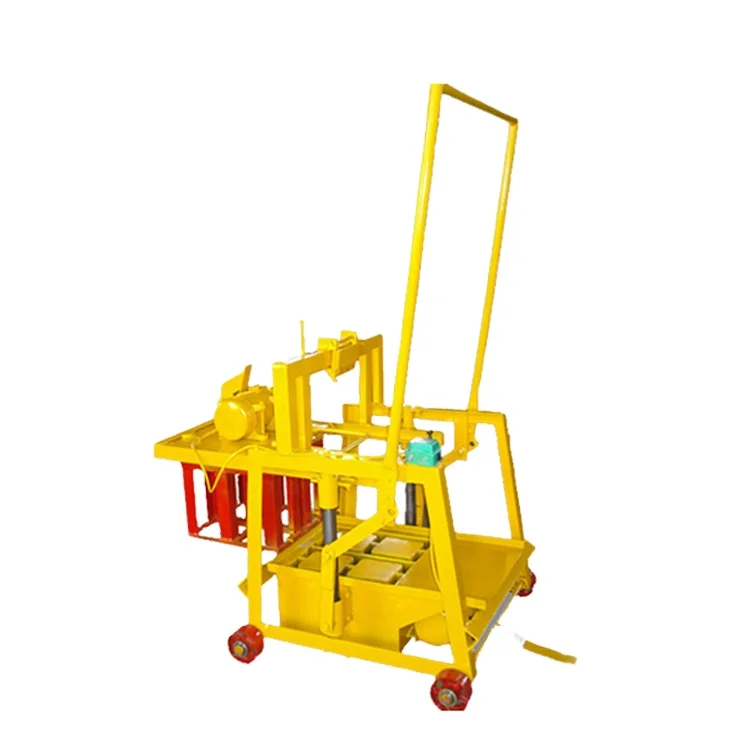
Integrated Line Design — every station around the QMJ2-45 is mapped from mixing through curing, so the press never waits on upstream or downstream bottlenecks.
Technical Specifications
| Parameter | Value |
|---|---|
| Model | QMJ2-45 |
| Product Type | Mobile Egg-Laying Concrete Block Making Machine |
| Machine Type | Mobile / egg-laying (no pallets required) |
| Power Source | Manual operation |
| Control System | Manual |
| Workers Required | 1 to 3 |
| Mould Change | Manual, interchangeable moulds for different hollow brick formats |
| Cycle Time | 25–30s (basis not stated in source — confirm block format and material) |
| Output Capacity | 160 pcs/h based on 400×200×200 mm hollow block, 2 pcs/mould |
| Output Capacity (alt.) | 320 pcs/h based on 400×100×200 mm hollow block, 4 pcs/mould |
| 8-Hour Output | 1,280 pcs (400×200×200 mm) / 2,560 pcs (400×100×200 mm) |
| 8-Hour Output (alt.) | 4,800 pcs (400×150×200 mm) (source value — verify against manufacturer catalog, discrepancy with hourly rate) |
| Pallet | Not required (egg-laying design) |
| Automation Level | Manual |
| Key Features | No pallet required, manual mould interchange, on-site production without fixed plant |
Application Suitability
| Application | Material or Output |
|---|---|
| Small-scale on-site hollow block production | Cement, sand, and crushed stone mix laid directly on compacted ground |
| Construction site block manufacturing | Hollow bricks in 400×200×200 mm and 400×100×200 mm formats for immediate wall building |
| Entrepreneur first-line setup | Low-investment hollow block production with manual feeding and open-air curing |
| Remote project block supply | Mobile production at locations where transporting finished blocks is impractical |
Why "Pieces per Hour" Means Nothing Without the Rest of the Line
A mobile block making machine production line is only as fast as its slowest station.
Quoting a cycle time at the press without matching the mixer output, manual feed pace, and curing area footprint leads to idle operators and half-cured stacks blocking the next lay cycle. I once worked with a contractor who sized a mixer for peak press output but forgot that manual wheelbarrow feeding introduces a variable delay between every cycle. The press sat waiting while workers hauled mix across uneven ground, and daily output fell well below what the hourly rate promised. Planning the mobile block making machine production line as connected stations — mixer, feed path, press, curing zone — prevents that mismatch before equipment arrives on site [NEED_CITE: line cycle matching principles for small-scale block plants].
How the Egg-Laying Design Reshapes the Line Layout
The QMJ2-45 eliminates the pallet station entirely. No pallet feeder, no pallet return conveyor, no pallet storage rack — the machine lays blocks directly on prepared ground and moves forward. This collapses the supporting equipment list and shifts the planning focus to ground preparation and curing area layout. The mobile block making machine production line built around this press requires a level, compacted surface that extends well beyond the machine footprint to accommodate rows of freshly laid blocks that cannot be disturbed for hours.
Matching Mixing and Feeding to a Manual Press Cycle
With a 25–30 second cycle, the press completes roughly two cycles per minute. A single pan mixer must deliver enough fresh mix to keep that rhythm unbroken. If the mixer batch size is too small or the manual feed distance too long, the press operator stands idle. I have seen lines where adding a second wheelbarrow and shortening the feed path from the mixer to the press made a visible difference in daily output. The entire mobile block making machine production line must be walked physically before equipment is placed [NEED_CITE: manual material handling workflow in small block operations].
Reading the Specs That Actually Matter on Site
The QMJ2-45 produces different output depending on the hollow brick format. At 2 pcs per mould for 400×200×200 mm blocks, the hourly rate is 160 pcs/h. Switching to 400×100×200 mm blocks with 4 pcs per mould doubles that figure to 320 pcs/h. The cycle time itself does not change — only the number of blocks deposited per cycle. This is why capacity must always be quoted against a specific block format. The manual mould change also means format switching takes labour time that must be factored into the production schedule. Vibration force and hydraulic pressure values are not stated in the source data, which means block strength depends entirely on the mix design and the operator’s consistency in feeding and levelling. For buyers working with local aggregates that have high clay content, adjusting the water-cement ratio and vibration duration becomes the primary lever for achieving target strength rather than relying on machine pressure alone.
The Hidden Cost of Treating the Press as the Whole Line
When the quotation covers only the QMJ2-45 without specifying the mixer capacity, feed method, and curing area dimensions, buyers discover gaps on arrival. Blocks laid on unprepared ground crack or settle unevenly. Without a defined curing zone, freshly produced rows block the machine’s forward path, forcing the operator to stop and wait. I have seen situations where the curing area was an afterthought, and the contractor ended up moving blocks by hand to a distant patch of ground — adding labour that the egg-laying design was supposed to eliminate [NEED_CITE: curing area requirements for egg-laying block machines].
Why Source the Supporting Stations Together
Block machinery as a single focus means the mixer, feed tools, and curing layout are specified to match the QMJ2-45 cycle, not pulled from separate catalogues. The line configuration is set against your actual mix design and local aggregate, so the manual feed pace and batch size align with the press rhythm. Mould options cover the hollow brick formats your market sells, with drawings provided before production. The automation level is selectable — a buyer can start with this manual mobile line and move to a semi-automatic fixed plant later without replacing the knowledge base. Installation support includes operator training on the full workflow, not just the press controls.
Documentation & Verification
- Line layout showing mixer, manual feed path, QMJ2-45 press position, and curing area boundaries
- Capacity calculation sheet stating output per hollow brick format with cycle time assumptions
- Mould drawing and format list for 400×200×200, 400×150×200, and 400×100×200 mm blocks
- Operation manual covering the complete line workflow from mixing through curing
- Factory test record on your specified block format before dispatch
Installation, Commissioning & Support
- Ground preparation guide specifying level tolerance and compaction for the egg-laying travel path
- Mixer placement recommendation to keep manual feed distance within efficient range of the QMJ2-45
- Mould change procedure walkthrough with tool list and expected time per format swap
- Curing area layout plan sized to your target daily output and block format dimensions
- Operator training covering mix consistency checks, feed timing, and block quality inspection
- Wear parts list for moulds and moving components with recommended replacement intervals
What to Include in Your Inquiry
Send your target hollow brick format, daily output goal, and the raw materials available locally — including aggregate type and water source. Include the dimensions of the site area where the mobile block making machine production line will operate, along with any existing equipment such as mixers or material handlers. This allows the line layout and supporting equipment list to be matched to your actual conditions before a proposal is issued.
Frequently Asked Questions
Q: What supporting equipment does the QMJ2-45 line need beyond the press itself?
A: The line requires a mixer sized to match the press cycle, manual feed tools such as wheelbarrows, and a prepared open-air curing area. Because the egg-laying design removes the pallet station, the supporting equipment list is shorter than a fixed plant, but ground preparation and curing zone planning become more critical to maintain continuous production flow.
Q: How is capacity calculated per block format, and why does one output figure need verification?
A: Output is calculated by multiplying the cycle rate by the number of blocks per mould for each format. The 400×200×200 mm format yields 160 pcs/h and the 400×100×200 mm yields 320 pcs/h. The 4,800 pcs figure for 400×150×200 mm in the source data does not align with the stated hourly rate and should be confirmed against the manufacturer catalog before planning.
Q: What curing area footprint is required when blocks are laid directly on the ground?
A: The curing area must extend far enough ahead of the machine to hold several hours of production without blocking the forward travel path. For the QMJ2-45, this means a level compacted surface sized to your chosen block format and daily target, with enough spacing between rows for air circulation during the initial set period.
Q: How do cycle times at the press match with manual mixing and feeding?
A: The 25–30 second cycle means the press completes a lay roughly every half minute. The mixer batch size and the manual feed distance must allow fresh mix to arrive before the next cycle begins. If the feed path is long or the mixer undersized, the press sits idle and actual daily output drops below the calculated rate.
Q: What is the upgrade path from this manual mobile line to a fixed plant?
A: The manual mobile line serves as an entry point. When production volume and market demand grow, the operation can transition to a semi-automatic or automatic fixed plant with pallet-based pressing and automated stacking. The block format knowledge and mould specifications developed on the QMJ2-45 carry forward into the new line configuration.


