
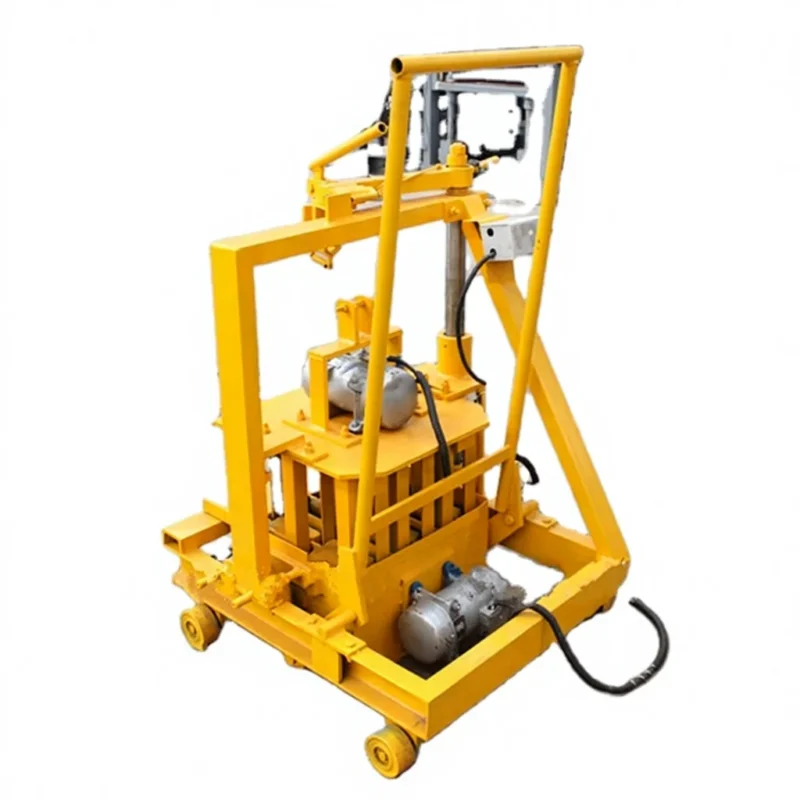
Matched System Sourcing — the QMJ2-45 mobile block making machine production line eliminates the need for separate pallet suppliers by designing the entire on-site workflow around a palletless egg-laying press, so mixer, material feed, and stacking integrate without pallet return loops.
Technical Specifications
| Parameter | Value |
|---|---|
| Model | QMJ2-45 |
| Product Type | Mobile Egg-Laying Concrete Block Making Machine |
| Machine Type | Mobile / egg-laying (palletless operation) |
| Moulding Cycle | 25–30 s |
| Output Capacity | 160 pcs/h based on 400×200×200 mm hollow block, 2 pcs/mould |
| Output Capacity | 240 pcs/h based on 400×150×200 mm hollow block, 3 pcs/mould |
| Output Capacity | 320 pcs/h based on 400×100×200 mm hollow block, 4 pcs/mould |
| Daily Output (8 h) | 1,280 pcs (400×200×200 mm) / 2,560 pcs (400×100×200 mm) |
| Block Formats | Hollow bricks: 400×200×200 mm, 400×150×200 mm, 400×100×200 mm |
| Mould Technology | Heat treatment & carburization |
| Pallet System | None (palletless egg-laying design) |
| Labor Requirement | 1–3 operators |
| Mould Change | Quick-change, manual |
| Construction | High-quality steel frame |
| Automation Level | Semi-automatic / manual operation |
| Standards | ISO 9001:2000, CE |
Application Suitability
| Application | Material or Output |
|---|---|
| On-site hollow block production for housing projects | Crushed stone, river sand, cement, water |
| Small-scale block plants with limited space | Local aggregate mixed with Portland cement |
| Mobile production at remote job sites | Standard concrete mix designs for hollow masonry units |
| First block production operation for entrepreneurs | Low-investment hollow block formats without pallet infrastructure |
What "Output Per Hour" Actually Means on a Job Site
Capacity figures only hold when the block format, mix design, and crew rhythm align with the stated cycle time.
When a mobile block making machine production line quotes output, the number assumes a specific hollow block dimension and a consistent 25–30 second moulding cycle. On a real job site, the mixer must deliver fresh concrete exactly when the press finishes its cycle; if the batch arrives late, the press sits idle and daily volume drops. I have seen crews lose entire shifts because the raw material feed could not keep pace with the QMJ2-45, and the capacity chart looked nothing like the pallet count at day’s end [NEED_CITE: common causes of output shortfall in mobile block production].
The Line Around the Press
A mobile block making machine production line is only as fast as its slowest station. The QMJ2-45 operates without pallets, laying blocks directly on a flat concrete floor. This means the supporting equipment — pan mixer, aggregate batcher, and manual stacking crew — must be positioned so that fresh mix arrives at the hopper every 25–30 seconds without interrupting the operator’s rhythm. If the mixer is undersized or placed too far from the press, the cycle stretches and daily output falls below the format-based calculation.
Space, Floor, and Curing Area
Because the QMJ2-45 leaves blocks on the ground where they are formed, the production floor doubles as the initial curing area. The site must be flat, level, and large enough to hold eight hours of output before blocks are moved to secondary stacking. A 400×200×200 mm hollow block occupies roughly 0.08 m² of floor space; at 1,280 pieces per shift, the curing footprint reaches approximately 100 m². Planning this area before the machine arrives prevents the crew from walking over fresh blocks or running out of room mid-shift [NEED_CITE: curing area planning for palletless block machines].
How Vibration and Pressure Define Block Density
The QMJ2-45 relies on mechanical vibration rather than hydraulic pressure to compact the concrete mix inside the mould. Vibration force must match the aggregate size and moisture content of the local mix; too little vibration leaves voids and weak edges, while excessive vibration segregates the cement paste from the coarse fraction. The 25–30 second moulding cycle gives the vibration enough time to settle a standard hollow block mix, but if the buyer switches to a finer sand or a drier mix, the cycle may need manual adjustment to maintain consistent density and compressive strength across every block.
The Hidden Cost of Overlooking Voltage and Frequency
Exporting a mobile block making machine production line without confirming the destination voltage and frequency often leads to motor burnout within the first week. The QMJ2-45’s electric motors are wound for a specific voltage and Hz; running a 380 V/50 Hz motor on a 440 V/60 Hz supply increases synchronous speed, overheats the windings, and voids the warranty. I once troubleshot a site where the generator frequency drifted under load, causing the vibration motor to stall mid-cycle and crack half the day’s output before the crew noticed the pattern [NEED_CITE: voltage and frequency standards by export market].
Why Source the Whole Line from One Supplier
Specifying the mixer, material feed, and stacking plan together with the QMJ2-45 ensures that cycle times match and no station becomes a bottleneck. The palletless design means the supporting equipment list is shorter, but the stations that remain must still synchronize. Configuration is set against the buyer’s actual mix design and local aggregate, not a catalogue default, so vibration settings and moulding cycle are validated before the machine leaves the factory. Mould drawings for the three hollow block formats are included, and custom formats can be added later without replacing the press frame.
Documentation & Verification
- Factory test record running the buyer’s specified hollow block format before dispatch
- Machine specification sheet confirming voltage, frequency, and control language
- Mould drawing and format list for 400×200, 400×150, and 400×100 mm hollow blocks
- Line layout showing mixer, material feed, and stacking positions around the mobile press
- Operation and maintenance manual covering daily lubrication points and mould change procedure
Installation, Commissioning & Support
- Flat concrete floor of at least 100 m² required for QMJ2-45 production and initial curing
- Dedicated electrical circuit matching confirmed voltage and frequency for all motors
- Machine arrives fully assembled; only mould and vibration motor connections need on-site check
- First-hour commissioning includes cycle timing verification with the buyer’s local aggregate mix
- Operator training covers manual mould change, vibration adjustment, and daily grease-point schedule
- Wear parts list identifies mould liners and vibration springs for first reorder
What to Include in Your Inquiry
Provide the hollow block format your market sells most, the daily volume you need to hit, and the local aggregate type you plan to use. Confirm your site’s available voltage and frequency so the QMJ2-45 motors can be wound correctly before production. If you already own a mixer or material feed system, share its model and output rate so the mobile block making machine production line can be balanced around your existing equipment.
Frequently Asked Questions
Q: How do I verify the daily output figure for my specific hollow block format?
A: The QMJ2-45 output is calculated per format: 160 pcs/h for 400×200×200 mm, 240 pcs/h for 400×150×200 mm, and 320 pcs/h for 400×100×200 mm, each based on a 25–30 s cycle. Multiply the hourly rate by your actual shift hours, then subtract time for mould changes and mixer refills to get a realistic daily count.
Q: What supporting equipment completes the mobile block making machine production line?
A: A pan mixer sized to deliver one batch every 25–30 s, a manual or belt-fed aggregate hopper, and a flat concrete floor for curing. Because the QMJ2-45 is palletless, no pallet feeder, return conveyor, or curing rack is needed, keeping the line compact and the investment low.
Q: How does mould change time affect format flexibility with a small crew?
A: The QMJ2-45 uses a quick-change manual mould system. With one operator and one helper, a swap typically takes several minutes, during which the press is idle. If your market requires daily format changes, factor this downtime into your shift plan or consider dedicating the machine to a single format for maximum output.
Q: What curing area do I need when there are no pallets?
A: Blocks are left on the ground where formed. For 1,280 pieces of 400×200×200 mm hollow block in an eight-hour shift, plan roughly 100 m² of flat, level floor. Blocks remain in place until initial set, usually 24 hours, before being moved to secondary stacking or dispatch.


