
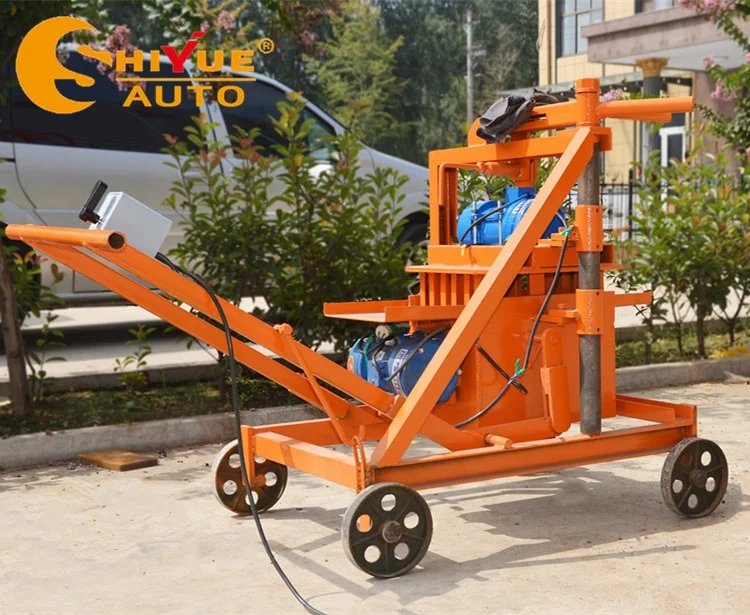
Engine-Powered Line Independence — This QMJ2-45 mobile block making machine operates without grid electricity, pallets, or curing racks, letting contractors produce hollow bricks directly on remote project sites where a full fixed plant is not justified.
Technical Specifications
| Parameter | Value |
|---|---|
| Model | QMJ2-45 |
| Product Type | Manual Mobile Concrete Block Making Machine |
| Operation Type | Manual, mobile (egg-laying) |
| Pallet Requirement | None (pallet-free) |
| Power Source | Engine (diesel or gasoline) |
| Labour Requirement | 1 to 3 workers |
| Mould Change | Manual swap |
| Cycle Time | 25–30s (basis: hollow brick formats below) |
| Output Capacity | 160 pcs/h (400×200×200mm, 2 pcs/mould); 240 pcs/h (400×150×200mm, 3 pcs/mould); 320 pcs/h (400×100×200mm, 4 pcs/mould) |
| Daily Output (8-hour shift) | 1,280 pcs (400×200×200mm); 1,920 pcs (400×150×200mm); 2,560 pcs (400×100×200mm) |
| Mould Formats | 400×200×200mm, 400×150×200mm, 400×100×200mm hollow brick |
| Control System | None (manual operation) |
| Stacking Method | Blocks laid directly on ground |
| Automation Level | Manual |
Application Suitability
| Application | Material or Output |
|---|---|
| On-site housing project hollow block production | Crushed stone, sand, cement and water mixed on location |
| Low-investment startup block yard | Local aggregate and cement with manual batching |
| Remote or off-grid construction sites | Engine-powered production without grid connection or fixed plant infrastructure |
| Contractor self-supply for masonry walls | 400×200×200mm and 400×150×200mm hollow blocks laid and cured on prepared ground |
What "Pieces per Hour" Leaves Out About Mobile Block Production
A capacity figure without a block format attached is not a capacity figure at all.
When a supplier quotes a mobile block making machine production line at a single hourly number, that number almost always assumes the smallest block in the mould range. Swap to the larger hollow format your market actually buys and the output drops, sometimes by half. I have seen buyers in West Africa plan an entire project timeline around a quoted 320-piece-per-hour figure, only to discover on the first production day that their 400×200×200mm blocks came off at barely 160 per hour because the vibration cycle needed to be longer for the heavier mould. The machine was not faulty; the expectation was simply built on the wrong row of the spec sheet [NEED_CITE: capacity calculation standards for concrete block machines]. Stating output per format, per mould cavity count, and per verified cycle time is the only way a buyer can plan curing area, labour shifts, and raw material delivery without surprises on day one.
Eliminating the Pallet Circuit from the Line Layout
In a fixed block plant, the press is only one station among many. Pallets must be fed, returned, stacked, and moved to curing racks — each step requiring conveyors, elevators, and forklifts. The QMJ2-45 removes that entire circuit. Blocks are extruded directly onto the prepared ground surface and left to cure in place, which means the mobile block making machine production line around this press consists of a mixer, a wheelbarrow or small loader, and the operators themselves. For a contractor who needs hollow blocks for a single housing development and has no intention of running a permanent yard, this simplification is the difference between a workable setup and a capital project that never gets approved.
Engine Power as a Line Constraint
Without an electric motor, the surrounding equipment must also be chosen to match. A diesel-driven pan mixer, manual batching, and gravity-fed material handling form a coherent mobile block making machine production line that operates independently of the local grid [NEED_CITE: off-grid block production equipment configurations]. The trade-off is throughput consistency: engine RPM fluctuates with load and fuel quality, which means cycle times on the QMJ2-45 vary slightly across a shift. Operators learn to read the engine sound and adjust the vibration lever timing accordingly — a skill that comes within the first two days of production.
Reading the Spec Sheet Against Your Actual Block Format
Three mould formats are available: 400×200×200mm at 2 cavities, 400×150×200mm at 3 cavities, and 400×100×200mm at 4 cavities. The vibration force and manual lever pressure must compact the mix adequately in each cavity, and the denser the mix, the longer the 25–30 second cycle window stretches. Hydraulic pressure is not a factor here since this is a manual machine, so compaction depends entirely on the vibration motor and the operator’s technique. Pallet size is irrelevant because there are no pallets, but the ground surface must be flat, firm, and swept clean before each pass — otherwise blocks crack at the base during the first hours of curing. The daily output of 1,280 to 2,560 pieces across an 8-hour shift assumes the operator maintains a steady rhythm and the mixer keeps up.
When the Mix Design Fights the Machine
A mobile press with a fixed vibration amplitude cannot adjust itself to different raw materials. I worked with a buyer who sourced high-clay laterite soil for his hollow blocks; the mix stuck to the mould walls and release was inconsistent, leaving rough surfaces and rejected units piling up along the curing row. The fix was adjusting the sand-to-clay ratio and adding a light oil spray to the mould between cycles — but that adjustment cost the first week of production. Specifying your local aggregate and having a test batch run before the machine ships avoids discovering material incompatibility on a project deadline [NEED_CITE: aggregate compatibility testing for manual block presses].
Sourcing the Press Without the Line Around It
One reason buyers choose this machine is the minimal supporting equipment it demands. But that same simplicity becomes a problem if the mixer is undersized. A pan mixer that delivers one batch every three minutes keeps the QMJ2-45 fed; a smaller drum mixer that takes five minutes per batch leaves the press idle and the operators waiting. Line balance matters even in a manual setup, and the throughput calculation should start from the mixer output, not the press capacity.
Why the Line Starts Here
- Block machinery is the single focus of the workshop that builds the QMJ2-45, so the machine, mould, and vibration assembly are matched as one unit rather than sourced from separate vendors.
- Configuration is set against the buyer’s actual mix and target block format, meaning the mould cavity count and cycle time are confirmed before production begins.
- Mould design covers the three standard hollow brick formats listed above, and custom drawings can be reviewed if the local market demands a non-standard size.
- The manual automation level is deliberate: buyers who plan to scale later can add a mixer upgrade and pallet-based press without replacing the entire workflow at once.
- Installation support covers the ground preparation and curing area layout so the first production day is not spent troubleshooting surface flatness.
Documentation & Verification
- Capacity calculation sheet stating output per block format and mould cavity count
- Mould drawing with hollow brick dimensions and changeover procedure
- Machine specification sheet with overall dimensions for transport planning
- Engine type and fuel specification confirmed before dispatch
- Factory test record on the buyer’s selected block format
- Operation manual covering mix ratios, vibration timing, and mould maintenance
Installation, Commissioning & Support
- Flat, compacted ground area prepared to the length of each curing row before the QMJ2-45 arrives on site.
- Engine fuel type confirmed — diesel or gasoline — to match local availability and the mixer engine if both run on the same supply.
- Mould change procedure walked through on site so operators can swap formats within a single shift without damaging the cavity walls.
- First-day production supervised to verify cycle time and block density against the agreed format and mix design.
- Wear parts list provided covering vibration motor brushes, mould liner plates, and lever pivot pins for the first replacement cycle.
- Curing area layout reviewed to ensure blocks are spaced for airflow and not stacked until the initial set is complete.
Before You Send the Inquiry
To size this mobile block making machine production line to your project, provide the hollow block format your market sells, the daily volume you need to hit, and the raw materials available within hauling distance of your site. If you already own a mixer or have a curing area with fixed dimensions, share those details so the layout can be planned around what you have rather than what the catalogue assumes. Engine type preference — diesel or gasoline — should also be stated early to avoid a fuel mismatch on arrival.
Frequently Asked Questions
Q: How is daily output calculated for this mobile block machine?
A: Daily output is derived from the cycle time per mould and the number of cavities for a specific block format, multiplied across an 8-hour shift. For the 400×200×200mm hollow brick at 2 cavities and a 25–30 second cycle, the calculation yields 1,280 pieces per day. Switching to a smaller format with more cavities raises that figure, so always confirm which format the quoted capacity assumes.
Q: What supporting equipment does this mobile machine need to form a working line?
A: At minimum, a mixer sized to deliver batches at a rate that keeps the press fed continuously, plus manual transport such as wheelbarrows to move the mix from the mixer to the machine. No pallets, curing racks, or conveyors are required since the QMJ2-45 lays blocks directly on the ground.
Q: What ground conditions are required for egg-laying block production?
A: The surface must be flat, firm, and free of loose debris so blocks do not crack at the base during initial curing. Compacted soil or a thin concrete screed both work. The area must be large enough to lay a full shift’s output in rows with spacing for airflow between units.
Q: How long does a mould change take on the QMJ2-45?
A: A manual mould swap on this machine typically takes a portion of a shift when performed by trained operators, since the mould is unbolted, lifted, and the replacement unit seated and secured. Planning format changes at the start of a production day rather than mid-shift avoids disrupting output rhythm.
Q: What is the dispatch lead time and how is the machine shipped?
A: The QMJ2-45 is compact enough to ship in a standard container, often alongside a mixer and spare moulds in the same load. Dispatch lead time depends on current production scheduling and whether the buyer’s chosen engine type is in stock; confirm timing at the quotation stage to align with your project start date.


