
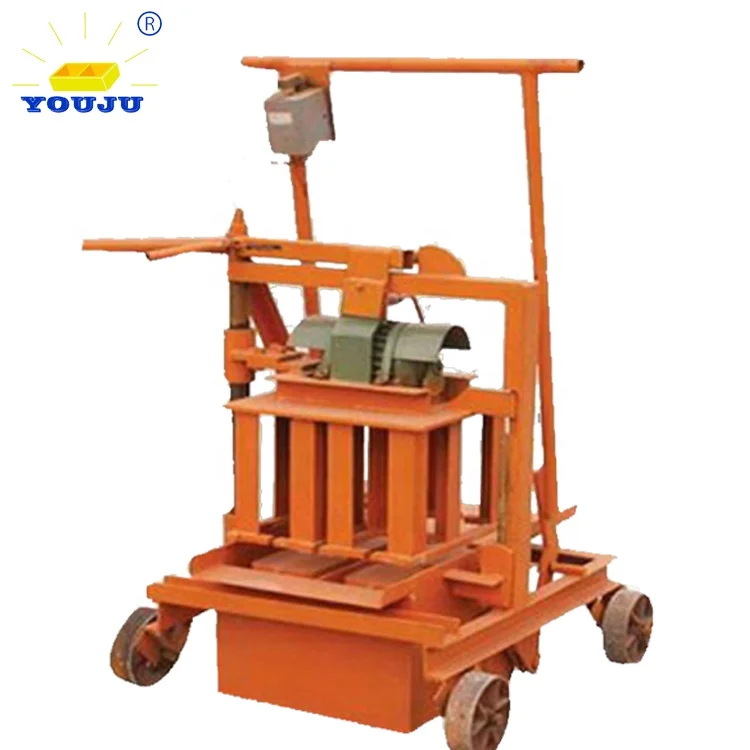
Complete line mapping — The QMJ2-45 mobile block making machine production line supporting equipment is positioned here as a system, not an isolated press, so raw material mixing, curing space, and crew workflow are sized before the machine ships.
Technical Specifications
| Parameter | Value |
|---|---|
| Product Type | Mobile Concrete Block Making Machine |
| Model | QMJ2-45 |
| Machine Type | Hand-pushed mobile (egg-laying) block making machine |
| Pallet Requirement | None (palletless / egg-laying operation) |
| Control System | Manual operation |
| Moulding Cycle | 25-30 seconds |
| Labour Requirement | 1 to 3 workers |
| Mould Formats Available | 400×200×200 / 400×150×200 / 400×100×200 mm hollow brick |
| Output Capacity (400×200×200 mm) | 160 pcs/h, 1280 pcs/8hr (basis: 2 pcs/mould, 25-30s cycle) |
| Output Capacity (400×150×200 mm) | 240 pcs/h, 4800 pcs/8hr (basis: 3 pcs/mould, 25-30s cycle) |
| Output Capacity (400×100×200 mm) | 320 pcs/h, 2560 pcs/8hr (basis: 4 pcs/mould, 25-30s cycle) |
| Certification | ISO 9001:2000, CE |
Application Suitability
| Application | Material or Output |
|---|---|
| On-site hollow block production for housing contractors | Concrete mix using local crushed stone, sand, and cement |
| Small-scale first plant for entrepreneurs | Hollow bricks in 400×200×200 / 400×150×200 / 400×100×200 mm formats |
| Remote job sites without fixed plant infrastructure | Palletless egg-laying operation on compacted ground |
| Complement to an existing fixed block plant | Mobile output for specific project locations |
Why "Pieces per Hour" Means Nothing Without Line Context
A mobile block making machine production line supporting equipment quote that lists only the press leaves the buyer stacking output by hand.
Many buyers discover after delivery that mixing capacity, curing area, and raw material feed were never discussed. The QMJ2-45 completes a moulding cycle every 25-30 seconds, which means the mixer must deliver a fresh batch at that same pace or the press sits idle. When the upstream mixer is undersized, the actual daily output falls far short of the quoted hourly rate [NEED_CITE: typical mixer-to-press batch timing in small block plants]. I have watched operators wait four or five minutes between cycles because the pan mixer could not keep up, turning a machine rated for over a thousand blocks per shift into a few hundred.
Matching the Mixer to the Moulding Cycle
The 25-30 second cycle of the QMJ2-45 sets the heartbeat for the entire mobile block making machine production line supporting equipment setup. A mixer that takes three minutes per batch will force the press operator to wait, and a crew of one to three workers cannot compensate by speeding up manual handling. The mixer batch size should match what the press consumes in roughly two to three cycles so there is always material ready without over-mixing and letting the batch stiffen.
Curing Area When There Are No Pallets
Egg-laying operation means blocks are laid directly on the ground, so the curing area must be flat, compacted, and large enough to hold a full shift of output. For the 400×100×200 mm format producing up to 2560 pieces in an eight-hour shift, the ground space required is considerable. Planning the curing zone before the machine arrives prevents the situation where fresh blocks are stacked on top of each other before they have set, causing breakage that erases any output gain [NEED_CITE: ground curing space requirements for palletless block production].
Reading the Cycle Time Against Your Format
The 25-30 second moulding cycle applies across the three available hollow brick formats, but the output per cycle changes with the mould. The 400×200×200 mm mould produces 2 pieces per cycle, the 400×150×200 mm produces 3, and the 400×100×200 mm produces 4. This means the mixer demand is highest when running the smallest format, because four blocks worth of concrete is consumed every half minute. Buyers who switch formats during a shift need a mixer that can handle the peak demand of the 400×100×200 mm configuration, not just the average.
When the Supporting Equipment Does Not Match
A mobile press that arrives without a correctly sized mixer, or with no voltage and frequency confirmation for the local grid, creates delays that no amount of operator effort can fix. I have seen a QMJ-class machine sit idle for weeks because the site only had single-phase power and the motor was wound for three-phase, and the rewinding cost more than the mixer would have. Mismatched supporting equipment turns a low-investment entry into a series of expensive corrections [NEED_CITE: voltage and frequency standards by export market].
Why Procurement Here Covers the Full Line
Block machinery is our single focus, so the QMJ2-45 is specified alongside its mixer, curing layout, and pallet requirements — or in this case, the absence of pallets. Configuration is set against the buyer’s actual mix design and local aggregate, not a catalogue default. Mould design covers the formats the buyer’s market actually sells. The automation level is manual by design, keeping the crew at one to three workers, but the line around the press is planned as a matched system. Installation support and operator training ensure the crew understands the cycle rhythm from mixer to curing ground.
Documentation & Verification
- Line layout showing mixer position, curing area dimensions, and crew workflow for the QMJ2-45 footprint
- Capacity calculation sheet stating the block format assumed for each output figure
- Voltage and control language confirmation form completed before production begins
- Factory test record on the buyer’s selected hollow brick mould format before dispatch
- Operation and maintenance manual covering mould change procedure and daily greasing points
Installation, Commissioning & Support
- Ground preparation guide specifying the flat, compacted curing area the QMJ2-45 requires for egg-laying operation
- Power supply checklist confirming motor rating, voltage, and frequency before the machine and mixer are built
- Assembly state confirmation detailing whether the press ships fully assembled or dismantled for container loading
- On-site commissioning covering first-cycle timing adjustment and mixer batch-to-press feed rhythm
- Operator training on the 25-30 second cycle pace and mould change between the three hollow brick formats
- Wear parts list identifying the mould liner and vibration components most likely to need first replacement
What to Include With Your Inquiry
Send us the hollow brick format you plan to produce most often, the daily output you need, and the raw materials available locally — aggregate type, cement grade, and any admixtures. Tell us your site voltage and frequency, and the ground space you can dedicate to curing. If you already own a mixer, share its batch capacity and cycle time so we can confirm whether it matches the press rhythm or needs to be part of the package.
Frequently Asked Questions
Q: What supporting equipment does the QMJ2-45 need around it to form a complete line?
A: The QMJ2-45 is a palletless, hand-pushed press, so there is no pallet feeding or return system. The line needs a correctly sized mixer that delivers a fresh batch every 25-30 seconds, a flat compacted curing area large enough for a full shift of output, and a raw material feed point positioned so one to three workers can move mixed concrete to the hopper without delay.
Q: How does the moulding cycle dictate mixer batch size?
A: The 25-30 second cycle means the press consumes material quickly, especially on the 400×100×200 mm mould where four blocks form per cycle. A mixer should complete a batch in roughly one to two minutes so the press is never left waiting. Undersized mixers are the most common bottleneck I see on mobile block sites.
Q: What raw material mixing setup matches the output without bottlenecking?
A: A pan mixer or small drum mixer with a batch capacity matching two to three press cycles works well. The exact size depends on the block format being run and the mix density. We confirm the mixer rating against the buyer’s target format and local aggregate before adding it to the line layout.
Q: How is the curing area sized for palletless operation?
A: Since blocks are laid directly on the ground, the curing area must hold an entire shift of output laid flat. For the 400×100×200 mm format at up to 2560 pieces per eight-hour shift, the required ground area is substantial. We include curing space calculations in the line layout so the buyer can prepare the site before the machine arrives.
Q: What voltage and frequency confirmation is needed before building?
A: The motor rating, voltage, and frequency must match the buyer’s site supply before the press and any supporting mixer enter production. Three-phase and single-phase requirements differ by market, and getting this wrong delays commissioning by weeks. We require a signed voltage confirmation form before production begins.


