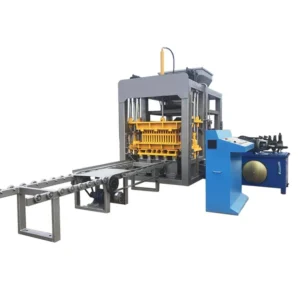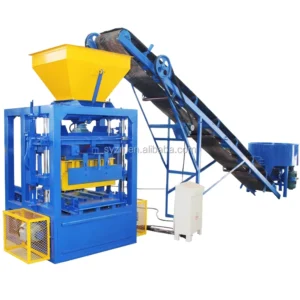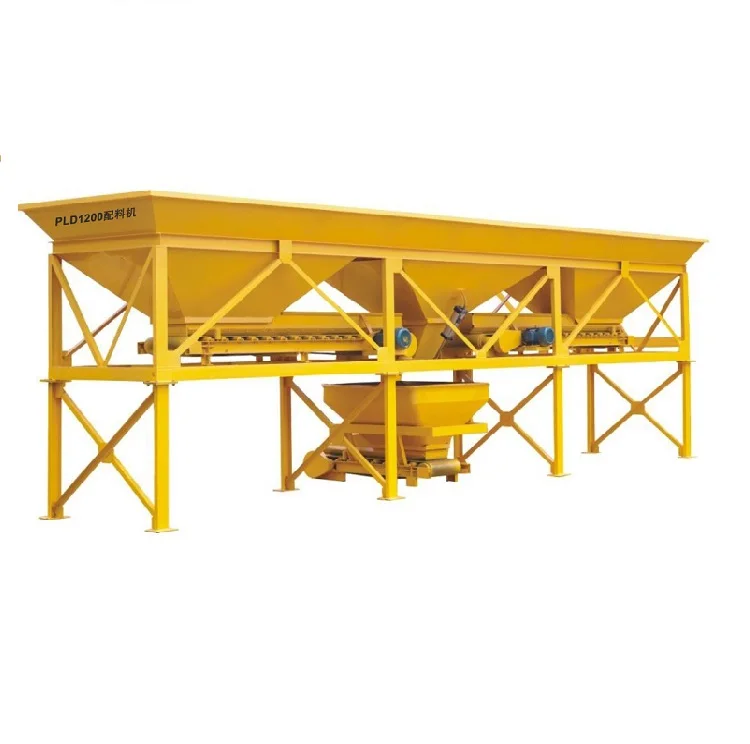
Line-Synchronised Feeding — the PLD1200 batching station is configured against your mixer charge time and press cycle so the raw material supply never becomes the bottleneck that stalls the rest of the block plant.
Technical Specifications
| Parameter | Value |
|---|---|
| Model | PLD1200 |
| Product Type | Concrete Batching Machine |
| Weigh-batching Hopper Capacity | 1200 L |
| Theoretical Productivity | 56 m³/h (basis not stated in source — confirm block format, material and thickness before relying on this figure) |
| Ingredient Precision | ±2% |
| Belt Speed | 1.25 m/s |
| Total Power | 4 × 4 kW |
| Height of Adding Material | 2.8 m (source value — verify against actual site layout) |
| Assembly State | Skid-mounted / pre-assembled modules |
| Warranty | 1 year for whole machine (excluding spare parts) |
Application Suitability
| Application | Material or Output |
|---|---|
| Hollow and solid block production lines | Crushed stone, sand, cement and fly ash proportioning |
| Paving block and kerbstone manufacturing | Fine aggregate and pigment dosing for face-mix layers |
| Mid-to-high output block plants upgrading from loader-fed batching | Weighed belt-discharged feeding replacing manual estimation |
| Multi-format plants running alternating mixes | Consistent aggregate-to-cement ratios across product changes |
Why "56 m³/h" Means Nothing Without the Block Format
Batching capacity is only meaningful when tied to the exact block format, mix design and press cycle time it must sustain.
I have watched entire block lines sit idle because the raw material station could not keep pace with the press. The supplier quoted a headline productivity figure, but that number assumed a lightweight mix and a block format the buyer never intended to produce. Once the actual hollow block mix — heavier aggregate, higher cement content, longer mixing time — was loaded, the feeder fell behind and the press waited. The PLD1200 concrete batching machine production line must therefore be evaluated against your specific daily output target and the format that dominates your order book [NEED_CITE: block format impact on line cycle time].
How the Batching Station Connects to the Rest of the Line
The PLD1200 concrete batching machine production line does not operate in isolation. Its belt speed of 1.25 m/s and 1200 L hopper capacity are chosen so that each discharge cycle aligns with the mixer charge window. If the mixer finishes a batch before the feeder has delivered the next weighed load, the press downstream inherits that delay and the whole line loses rhythm. Matching these intervals at the layout stage prevents the press from sitting idle between cycles.
Synchronising Discharge Height with the Mixer Inlet
The stated adding-material height of 2.8 m must be checked against your mixer charging hopper elevation. A mismatch here forces a site-built chute or an extra lift conveyor, both of which introduce spillage and maintenance points. Confirming this dimension during the proposal stage — alongside the mixer model and its inlet geometry — keeps the material flow gravity-assisted and the footprint compact [NEED_CITE: material handling elevation alignment in concrete plants].
Reading the Numbers That Actually Matter on Site
Ingredient precision of ±2% directly affects block-to-block strength consistency. When cement dosage drifts beyond this band, some blocks cure weaker than others and breakage rates at the cubing station rise noticeably. The 4 × 4 kW total power rating across the feed and belt drives is sized for continuous duty rather than intermittent bursts, which matters when the line runs two shifts back-to-back. The skid-mounted assembly reduces on-site welding and lets the station be repositioned if the plant layout changes later.
The Hidden Cost of Skipping the Line-Matching Step
When a batching machine is ordered as a standalone item without confirming its discharge timing against the mixer and press, the consequences show up weeks after commissioning. Operators start manually overriding the feed sequence to compensate, which defeats the purpose of weighed batching. Block strength data becomes erratic, pallets pile up before the press, and the curing rack never fills on schedule. These problems are rarely blamed on the feeder, yet that is where the rhythm was lost [NEED_CITE: root cause analysis of block line downtime].
Why Source the Batching Station Through This Line
Block machinery is our single focus, so the PLD1200 is specified as part of a matched system — feeder, mixer, press, pallet handling — rather than a catalogue item dropped into a gap. Configuration is set against your actual mix design and local aggregate, not a default recipe. Mould formats, pallet sizes and automation levels are confirmed together, ensuring the batching station output matches what the press can form. Installation support covers the interface between stations, and operator training includes the weighing calibration routine so precision holds beyond the first week.
Documentation & Verification
- Line layout showing PLD1200 placement relative to mixer inlet and press position
- Capacity calculation stating the block format and mix assumed for the 56 m³/h figure
- Electrical schematic detailing how the batching station interfaces with mixer and press PLC
- Factory test record demonstrating weighing accuracy and discharge timing under your mix conditions
- Voltage, frequency and control language confirmation sheet signed before dispatch
Installation, Commissioning & Support
- Skid-mounted modules reduce on-site assembly time for the PLD1200 frame and belt conveyor
- 4 × 4 kW drive set requires dedicated circuit protection sized to the total connected load
- 2.8 m adding-material height verified against your mixer charging hopper before foundation pouring
- Weighing sensor calibration performed on-site with your actual aggregate and cement sources
- Operator training covers belt speed adjustment and hopper refill scheduling to match press cycles
- Wear parts list for belt scrapers, sensors and drive rollers included in the dispatch pack
What We Need from You to Size This Station Correctly
Share the block formats that make up the majority of your output, the daily volume you need to sustain, and the local aggregate types you plan to use. Confirm your existing mixer model and its charging hopper height so the PLD1200 discharge can be matched without field modifications. Provide your site voltage and frequency along with the preferred PLC display language so the control panel is configured before the machine leaves the factory.
Frequently Asked Questions
Q: How is the 56 m³/h productivity figure calculated, and for which block format?
A: That figure is a theoretical throughput that depends on the block format, mix density and press cycle time assumed during calculation. Without stating those variables the number cannot be compared to your actual daily target. We provide a capacity sheet that names the exact format, mix design and press model used as the basis, so you can judge whether it matches your production plan.
Q: Does the batching machine share a PLC with the mixer and press, or run independently?
A: This depends on the automation level you select. On a fully automatic line the batching station communicates with the central PLC so discharge timing follows the mixer and press sequence. On a semi-automatic setup it can run as a standalone unit with its own weighing controller. The control architecture is confirmed during the proposal stage to match your existing equipment.
Q: What is the discharge height, and will it reach my existing mixer hopper?
A: The stated adding-material height is 2.8 m, but this value must be verified against your actual mixer inlet elevation and any intermediate chutes. If the heights do not align, a site modification or an extra conveyor section may be needed. We check this dimension during the layout phase to avoid surprises at installation.
Q: Can the number of aggregate compartments match my local raw materials?
A: The compartment layout is configurable to suit the number of aggregate fractions available at your site. Each compartment feeds onto the weighing belt independently, so adding or removing a fraction does not require a hardware change — only a recipe update in the controller. We confirm the compartment count once your material sources are identified.