
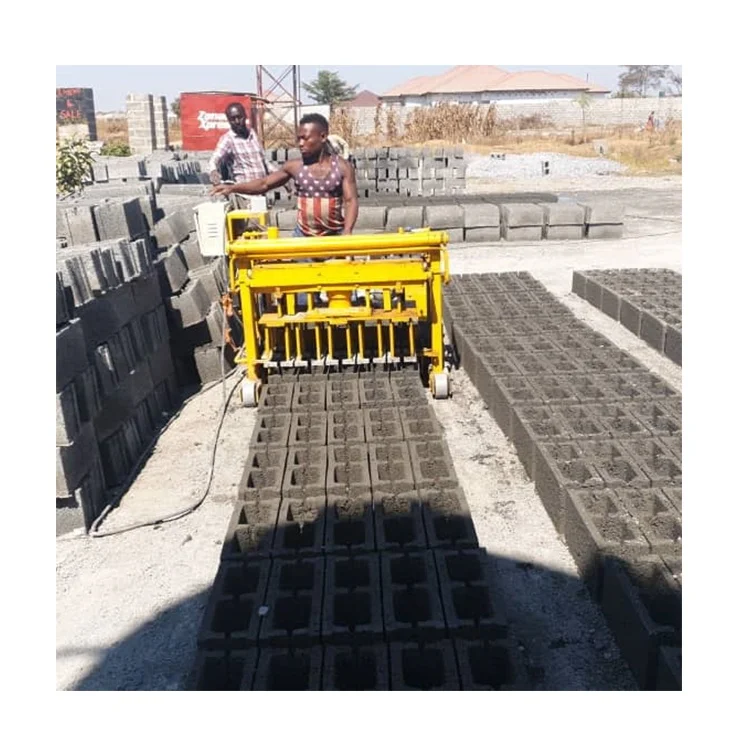
Block Line System Design — The QMY4-30 mobile block machine is specified as the center of a matched workflow, where mixer output, curing yard size, and material feeding are calculated around the machine’s 30-second cycle so the press never waits on upstream or downstream stations.
Technical Specifications
| Parameter | Value |
|---|---|
| Model | QMY4-30 |
| Product Type | Mobile Hollow Block Making Machine |
| Rated Power | 5 kW |
| Overall Dimensions (L×W×H) | 1200 × 1200 × 1100 mm |
| Net Weight | 950 kg |
| Mould Format | Hollow block and solid brick (moulds changeable) |
| Cycle Time | 30 seconds |
| Output Capacity (400×200×200 mm hollow block) | 4 pcs/mould, 480 pcs/hour, 3840 pcs/8 hours |
| Output Capacity (400×150×200 mm hollow block) | 5 pcs/mould, 600 pcs/hour, 4800 pcs/8 hours |
| Output Capacity (400×100×200 mm hollow block) | 7 pcs/mould, 840 pcs/hour, 6720 pcs/8 hours |
| Raw Materials | Cement, sand, crushed stones, slag |
| Automation Level | Semi-automatic / mobile (egg-laying type) |
| Assembly State | Standalone mobile unit, no fixed plant required |
| Pallet Size | Not applicable (blocks laid directly on ground) |
| Stacking Method | Manual (blocks cured on ground) |
| Voltage & Frequency | To be confirmed with buyer’s site supply |
| Control System | To be confirmed (PLC or relay logic) |
| Hydraulic Pressure | To be confirmed |
| Vibration Force | To be confirmed |
| Warranty | One year guarantee |
Application Suitability
| Application | Material or Output |
|---|---|
| On-site concrete block production | Cement, sand, crushed stones, slag mixed locally |
| Small-scale hollow block manufacturing | 400×200×200 mm and 400×150×200 mm hollow blocks |
| Construction contractor project sites | Solid brick and hollow block formats with changeable moulds |
| First block plant with low investment | 400×100×200 mm hollow blocks at lower output volumes |
What "480 Pieces per Hour" Leaves Out About Mobile Block Machine Production Line Output
Capacity numbers only mean something when tied to the block format you actually sell and the workflow feeding the press.
I learned this the hard way when a buyer in West Africa took a mobile block machine rated at sample capacity and ran it with locally sourced aggregate that was coarser than assumed. The 30-second cycle stretched well beyond spec, daily output dropped sharply, and the curing yard — sized for the brochure number — overflowed before noon. Nobody had asked what stone size the local quarry produced [NEED_CITE: aggregate grading standards for concrete block production]. The mobile block machine production line only delivers its stated output when every station around the press — mixer, material feed, water supply, curing area — is planned against the same block format and cycle assumption.
Raw Material Feeding and Mixer Sizing Around the Press
The QMY4-30 completes a moulding cycle every 30 seconds, which means the mixer must deliver a fresh batch at that same rhythm or the operator stands idle. For a mobile block machine production line, the mixer is typically positioned beside or slightly ahead of the machine’s travel path, and material must arrive at a consistent moisture content. If the sand is too wet or the crushed stone exceeds the grading the mould was designed for, the mix will not compact evenly and block edges will crumble before curing.
Curing Area Layout and Ground Preparation
Since the QMY4-30 is an egg-laying machine that deposits blocks directly on the ground, the curing area is not optional — it is the single largest piece of the line. At stated output of 480 pieces per hour for 400×200×200 mm hollow blocks, the machine covers a significant stretch of flat ground each shift. The yard must be level, swept, and hard enough to support wet blocks without settling. Buyers who skip ground preparation find blocks cracking unevenly within the first 24 hours [NEED_CITE: concrete curing conditions and compressive strength development].
Mould Changeover and Daily Scheduling
The QMY4-30 accepts changeable moulds for hollow block and solid brick formats, but each swap stops the entire line. On a mobile block machine production line, that downtime compounds if the operator has to walk back to a storage shed, align bolts without a guide, and re-test the first few cycles. Planning the day around one or two formats — rather than switching every hour — protects realistic daily throughput far more than any automation upgrade could at this scale.
Reading the Specs That Actually Matter
The 5 kW rated power tells you the electrical draw at the press, but the full line — mixer, water pump, possible conveyor — will pull considerably more, so site supply must be confirmed before dispatch. The 950 kg net weight means the machine can be repositioned by a small loader or several workers, but the ground it travels on must still bear that load plus wet concrete without rutting. Vibration force and hydraulic pressure are not yet stated, and these two values together determine whether the machine can compact the buyer’s specific aggregate into a block that meets local strength requirements. Without matching vibration to the mix design, blocks may look formed on the outside but remain porous and weak at the core [NEED_CITE: vibration force and hydraulic pressure matching in block compaction].
The Hidden Cost of Treating the Press as the Whole Line
When buyers focus only on the QMY4-30 press price and skip planning the surrounding stations, the failures show up weeks later. Blocks laid on uneven ground crack during curing, forcing rejection rates that erase any margin gained on the machine itself. A mixer that cannot keep pace with the 30-second cycle leaves the operator waiting, and the curing yard runs out of space before the shift ends. Water supply interruptions halt production entirely because a mobile egg-laying machine cannot buffer material the way a fixed plant with a hopper can [NEED_CITE: workflow bottleneck analysis in small-scale block plants].
Why Procure the Line From a Single Equipment Source
Block machinery is our only product focus, so the QMY4-30 is specified alongside the mixer, pallet handling where applicable, and curing layout as one system rather than assembled from unrelated suppliers. We set the configuration against your actual mix design and local aggregate, not a catalogue default. Mould options cover the hollow block and solid brick formats your market demands, and custom mould design is available to buyer drawings. The automation level is selectable — you can start with the QMY4-30 semi-automatic mobile setup and plan an upgrade path later. Installation support includes operator training on the full workflow, not just the press controls.
Documentation & Verification
- Line layout drawing with capacity calculation stated per block format for the QMY4-30
- Machine specification sheet confirming voltage and frequency before dispatch
- Mould drawing and format list showing exact dimensions for each changeable mould
- Factory test record on buyer’s target block format before shipment
- Operation and maintenance manual covering mixer, press, and curing workflow
Installation, Commissioning & Support
- Ground leveling and compaction requirements for the QMY4-30 curing yard footprint
- Electrical supply confirmation for 5 kW press plus mixer and water pump combined draw
- Machine arrives as standalone mobile unit requiring no fixed foundation assembly
- First-run commissioning includes cycle timing verification against buyer’s local aggregate
- Operator training on mould change procedure and daily maintenance for the QMY4-30
- Wear parts and replacement mould availability confirmed at time of initial order
What to Include With Your Inquiry
Tell us which block format your market actually buys and the daily volume you need to hit, not just the machine model. Share the aggregate grading available from your local quarry and the water source on site. Confirm your site voltage, frequency, and whether single or three-phase supply is available so we can match the electrical configuration before the QMY4-30 ships.
Frequently Asked Questions
Q: How do I calculate realistic daily output by block format?
A: The QMY4-30 produces 4 pieces per mould at 400×200×200 mm in a 30-second cycle, yielding 3840 pieces per 8-hour shift under ideal conditions. Larger-format blocks yield fewer per cycle, and real output depends on mixer pacing, curing yard space, and operator workflow. Request a capacity table calculated against your specific format mix rather than relying on a single headline number.
Q: What does the buyer need to provide around a mobile block machine?
A: The QMY4-30 press is self-contained, but the buyer must prepare a flat curing yard, arrange raw material storage and a mixer, secure a water supply at the production area, and plan manual block handling after laying. Electrical supply for the 5 kW press plus auxiliary equipment must be available on site before commissioning.
Q: How do I match the machine to my local raw materials?
A: The QMY4-30 accepts cement, sand, crushed stones, and slag, but the aggregate grading and moisture content affect compaction and cycle time. Share your local supplier’s sieve analysis so the mix design and mixer setup can be validated before dispatch, avoiding costly material substitution after arrival.
Q: What electrical supply does the QMY4-30 need on-site?
A: Voltage, frequency, and phase must be confirmed with the buyer’s site supply before the machine is configured for dispatch. The press itself draws 5 kW, but the full line including mixer and water pump will require additional capacity. Confirm your site’s available supply early to avoid commissioning delays.
Q: How are mould changes managed in daily production?
A: Each mould change on the QMY4-30 stops the line and requires the operator to swap and realign the new mould. Buyers should plan production around one or two formats per day and store spare moulds near the machine to reduce walk time. Frequent changeovers will reduce effective daily output below the stated per-format capacity.


