
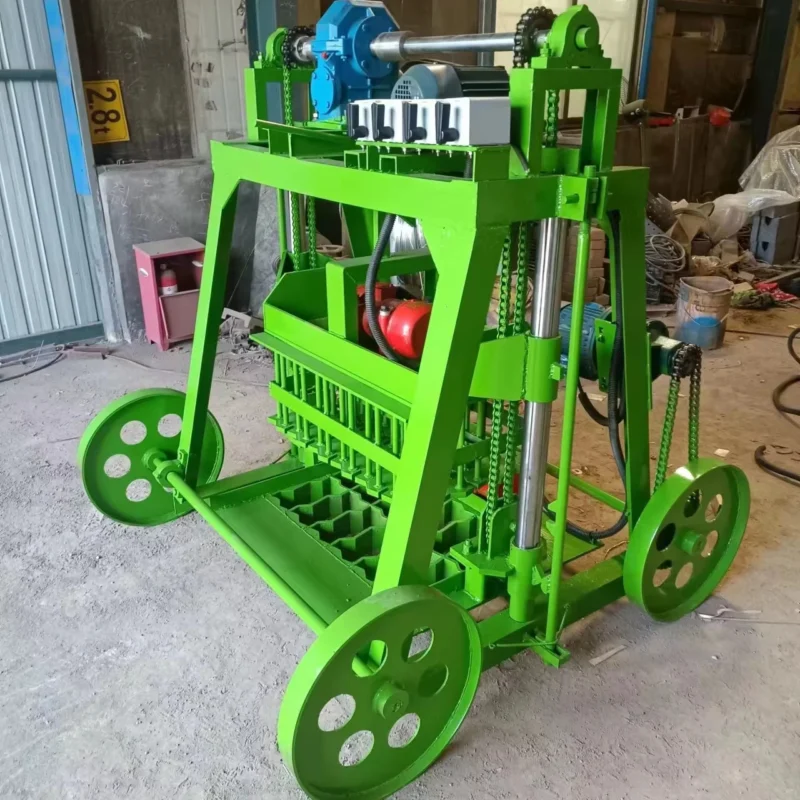
Integrated System Focus — The QMJ4-45 mobile block machine and its supporting feeding, mixing, and curing stations are configured as a single matched line rather than isolated components from different suppliers.
Technical Specifications
| Parameter | Value |
|---|---|
| Model | QMJ4-45 |
| Product Type | Mobile Egg Laying Block Making Machine |
| Molding Capacity | 4 pcs/mold |
| Vibration Frequency | 2400 r/m |
| Compaction Method | Mold vibration (twice-vibration molding core) |
| Demold & Turning Method | Manual |
| Total Power | 6 kW |
| Power Source | Diesel / Petrol engine |
| Molding Cycle | 40-45 s |
| Productivity (400×200×200mm Hollow Block) | 3000 pcs/day (based on 4 pcs/mould, 40-45s cycle, 8-hour shift) |
| Productivity (400×150×200mm Hollow Block) | 3500 pcs/day (based on 5 pcs/mould, 40-45s cycle, 8-hour shift) |
| Productivity (400×120×200mm Hollow Block) | 4500 pcs/day (based on 6 pcs/mould, 40-45s cycle, 8-hour shift) |
| Pallet Requirement | Not applicable (egg-laying, lays blocks directly on the ground) |
| Automation Level | Manual operation, mobile |
| Voltage & Frequency | Not applicable (engine-driven) |
Application Suitability
| Application | Material or Output |
|---|---|
| On-site hollow block production | Crushed stone, sand, cement, and water mix laid directly on prepared ground |
| Remote construction projects | Engine-powered operation in areas without reliable grid electricity |
| First-stage block plant setup | Low-investment entry point before adding upstream batching and downstream curing racks |
Why the Upstream Feeding Station Dictates the Press Cycle
A mobile press is only as fast as the mixer that feeds it.
When planning a mobile block machine production line, the 40-45 second molding cycle of the QMJ4-45 sets a hard pacing baseline. I once saw a contractor pair a high-cycle mobile press with a pan mixer that took several minutes per batch; the press operator spent most of the shift waiting for material, and daily output fell well short of the quoted figure. [NEED_CITE: material flow matching in concrete block production lines] The feeding and mixing stations upstream must deliver a consistent, workable batch to the press hopper at intervals that match or exceed the press cycle, otherwise the entire line rhythm collapses and the curing area sits empty.
Mapping the Stations Around the Mobile Press
The core advantage of a mobile egg-laying block machine production line is that it removes the need for pallets and a fixed curing rack system. The press moves along the ground, depositing blocks in rows. However, this simplicity demands that every surrounding station is planned with equal care. Raw material stockpiles must be positioned close enough for manual or loader-assisted feeding into the mixer, and the mixer discharge height must align with the press hopper to avoid double-handling.
Curing and Handling Without Pallets
Because the QMJ4-45 lays blocks directly on the ground, downstream curing handling looks different from a stationary plant. The blocks must remain undisturbed in place until they reach sufficient green strength for movement. This means the production floor area must be large enough to hold a full shift’s output — roughly several thousand blocks depending on format — plus walkways for water sprinkling and eventual transport to the stacking yard. [NEED_CITE: concrete block curing time and floor space planning] Planning the curing zone as part of the line from day one prevents the common problem of blocks being moved too early and cracking under their own weight.
What Vibration Frequency and Cycle Time Mean on the Ground
The twice-vibration molding core running at 2400 r/m compacts the concrete mix through the mold cavity, and the 40-45 second cycle includes the time for vibration, initial set, and the machine advancing to the next position. The vibration force must be matched to the buyer’s local aggregate gradation and cement content; a mix that is too dry will not consolidate fully, while a mix that is too wet will slump after demolding. The diesel or petrol engine driving the 6 kW total load means the press can operate independently of grid availability, which is critical for remote housing projects. The manual demold and turning keep the supporting equipment list short at the start, with no hydraulic clamps or automated pallet feeders to maintain.
The Hidden Cost of an Undersized Mixer
Selecting a mixer with insufficient batch capacity relative to the press cycle is the most frequent cause of output shortfall in mobile block lines. The press will idle, fuel will burn, and operators will stand by — all while the quoted daily capacity slips away. [NEED_CITE: equipment sizing mismatches in small-scale block production] A line that is planned as a whole, with each station’s throughput verified against the next, avoids this silent drain on project timelines and margins.
Why the Line Is Planned as One System Here
Configuration starts from the buyer’s actual mix design and local aggregate, not a catalogue default. The machine, mold, and supporting handling equipment are specified together so that cycle times align across stations. Mould options cover the hollow block formats the buyer’s market actually sells, with drawings confirmed before production. The automation level is selectable — a buyer can begin with the manual QMJ4-45 and add feeding conveyors or curing rack handling as volume grows. Installation support includes operator training on the specific line layout delivered to site.
Documentation & Verification
- Line layout drawing showing mixer placement, material stockpile zones, and curing floor area relative to the QMJ4-45 travel path
- Machine specification sheet confirming vibration frequency, engine type, and molding cycle per block format
- Mould drawing and format list for each hollow block size included in the order
- Factory test record with blocks produced using the buyer’s confirmed mix proportions
- Operation and maintenance manual covering engine servicing, vibration core inspection, and mould wear checks
Installation, Commissioning & Support
- Ground preparation requirements specifying a level, compacted surface for the QMJ4-45 to travel on without block deformation
- Engine commissioning and fuel system check completed before first production run on site
- Mixer discharge height verified against the press hopper inlet to eliminate manual transfer
- Operator training covering molding cycle pacing, mix consistency judgment, and manual demold technique
- Wear parts list identifying vibration core elements and mould liner plates for first reorder
Planning Your Line Starts With a Conversation
To size the supporting stations correctly around the QMJ4-45, we need to know the target hollow block format and daily output requirement, the local aggregate type and cement availability, and the dimensions of the available production floor. Share your site conditions and project timeline, and we will map the complete mobile block machine production line from raw material infeed to cured block stacking.
Frequently Asked Questions
Q: How is the daily output of the QMJ4-45 calculated per block format?
A: The stated outputs are based on specific mould cavities — 4 pcs for 400×200×200mm, 5 pcs for 400×150×200mm, and 6 pcs for 400×120×200mm hollow blocks — with a 40-45 second molding cycle over an 8-hour shift. Actual daily output depends on the upstream mixer keeping pace and the curing floor being large enough to hold the full shift’s production without interruption.
Q: What mixing and feeding setup keeps pace with the 40-45 second cycle?
A: The mixer must deliver a complete batch to the press hopper within or below the 40-45 second window. This typically means a pan mixer or drum mixer sized so that mixing time plus discharge time does not exceed the press cycle. Positioning the mixer adjacent to the press travel path minimizes transfer time and keeps the line rhythm intact.
Q: How does curing work when blocks are laid directly on the ground?
A: Blocks remain in place on the production floor until they develop enough green strength to be moved, typically requiring water sprinkling and protection from direct sun or wind. The curing area must be sized to hold a full shift’s output, and blocks are transferred to a stacking yard only after initial curing is complete.
Q: Can the line be upgraded later with additional handling equipment?
A: Yes. The manual QMJ4-45 can serve as the starting press in a line that later adds a belt conveyor for raw material feeding, a larger-capacity mixer, or a manual cart system for moving cured blocks to a stacking area. The upgrade path depends on volume growth and available floor space.
Q: What spare parts should be stocked for continuous on-site production?
A: Critical wear items include vibration core components, mould liner plates that contact the abrasive concrete mix, and engine service parts such as filters and belts. Keeping a first replacement set on site prevents production stoppages in remote locations where shipping lead times are unpredictable.


