
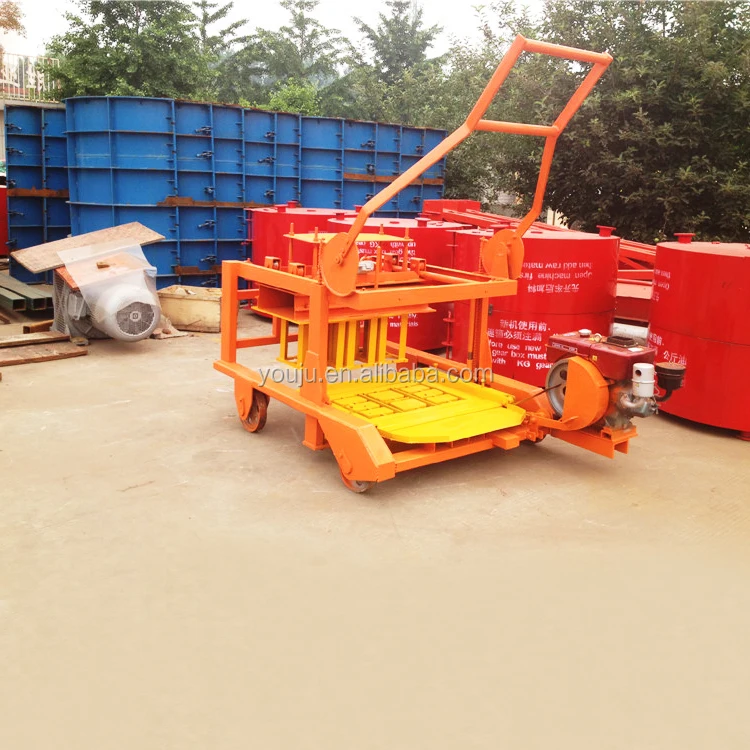
Single focus on block machinery — every mixer, feeder and pallet station is specified to match the QMR4-45 cycle time, so the press never idles waiting for upstream or downstream equipment to catch up.
Technical Specifications
| Parameter | Value |
|---|---|
| Model | QMR4-45 |
| Product Type | Mobile Egg Laying Block Making Machine |
| Overall Dimensions (L×W×H) | 2420×1320×1650mm |
| Net Weight | 810kg |
| Rated Power | 6kW |
| Diesel Engine Option | 6kW or 6-8HP |
| Voltage & Frequency | 220V or 380V or according to client local voltage (frequency not stated in source — confirm with manufacturer) |
| Moulding Cycle | 40-45s |
| Pallet Requirement | No need pallet (egg laying type) |
| Output Capacity | 3000 pcs/day based on 400×200×200mm hollow block, 4 pcs/mould, 8 hours |
| Output Capacity | 3500 pcs/day based on 400×150×200mm hollow block, 5 pcs/mould, 8 hours |
| Output Capacity | 4500 pcs/day based on 400×120×200mm hollow block, 6 pcs/mould, 8 hours |
| Mould Format | Hollow block (400×200×200 / 400×150×200 / 400×120×200); other formats available via mould change |
| Automation Level | Semi-automatic |
| Warranty | One year for the whole machine |
Application Suitability
| Application | Material or Output |
|---|---|
| On-site hollow block production | Crushed stone, sand, cement and water mix laid directly on prepared ground |
| Project-site multicellular brick laying | Lightweight aggregate or standard concrete mix for housing development walls |
| Paving brick and standard brick production | Fine aggregate blend with cement for walkways, yards and perimeter kerbs |
| Contractors supplementing fixed plant capacity | Existing concrete batch fed into mobile unit during peak demand periods |
What "3000 Blocks a Day" Leaves Out When Planning a Mobile Block Making Machine Production Line
Quoted daily output only holds when the mixer feeds at the same rhythm the press consumes. A mobile block making machine production line stops being mobile the moment upstream batching falls behind or downstream curing space runs out. I have watched contractors buy a mobile unit, pair it with an undersized pan mixer, and spend half the shift waiting for the next batch. The QMR4-45 completes a moulding cycle every 40-45 seconds, which means the mixer must deliver a fresh batch roughly every three minutes to keep the hopper charged [NEED_CITE: typical mixer batch cycle matching block press feed rate]. If the line layout does not state the block format assumed, the daily figure on the quotation may refer to the smallest hollow block while the buyer intends to produce the largest.
How the Egg Laying Design Changes Downstream Line Planning
The QMR4-45 lays blocks directly onto the ground and moves forward on its own wheels, removing pallets from the equation entirely. In a conventional static press line, pallet return conveyors, pallet brushing stations and curing rack handlers can occupy as much floor space as the press itself. Here, the mobile block making machine production line only needs a cleared and levelled strip of ground, a mixer positioned within wheelbarrow or belt reach, and an open curing zone where blocks can sit undisturbed. This simplification cuts the number of line stations but shifts responsibility to site preparation and curing area management.
Matching Mixer Capacity to the 40-45 Second Moulding Cycle
A 40-45 second cycle means the QMR4-45 consumes raw material at a steady and predictable rate. The mixer feeding it must deliver a usable batch before the hopper runs dry, otherwise the press sits idle and the quoted output drops proportionally. When a belt conveyor is used for feeding, its speed must be governed so the hopper does not overflow — I once saw an African project lose a full day because an ungoverned belt buried the hopper in dry mix and the crew had to dismantle the feed chute entirely [NEED_CITE: common mobile block machine feed system integration issues]. A correctly specified mixer, whether pan type or drum type, is the single most important upstream decision for this machine.
Reading the Spec Sheet Against Your Actual Block Format
Three daily output figures appear on the QMR4-45 specification sheet, each tied to a different hollow block dimension: 3000 pieces per day at 400×200×200mm, 3500 at 400×150×200mm, and 4500 at 400×120×200mm. The difference comes from the number of cavities per mould — four, five, or six — not from any change in cycle speed. Buyers who need the 200mm-wide block for structural walls must plan around the 3000-piece figure, not the headline 4500. Hydraulic pressure and vibration force, which are not stated in the source data and must be confirmed with the manufacturer, directly affect whether the chosen mix design reaches the required block strength at each of these formats [NEED_CITE: relationship between vibration force and block compressive strength in egg laying machines]. An honest capacity calculation should state the exact format and mix assumed.
When Upstream and Downstream Stations Fall Out of Sync
Choosing a mixer that is too small, a belt feeder that runs too fast, or a curing area that fills before blocks gain enough green strength to move — each of these mismatches stalls the press. On a mobile block making machine production line, the consequences show up faster than on a static plant because there are no buffer conveyors or pallet racks to absorb the imbalance. Blocks laid on the ground cannot be rerouted, and a hopper starved of mix produces half-formed units that must be scraped and re-fed. The cost is not just lost output for that shift but accelerated wear on the vibration motor from repeated dry cycling.
Why Buyers Source the Full Line From One Machinery Supplier
Block machinery is our single focus, which means the QMR4-45 is never quoted as a standalone press — the mixer, feeder and curing layout are specified together so cycle times align across every station. Configuration is set against the buyer’s actual mix design and local aggregate rather than a catalogue default, reducing the risk of a mix the site cannot source. Mould design covers the formats the buyer’s market actually sells, with custom drawings available when standard formats do not match local building codes. The automation level is selectable, so a contractor can begin with manual feeding and add mechanised upstream stations later without replacing the press.
Documentation & Verification
- Line layout drawing showing mixer position, feed path and curing strip length matched to QMR4-45 cycle time
- Capacity calculation sheet stating the exact block format and mix design assumed for each output figure
- Mould drawing and format list confirming cavity count for 400×200×200, 400×150×200 and 400×120×200 hollow blocks
- Voltage and frequency confirmation document specifying electric or diesel configuration before production begins
- Factory test record with the buyer’s chosen mould installed and running at stated cycle speed
- Operation and maintenance manual with mould change procedure and daily lubrication schedule
Installation, Commissioning & Support
- Site must provide a levelled, compacted ground strip at least 30 metres long for the QMR4-45 to travel and lay continuously
- Power supply requires a dedicated 6kW circuit at confirmed voltage and frequency, or a flat surface for diesel engine mounting
- Machine ships partially assembled; vibration motor, hopper and wheel assembly are bolted on-site using supplied fasteners
- First-day commissioning includes cycle timing verification against the stated 40-45 second range with the buyer’s actual mix
- Operator training covers hopper feed rhythm, mould change steps and daily vibration motor bearing inspection
- Wear parts list identifies mould liners, vibration springs and hopper gate seals with recommended reorder intervals
What We Need Before Quoting Your Line
Tell us the hollow block format your market demands, the daily volume you need to sustain, and whether your site has reliable grid power or requires the diesel engine option. Share your local aggregate type and any existing mixer or conveyor you plan to reuse, so we can calculate whether upstream feed rate matches the QMR4-45 cycle without bottlenecks.
Frequently Asked Questions
Q: How is daily output calculated per block format, and what is the basis for each figure?
A: Each output figure on the QMR4-45 assumes an 8-hour shift, a specific hollow block dimension, and the corresponding mould cavity count. The 3000-piece figure uses the 400×200×200mm mould with four cavities per cycle, while the 4500-piece figure uses the 400×120×200mm mould with six cavities. The moulding cycle remains 40-45 seconds regardless of format chosen.
Q: How does the egg laying machine connect with upstream mixers and downstream curing?
A: The QMR4-45 receives mixed material via wheelbarrow or short belt conveyor from a nearby mixer, lays blocks directly on prepared ground, and then moves forward. Downstream, no pallet return system is needed. The curing zone is simply the ground strip behind the machine, where blocks remain until they gain sufficient green strength for handling.
Q: What voltage and diesel engine options are available, and how do they affect line electrical planning?
A: The QMR4-45 is available with a 220V or 380V electric motor at 6kW, or a 6kW to 6-8HP diesel engine. Choosing diesel removes the press from the site electrical load entirely, which matters when the mixer and other line stations already draw near the supply limit. Voltage and frequency must be confirmed before production so the correct motor is fitted.
Q: Which block formats can one machine produce, and how long does a mould change take?
A: The QMR4-45 covers three standard hollow block formats — 400×200×200mm, 400×150×200mm and 400×120×200mm — through interchangeable moulds. Other block types such as paving bricks and solid bricks are available as additional moulds. Mould change time depends on crew familiarity and should be confirmed during commissioning training on your site.
Q: What documentation is provided to verify capacity claims before shipment?
A: Before dispatch, we supply a capacity calculation sheet that names the exact block format, mould cavity count and shift hours assumed. A factory test record shows the machine running with the buyer’s selected mould at the stated cycle time. The line layout drawing documents how the QMR4-45 connects with upstream and downstream stations.


