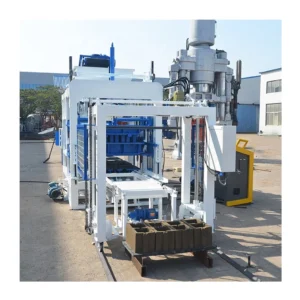
Matched System Design — The QT6-15 block production line is specified as one integrated setup where the mixer, conveyor, pallet loader, press, and stacker are balanced to the same cycle time, so no station sits idle while another catches up.
Technical Specifications
| Parameter | Value |
|---|---|
| Model | QT6-15 |
| Product Type | Automatic Concrete Block Making Machine Line |
| Molding Way | Vibration and hydraulic pressing |
| Rated Pressure | 21 MPa |
| Molding Cycle | 15 s – 20 s (depending on block format) |
| Pallet Size | 900 × 700 mm |
| Main Machine Weight | 6000 kg |
| Output — Hollow Block (400×200×200 mm) | 1,440 pcs/h · 11,520 pcs/8 h |
| Output — Paving Brick (200×100×60 mm) | 5,040 pcs/h · 40,320 pcs/8 h |
| Output — Solid Brick (240×115×53 mm) | 7,680 pcs/h · 61,440 pcs/8 h |
| Control System | PLC (brand and display language to be confirmed) |
| Voltage & Frequency | Configurable to local standard (exact voltage to be confirmed) |
| Raw Materials | Cement, sand, fly ash, stone powder, slag |
| Simple Line Package | JS500 mixer, 8 m conveyor belt, automatic stacker |
| Full Line Package | Cement silo, screw conveyor, cement scale, batching machine, pallet loader, block-pallet separator |
| Assembly for Shipment | Top cylinder removed for container loading; re-assembled on site |
| Warranty | 1 year (excluding wearing parts) |
Application Suitability
| Application | Material or Output |
|---|---|
| Hollow block production for load-bearing and partition walls | Cement, sand, fly ash, and stone powder blends |
| Interlocking paver manufacturing for driveways and walkways | Color-pigmented concrete mixes with fine aggregates |
| Solid brick supply for masonry and infill | Slag-blended or traditional sand-cement mixes |
| Kerbstone and curb production for road infrastructure | High-strength concrete with coarse aggregate |
| On-site block production for housing projects | Locally sourced sand and cement with mobile pallet circuits |
What the Quoted Output Figure Never Tells You
A capacity number without the block format it assumes is not a capacity at all — it is a marketing placeholder.
Quotations that list "1,440 pieces per hour" often omit that this figure applies only to a 400×200×200 mm hollow block. Switch the mould to a 200×100×60 mm paving brick and the same QT6-15 concrete block making machine line produces a different number entirely. When buyers plan their daily logistics, curing space, and pallet fleet around the hollow-block figure but actually run pavers, the entire downstream operation falls out of balance. Pallets run short before noon, the curing yard is under-utilised, and the forklift operator is waiting. [NEED_CITE: block format assumptions in quoted machine capacity]
Keeping Every Station in Step with the Press
The 15–20 second moulding cycle of the QT6-15 concrete block making machine line sets the tempo for every other station. If the JS500 mixer takes longer to deliver a consistent batch than the press needs to complete a cycle, the press stands empty and throughput drops. If the conveyor moves material faster than the mixer can replenish, the belt runs partially loaded and the hopper starves. Each piece of supporting equipment in this line is selected so that its throughput envelope overlaps with the press demand at the intended block format, not a catalogue peak that only applies under ideal conditions.
Where the Pallet Circuit Determines Actual Output
Pallet handling is often an afterthought in block line quotations, yet it governs how many blocks actually leave the plant each day. The 900×700 mm pallet size used by this line is carried through the pallet loader, the press table, the separator, and the automatic stacker. When all stations share the same pallet dimension, jams at transfer points are avoided and pallets cycle back to the press without manual intervention. [NEED_CITE: pallet circuit design and its impact on block plant daily throughput] Choosing the pallet material — wood, bamboo, or composite — then depends on the curing method the buyer already operates, whether that is open-air stacking or a closed curing chamber.
Pressure, Vibration, and the Density Balance
The 21 MPa hydraulic pressure works together with the vibration table to compact the concrete mix into the mould cavity. Higher pressure alone does not guarantee a stronger block; if vibration frequency is too low, air pockets remain regardless of tonnage. Conversely, excessive vibration with insufficient pressure produces a block that is dense on the surface but weak in the core. The QT6-15 block production line pairs both forces so that the mix — whether rich in fly ash or heavy on crushed stone — is consolidated uniformly. Pallet size also plays a role here: a 900×700 mm pallet spreads the vibration energy across a defined area, and changing to a larger pallet without adjusting the vibration table would dilute compaction force per square centimetre.
The Cost of Specifying Stations in Isolation
When the mixer, press, and stacking system are sourced from separate suppliers, each vendor optimises for their own machine and leaves integration to the buyer. The result is a line where the mixer floods the hopper during one cycle and starves it during the next, or where the stacker cannot keep pace and blocks pile up on the press table. [NEED_CITE: integration failures in multi-vendor block production lines] Operators spend shifts clearing jams and adjusting speeds by hand — exactly the labour the automatic stacker was supposed to eliminate. The QT6-15 line avoids this by quoting the supporting equipment as a single bill of materials tied to the press cycle.
Why Buyers Source This Line Here
Block machinery is our single focus, which means the press, mould, pallet, and handling equipment are specified as one matched system rather than assembled from separate catalogues. Every line configuration starts from the buyer’s actual mix design and local aggregate, not a default recipe. Mould design covers the formats the buyer’s market actually sells, with custom drawings available for non-standard shapes. Automation level is selectable — a buyer can begin with the simple line and add the cement silo, batching machine, and pallet loader later without replacing the main machine. Installation and commissioning support includes operator training on the specific PLC language confirmed before shipment.
Documentation & Verification
- Line layout drawing showing each station and the block format assumed for capacity calculations
- Pallet specification sheet confirming 900×700 mm size, material, and load rating
- Hydraulic and electrical schematic matching the dispatched configuration
- Voltage and PLC display language confirmation signed off before production
- Factory test record run on the buyer’s target block format
- Wear parts and mould list with recommended replacement intervals
Installation, Commissioning & Support
- Foundation plan sized to the 6,000 kg main machine weight and vibration load
- Dedicated electrical circuit matching the confirmed voltage and frequency before the line ships
- Top cylinder removal procedure documented for container loading and on-site re-assembly
- Commissioning run on the buyer’s chosen block format with cycle time verified at the press
- Operator training covering mould change, pallet loading, and PLC fault codes in the confirmed language
- Spare moulds and hydraulic seal kits listed in the delivered wear parts inventory
Planning Your Line Configuration
Before requesting a quotation, share the block formats your market currently sells, the daily volume you need for each format, and the raw materials available locally — especially sand type and moisture content. Let us know your existing curing area dimensions and forklift capacity so that the 900×700 mm pallet circuit is planned around your site, not the other way round. Confirm your local voltage and frequency early so the control panel and motor ratings are locked before production begins.
Frequently Asked Questions
Q: How is each station’s cycle time matched so the press is never waiting for material or pallets?
A: The JS500 mixer output, the 8 m conveyor feed rate, and the pallet loader return speed are all calculated against the 15–20 second moulding cycle of the QT6-15 for your chosen block format. If you later add a batching machine to the full line package, its dosing speed is re-verified against the same cycle to maintain balance.
Q: What is included in the simple line versus the full automatic line?
A: The simple line ships with the JS500 mixer, 8 m conveyor belt, and automatic stacker — enough to start producing blocks with manual pallet return. The full line adds a cement silo, screw conveyor, cement scale, batching machine, pallet loader, and block-pallet separator for higher daily output with reduced manual handling.
Q: How are pallet size and material chosen to fit my curing area and existing forklift?
A: The 900×700 mm pallet dimension is standard across the line. Material — wood, bamboo, or composite — is selected based on your curing method and forklift fork width. We confirm pallet weight and stacking height so your existing curing racks and handling equipment remain compatible.
Q: What voltage, frequency, and PLC language are confirmed before the line ships?
A: Voltage and frequency are set to your local supply standard and documented on the electrical schematic. The PLC display language is confirmed in writing before the control panel is wired, so the operator interface matches your team’s working language on arrival.
Q: What supporting equipment do I need to add later if I start with the simple line?
A: The most common additions are the cement silo and batching machine to improve mix consistency, followed by the pallet loader and block-pallet separator to close the pallet circuit. Each addition is designed to plug into the existing QT6-15 press without modifying the main machine frame.