
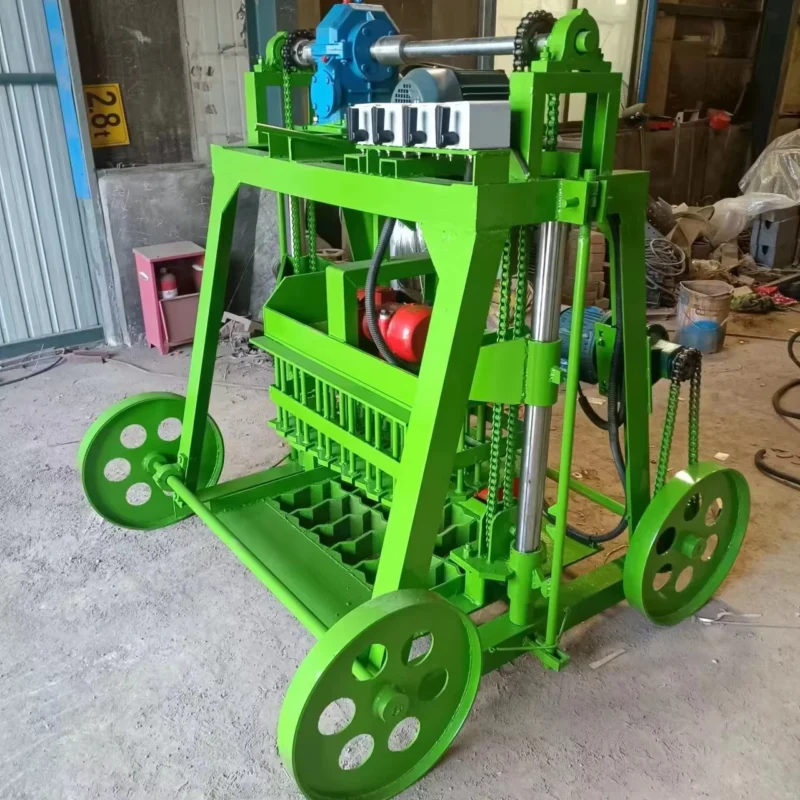
On-Site Line Integration — the QMJ4-45 mobile egg laying block making machine is specified here not as a standalone press but as the center of a matched on-site material flow, where mixer output and manual handling cadence are aligned to its 40–45 s molding cycle so the machine is never left waiting between batches.
Technical Specifications
| Parameter | Value |
|---|---|
| Model | QMJ4-45 |
| Product Type | Mobile Egg Laying Block Making Machine |
| Molding Capacity | 4 pcs/mould (based on 400×200×200mm hollow block) |
| Vibration Frequency | 2400 r/min |
| Vibration Method | Mold vibration (twice-vibration of molding core) |
| Total Power | 6 kW |
| Power Source | Diesel / Petrol engine |
| Molding Cycle | 40–45 s (basis: hollow block format, standard mix) |
| Demould Method | Manual |
| Turning Method | Manual |
| Daily Productivity | 3000 pcs/day (based on 400×200×200mm hollow block, 4 pcs/mould, 8-hour shift) |
| Daily Productivity | 3500 pcs/day (based on 400×150×200mm hollow block, 5 pcs/mould, 8-hour shift) |
| Daily Productivity | 4500 pcs/day (based on 400×120×200mm hollow block, 6 pcs/mould, 8-hour shift) |
| Pallet Requirement | None (egg-laying operation, blocks laid directly on ground) |
| Automation Level | Manual |
| Mould Format Options | Hollow block (400×200×200mm / 400×150×200mm / 400×120×200mm) |
| Certification | CE |
Application Suitability
| Application | Material or Output |
|---|---|
| On-site block production without fixed plant | Crushed stone, sand, cement, and water mixes for hollow block formation |
| Construction contractor self-supply | Hollow blocks laid directly on compacted ground at active building sites |
| First block plant with minimal infrastructure | Standard hollow block formats using locally available aggregate |
| Housing project block supply | Continuous hollow block production at remote or off-grid locations via engine power |
What "3000 Blocks a Day" Actually Requires Upstream
Daily output figures only hold when the mixer and material feed keep pace with the 40–45 second press cycle.
I have watched mobile egg laying block making machine production lines stall repeatedly because the pan mixer could not deliver a fresh batch in time, leaving the operator standing idle beside a machine ready to mold. The QMJ4-45 cycles at roughly one mould every 40–45 seconds, which means upstream material handling must deliver a consistent, well-proportioned mix at that same rhythm. When the mixer falls behind, the quoted daily output collapses regardless of how fast the press itself can operate. [NEED_CITE: typical mixer batch cycle alignment with mobile block press throughput]
Matching Mixer Batches to the Press Rhythm
A mobile egg laying block making machine production line lives or dies by the material flow around the press. The QMJ4-45 demands a fresh batch roughly every 40–45 seconds during continuous operation, which means the mixer must complete its cycle, discharge, and be reloaded within that window. A single-shaft mixer with insufficient capacity or a slow-loading manual feed arrangement creates a bottleneck that no amount of operator effort can overcome. Planning the mixer size and loading method around the press cycle, rather than treating them as separate purchases, is what separates a productive site from a frustrated one.
Ground Preparation and Curing Area Layout
Since the QMJ4-45 lays blocks directly onto the ground without pallets, the condition of that ground surface determines block quality as much as the machine itself. A flat, compacted concrete floor allows the machine to move smoothly between rows and prevents freshly molded blocks from tilting or cracking on uneven surfaces. The curing area must be large enough to hold an entire day’s output — roughly 3000 hollow blocks at the 400×200×200mm format — with sufficient spacing for air circulation during the initial curing period. [NEED_CITE: standard curing area floor space requirements for egg-laying block production]
Vibration, Molding Core, and Block Density
The twice-vibration molding core operating at 2400 r/min compacts the mix within the mould cavity through two distinct vibration phases, which improves particle settlement and produces more uniform block density across different sections of the mould. Higher vibration frequency directly influences how tightly the aggregate and cement bond, reducing the likelihood of weak edges or hollow spots in the finished block. When combined with a properly proportioned mix using locally available sand and crushed stone, this vibration method delivers consistent block strength across a full production shift.
Engine Power and Off-Grid Operation
The 6 kW diesel or petrol engine eliminates dependency on grid electricity, which matters for contractors working at remote housing developments or rural project sites where power supply is unreliable. Engine selection should match local fuel availability and service infrastructure — diesel engines typically offer longer running life under continuous load, while petrol engines may be easier to service in areas with limited diesel supply. Either configuration drives the vibration system and hydraulic-free manual demould mechanism without requiring external power connections.
The Hidden Cost of an Undersized Mixer
Choosing a mixer based on price alone rather than matching its batch cycle to the QMJ4-45 press cycle leads to a pattern I have seen repeatedly: the machine sits idle on a dusty site while the operator waits for the next batch, and the daily output drops well below expectation. Manual material loading by wheelbarrow adds further delays that compound across an eight-hour shift. The result is a mobile egg laying block making machine production line that technically works but consistently underperforms because the upstream stations were never sized to the press rhythm. [NEED_CITE: impact of upstream equipment mismatch on mobile block machine daily output]
Why Source the Full Line Here
Every QMJ4-45 we configure is treated as the centerpiece of a complete on-site line, not a standalone item shipped in isolation. The mixer capacity and batch cycle are matched to the 40–45 second press rhythm from the start, so upstream and downstream stations work in sequence rather than against each other. Mould options are selected based on the hollow block formats your local market actually demands, not a default catalogue list. We confirm engine type against your site’s fuel availability and specify the raw material feed arrangement to match your local aggregate characteristics. Line layout drawings show the full on-site arrangement including curing area dimensions, material flow paths, and operator stations.
Documentation & Verification
- Line layout drawing showing mixer, press, and curing area positioning for the QMJ4-45
- Capacity calculation sheet stating assumed hollow block format and per-format daily output
- Machine specification sheet with confirmed engine type and power rating
- Mould drawing and format list for selected hollow block dimensions
- Factory test record on buyer-specified block format before dispatch
- Operation manual covering daily startup, mould change, and maintenance intervals
Installation, Commissioning & Support
- Site preparation guidance specifying floor flatness and curing area dimensions for egg-laying operation
- Engine startup and run-in procedure with fuel type and oil grade confirmation
- First-day production run with operator instruction on 40–45 s cycle pacing and manual demould technique
- Mould change walkthrough for switching between 400×200×200mm and alternative hollow block formats
- Wear parts list identifying vibration core and mould liner components with replacement intervals
- Daily and weekly maintenance schedule covering vibration assembly lubrication and engine servicing
What to Include with Your Inquiry
Tell us which hollow block format your market requires and the daily output you need to sustain your project schedule. Share details about your local aggregate type and mix proportions so we can align the raw material feed configuration accordingly. Let us know whether diesel or petrol fuel is more practical on your site and whether any existing mixing or handling equipment needs to be integrated into the line.
Frequently Asked Questions
Q: How is daily output calculated and what block format does each figure assume?
A: Each productivity figure in the specification table is tied to a specific hollow block format, mould cavity count, and an eight-hour shift. For example, 3000 pieces per day assumes the 400×200×200mm hollow block with 4 cavities per mould. Output changes when you switch to a different format because the number of cavities per mould changes.
Q: What upstream equipment is needed to keep the QMJ4-45 running continuously?
A: A mixer with batch capacity and cycle time matched to the 40–45 second press rhythm is essential. Raw material feeding must also keep pace, whether by manual loading or a small conveyor. Without this alignment, the press spends significant time idle between batches waiting for material.
Q: Can the engine type be matched to local fuel availability?
A: Yes. The QMJ4-45 is configurable with either a diesel or petrol engine at 6 kW. The choice depends on which fuel is reliably available at your site and which engine type your local mechanics can service. We confirm this during the configuration stage before production begins.
Q: What curing area and floor space does the egg-laying layout require on site?
A: Since blocks are laid directly on the ground, you need a flat, compacted surface large enough to hold a full day’s output with spacing between rows for air circulation. The exact area depends on the block format and daily volume you plan to produce.
Q: How does manual demould and turning affect actual shift output?
A: Manual demould and turning add time to each cycle that an operator must manage consistently. If the operator falls behind or the material feed is irregular, the actual shift output will be lower than the theoretical cycle-based calculation. Proper line pacing and operator training reduce this gap.


