
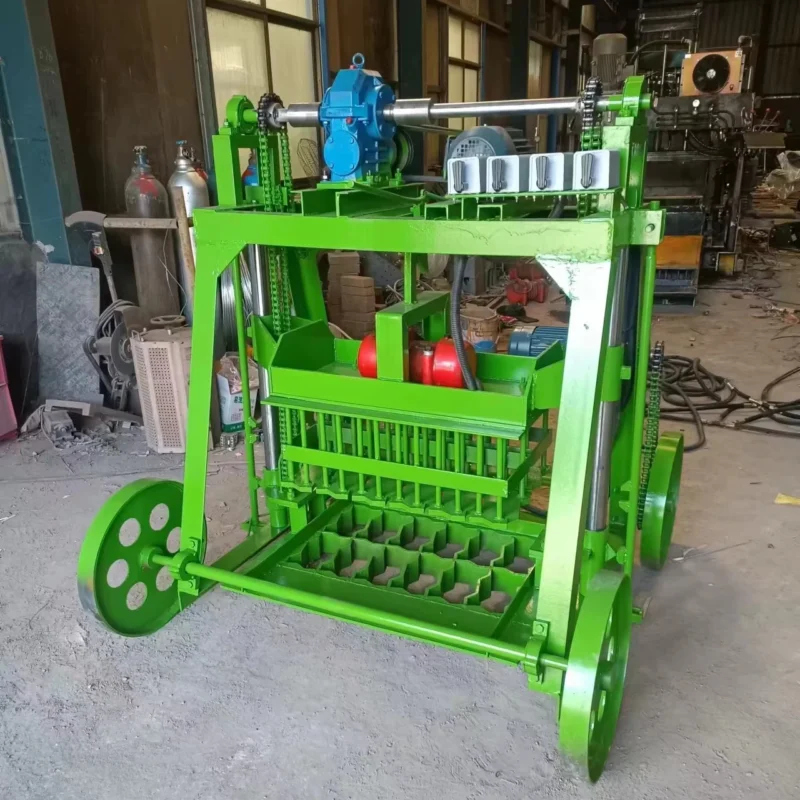
Matched system thinking — the QMJ4-45 is specified as one engine-driven mobile egg laying block machine production line, not a press assembled from separate component suppliers, so mould, engine, and handling requirements are verified together before dispatch.
Technical Specifications
| Parameter | Value |
|---|---|
| Product Type | Mobile Egg Laying Block Making Machine |
| Model | QMJ4-45 |
| Molding Capacity | 4 pcs/mould (for 400×200×200mm hollow block) |
| Vibration Frequency | 2400 r/min |
| Productivity | 3000 pcs/day (basis: 400×200×200mm hollow block, 8 hours, 4 pcs/mould, 40-45s cycle) |
| Productivity | 3500 pcs/day (basis: 400×150×200mm hollow block, 8 hours, 5 pcs/mould, 40-45s cycle) |
| Productivity | 4500 pcs/day (basis: 400×120×200mm hollow block, 8 hours, 6 pcs/mould, 40-45s cycle) |
| Vibration Method | Mould vibration |
| Demould & Turning Method | Manual operation |
| Total Power | 6 kW |
| Power Source | Diesel / Petrol engine |
| Molding Cycle | 45 s (source value — verify against manufacturer catalog) |
| Automation Level | Manual operation, engine-driven |
| Warranty | One year guarantee for the whole machine |
Application Suitability
| Application | Material or Output |
|---|---|
| On-site hollow block production | Crushed stone, sand, cement, and water mix |
| Remote construction projects | Off-grid sites where grid electricity is unavailable |
| Contractor block production | 400×200×200mm, 400×150×200mm, and 400×120×200mm hollow blocks |
| Development and housing projects | Local aggregate and cement without fixed plant infrastructure |
Why "Output per Day" Means Nothing Without Block Format
Capacity figures assume a specific hollow block size, mould cavity count, and cycle time.
A buyer reviewing a mobile egg laying block machine production line often sees daily output stated as a single number. That number is calculated against one block format, one mould configuration, and one cycle duration. Switch to a larger block, and the same machine produces fewer units per cycle. Switch to a thicker wall requirement, and the cycle extends. I have seen contractors arrive on site expecting one throughput level, only to discover their actual format delivers substantially less. [NEED_CITE: block format assumptions in capacity quotations].
Raw Material Feeding and Mixer Station Positioning
The feeding and mixing station must keep pace with the QMJ4-45 engine-driven mobile block machine. When the press completes a cycle and moves forward, the mixer must have fresh material ready at the hopper. If the mixer output falls behind, the operator stands idle while the press waits, and daily output drops below the stated capacity for that block format.
Pallet Elimination and Ground Preparation
This mobile egg laying block machine production line deposits blocks directly onto prepared cement ground, eliminating pallet purchase, pallet storage, and pallet handling from the operational workflow. The curing area becomes the ground itself, so the contractor must ensure the surface is level, clean, and sufficiently cured concrete before production begins. Uneven ground causes blocks to deform during demoulding or crack during the initial curing hours.
Vibration Frequency and Mould Core Design
The 2400 r/min vibration frequency works with the twice-vibration mould core to compact the concrete mix into the cavity. Single-vibration designs leave density variation between the top and bottom of the block. The dual-vibration approach applies force from the mould base and the core simultaneously, producing more uniform wall thickness and compressive strength across the block height. For hollow block formats where wall thickness is thin, consistent vibration prevents weak points that fail during handling or transport.
Engine Power and Fuel Availability
The 6 kW total power requirement is met by a diesel or petrol engine, removing dependence on grid electricity at remote sites. The buyer must confirm fuel type availability and cost at the project location before ordering. Diesel engines typically run longer between refueling but require more maintenance attention. Petrol engines start more easily in cold climates but consume fuel at a higher rate under continuous load. [NEED_CITE: diesel versus petrol engine maintenance intervals for construction equipment].
When the Mixer Cannot Match the Press Cycle
If the mixing station delivers material slower than the 40-45 second molding cycle, the QMJ4-45 sits idle between cycles. The operator watches the hopper fill gradually, and the daily output for any block format falls below the calculated figure. I have seen this mismatch cost contractors thousands of blocks per week on active housing projects. [NEED_CITE: production line bottleneck analysis for block making operations].
Why Source the Machine, Mould, and Engine as One Package
Block machinery is the single focus here, so the QMJ4-45 mobile egg laying block machine production line arrives with mould, engine, and manual handling specified as one matched system. The configuration is set against the buyer’s actual mix design and local aggregate, not a catalogue default. Mould design covers the hollow block formats the buyer’s market sells, with custom drawings available for non-standard sizes. Installation support includes operator training on cycle timing, mould change procedure, and engine maintenance. Documentation covers machine specification, mould drawing and format list, engine specification, and operation and maintenance manual.
Documentation & Verification
- Line layout and capacity calculation stating which hollow block format the daily output assumes
- Machine specification sheet confirming vibration frequency, cycle time per format, and engine power rating
- Mould drawing and format list showing included hollow block sizes and those requiring additional moulds
- Engine specification and fuel type confirmation matched to local availability
- Factory test record on buyer’s specified block format before dispatch
- Operation and maintenance manual covering engine maintenance intervals and mould change procedure
Installation, Commissioning & Support
- Ground must be level cured concrete to support manual demould without block deformation
- Diesel or petrol engine fuel type confirmed against local supply before machine dispatch
- Manual demould and turning mechanism demonstrated during on-site operator training
- Mould change procedure trained for each hollow block format the buyer will produce
- Engine maintenance schedule provided matching the 6 kW power unit specification
- Wear parts list supplied covering vibration components and mould surfaces
What Information Shapes Your Configuration
Provide the hollow block formats your market requires, the daily output target for each format, and your local aggregate type and cement ratio. Confirm whether diesel or petrol fuel is more accessible at your project site. State the ground preparation status at your production location so curing area requirements can be assessed.
Frequently Asked Questions
Q: How is daily capacity calculated, and which block format does the figure assume?
A: Daily capacity is calculated from the number of blocks per mould multiplied by the cycles completed in an eight-hour shift. The QMJ4-45 mobile egg laying block machine production line capacity assumes a specific hollow block size, mould cavity count, and 40-45 second cycle. Switching to a larger format reduces units per cycle, so confirm the calculation against your actual product.
Q: What ground preparation is needed for on-site egg laying operation?
A: The ground must be level, clean, cured concrete to prevent block deformation during demoulding and early curing hours. The QMJ4-45 engine-driven mobile block machine deposits blocks directly on this surface, eliminating pallet requirements. The contractor prepares the curing area before production begins and ensures the surface remains clear of debris and standing water.
Q: Can I add paving block or interlocking brick moulds later, and how long does a mould change take?
A: Additional moulds can be designed and supplied for formats beyond the standard hollow block sizes. Mould change time is not stated in the source documentation, so confirm this figure during the proposal stage. Manual operation means the change procedure requires operator training but no specialized tooling beyond what is supplied with the machine.
Q: What spare parts and wear items should I stock for the first year of operation?
A: The wear parts and mould list provided with the QMJ4-45 mobile block machine identifies vibration components, mould surfaces, and engine maintenance items. Stock these before production begins so replacement does not interrupt operations when the first wear occurs. Engine spare parts depend on the diesel or petrol unit specified for your location.
Q: How does the engine-driven model compare to an electric mobile machine in fuel cost and maintenance?
A: Engine-driven operation removes grid electricity dependence but introduces fuel cost and engine maintenance requirements. The QMJ4-45 diesel or petrol engine requires regular service intervals that electric motors do not. Confirm local fuel pricing and engine service availability at your project site before selecting the engine-driven configuration over an electric alternative.


