
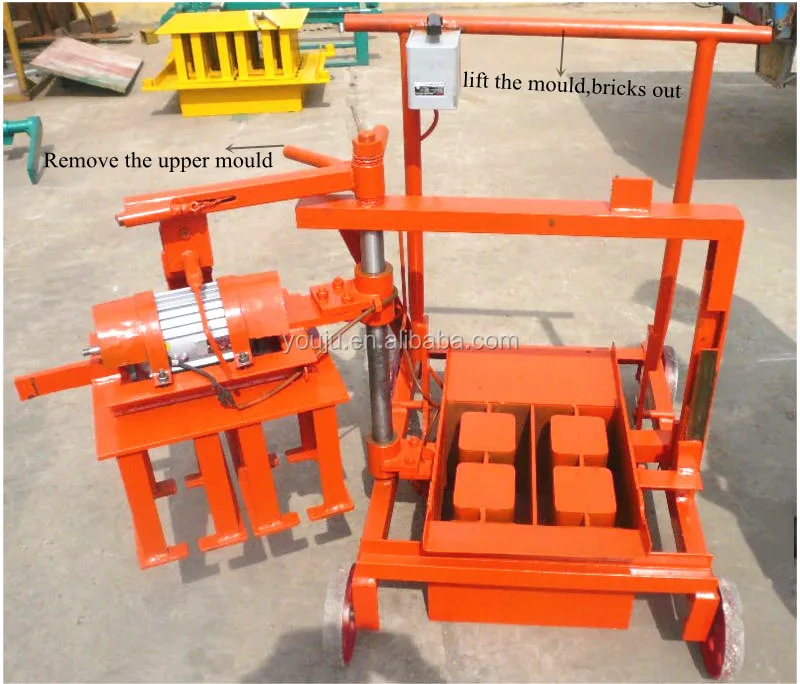
Line-Matched Sizing — every mixer, feed station and curing layout is calculated around the QMJ2-45’s actual cycle pace so the press never sits idle waiting for material.
Technical Specifications
| Parameter | Value |
|---|---|
| Model | QMJ2-45 |
| Product Type | Mobile Egg-Laying Block Making Machine |
| Automation Level | Manual mobile operation, pallet-free |
| Labor Requirement | 1 to 3 workers |
| Mould Format | Interchangeable hollow brick moulds |
| Mould Change Method | Manual |
| Cycle Time | 25–30 s per mould |
| Output (400×200×200 mm hollow brick) | 2 pcs/mould, 160 pcs/h, 1,280 pcs/8 hr |
| Output (400×150×200 mm hollow brick) | 3 pcs/mould, 240 pcs/h (basis not stated in source — confirm block format and mix) |
| Output (400×100×200 mm hollow brick) | 4 pcs/mould, 320 pcs/h, 2,560 pcs/8 hr |
| Pallet Size | Not applicable (egg-laying operation) |
| Power Source | Electric |
| Standards | ISO 9001:2000, CE |
Application Suitability
| Application | Material or Output |
|---|---|
| On-site housing project block production | Hollow bricks from crushed stone, sand and cement |
| Small-scale yard operation | Interlocking or solid bricks with mould swap |
| Remote construction site supply | Kerb and paving formats where grid power is available |
| First-line entrepreneur setup | Low-capital entry producing hollow blocks for local sale |
Why the Mixer Matters More Than the Press Itself
A mobile block making machine production line is only as fast as the station that feeds it.
Sellers quote the QMJ2-45 cycle time per mould, and buyers take that as daily output. I have watched machines of this class sit idle for half a shift because the pan mixer could not batch fast enough for the operator’s pace. When you plan a turnkey mobile block plant, the bottleneck is almost never the press — it is the raw material feeding, the water supply, and the curing space that surrounds it [NEED_CITE: common causes of mobile block line downtime].
Mapping the Full Line Around the Press
The QMJ2-45 drops blocks directly onto the ground, which removes pallets and their return conveyors from the equation entirely. That simplification is an advantage, but it shifts the planning burden to the rest of the mobile block making machine production line. The mixer, aggregate batching point, and water tank must all sit within a few steps of the operator’s walking path, or cycle time stretches beyond the quoted 25–30 seconds.
Curing Area Layout and Daily Footprint
Because the machine lays blocks in rows across the slab, the curing area grows with every hour of production. A turnkey mobile block plant needs a flat, level surface large enough to hold an entire day’s output without the operator having to double back or stack fresh blocks against set ones. If the slab is too small, workers spend time moving cured blocks instead of feeding the press, and the line stalls [NEED_CITE: curing area sizing for egg-laying block machines].
Reading the Capacity Figures Correctly
The specification sheet lists three hollow brick formats with different pieces per mould. The 400×100×200 mm format yields four pieces per cycle and a quoted 2,560 pieces over eight hours, while the wider 400×200×200 mm block yields only two per cycle and 1,280 pieces. These numbers assume continuous operation with no mixer delays, no mould changes, and no curing-area repositioning. Real daily output on a construction site will vary with how well the supporting stations keep pace. The electric drive means voltage and frequency must match the site supply — a detail that surfaces too often during commissioning when a machine is already on the ground and cannot run.
When Supporting Equipment Is Undersized
I once visited a site where the contractor paired a mobile egg-laying press with a drum mixer sized for half the throughput. The operator finished a mould every thirty seconds, but the mixer needed forty-five seconds per batch. The gap compounded through the day. By afternoon the crew was waiting on concrete more often than they were pressing, and the quoted capacity was never reached. That mismatch costs the buyer twice — once in lost output and again in labor hours paid for idle standing [NEED_CITE: mixer-to-press capacity matching guidelines].
Why Buyers Source the Line Here
The QMJ2-45 is specified as one system with its mixer, feed layout, and curing logistics rather than sourced as a standalone press from one vendor and supporting gear from another. Moulds are designed to the hollow brick formats the buyer’s market actually moves, with custom drawings available when a local size falls outside the standard range. Configuration is set against the buyer’s aggregate and mix design, not a default catalogue recipe. Voltage, frequency, and any control language are confirmed before the machine leaves the factory so commissioning happens on the first day, not the third. Documentation covers line layout, capacity calculation per stated format, and a full wear parts list so replacements are on hand before the first mould swap.
Documentation & Verification
- Line layout drawing showing mixer, feed, and curing zones around the QMJ2-45 path
- Capacity calculation sheet stating assumed block format for each output figure
- Mould drawing and format list confirming included and custom hollow brick sizes
- Voltage and frequency confirmation sheet matched to buyer site supply
- Factory test record on buyer’s target block format before dispatch
- Operation manual with mould change steps and daily maintenance checklist
Installation, Commissioning & Support
- Flat concrete slab preparation sized to hold one full day of egg-laid blocks
- Electric supply verification matching the QMJ2-45 motor voltage and frequency before uncrating
- Mixer positioning within manual-feed distance so the operator never waits on a batch
- First-day commissioning with mould alignment and cycle time verification on buyer’s mix
- Operator training on manual mould change and block spacing technique
- Wear parts list and first-set mould spares shipped with the machine
Before You Send an Inquiry
To size the mobile block making machine production line properly, share the hollow brick formats your market buys, the aggregate and cement available locally, and the daily volume you need to hit. Include your site slab dimensions and the voltage and frequency at the connection point so the electrical package is built right the first time.
Frequently Asked Questions
Q: How do I verify real daily output when mixing and curing are manual?
A: Request a capacity calculation sheet that names the exact block format and assumes realistic mixer batch times and curing-area moves. Compare that adjusted figure against the raw cycle-time output, then walk the line layout with your supplier to confirm the mixer is sized to keep pace with the QMJ2-45 throughout a full shift.
Q: What supporting equipment must be ready before the machine arrives?
A: You need a level concrete slab large enough for a day’s curing rows, a mixer matched to the press cycle, a reliable water supply, and aggregate stockpiles positioned near the batching point. Confirm voltage and frequency at your connection panel so the electric motor starts without a transformer delay.
Q: Does the line layout change between block formats?
A: Yes. Thinner hollow bricks yield more pieces per mould, so the curing area fills faster and the mixer must batch more frequently. When you plan a format switch, recalculate the walking path and curing rows so the operator is not stepping over freshly laid blocks to reach the next position.
Q: Can I move from this manual setup to a semi-automatic line later?
A: The QMJ2-45 itself is a mobile, pallet-free press, so adding automatic pallet feeding or stacking around it is not the typical upgrade path. Most buyers who outgrow manual operation move to a stationary semi-automatic plant. Discuss your growth timeline so the supplier can advise when a full line change makes sense.


