
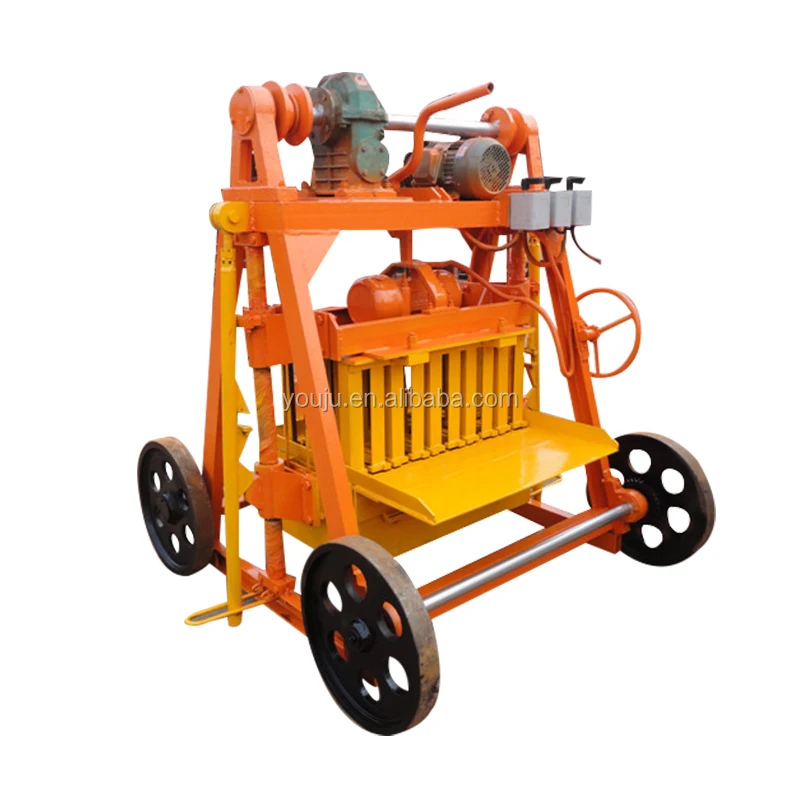
Integrated System Approach — The QMJ4-45 mobile block machine production line operates as a standalone unit, eliminating pallet logistics and curing rack infrastructure from your site layout entirely.
Technical Specifications
| Parameter | Value |
|---|---|
| Model | QMJ4-45 |
| Product Type | Mobile Egg-Laying Concrete Block Making Machine |
| Molding Method | Twice-vibration of molding core |
| Mould Cavity Count | 4 pcs/mould (400×200×200mm hollow block) |
| Vibration Frequency | 2400 r/m |
| Power Source | Diesel / Petrol engine |
| Total Power | 6 kW |
| Molding Cycle | 40–45 s |
| Demold Method | Manual |
| Turning Method | Manual |
| Automation Level | Manual |
| Output Capacity | 3000 pcs/day (basis: 400×200×200mm hollow block, 4 pcs/mould, 8-hour shift) |
| Output Capacity | 3500 pcs/day (basis: 400×150×200mm hollow block, 5 pcs/mould, 8-hour shift) |
| Output Capacity | 4500 pcs/day (basis: 400×120×200mm hollow block, 6 pcs/mould, 8-hour shift) |
| Stacking Method | Manual (egg-laying, blocks cured on ground) |
| Pallet Requirement | Not applicable (egg-laying design) |
| Warranty | One year for whole machine |
Application Suitability
| Application | Material or Output |
|---|---|
| On-site housing project block production | Hollow blocks from local aggregate and cement |
| Remote infrastructure construction | Solid blocks without grid power dependency |
| Startup block plant with minimal capital | Multiple block formats from single machine |
| Contractor-produced blocks at cement working sites | Paving bricks and standard bricks |
Why "3000 Blocks Per Day" Means Nothing Without Context
Capacity figures only matter when tied to the specific block format you actually sell.
Buyers often receive quotations stating output per hour without disclosing which block dimension that calculation assumes. The QMJ4-45 egg laying block machine supporting equipment produces different volumes depending on mould configuration — a 400×200×200mm hollow block yields different daily throughput than a 400×120×200mm variant. When your local market demands a specific format, the realistic output may fall short of catalogue promises if the supplier never asked what you actually need to produce [NEED_CITE: block format capacity calculation standards].
Last year an African client purchased a mobile unit based on generic output claims, only to discover his volcanic ash aggregate required parameter recalibration that took weeks to stabilize. That experience reinforced why I now request raw material testing reports before any configuration discussion begins.
How the Line Actually Functions on Site
The mobile block machine production line operates without upstream feeding systems or downstream stacking automation. Raw materials are batched manually, mixed in a separate pan mixer, then shoveled into the mould box. The twice-vibration molding core compacts the mix, and the operator manually demolds the formed blocks directly onto prepared ground. This standalone approach removes pallet procurement and return logistics from your operational workflow.
The egg-laying design means blocks cure in place where they are laid, requiring adequate ground preparation and curing space allocation. Your site layout must account for block spacing, curing duration, and manual handling pathways between production area and storage zones.
What Supporting Equipment You Actually Need
The egg laying block machine supporting equipment category includes only the press itself — no mixer, conveyor, or feeding station is integrated. You must source a pan mixer separately and determine whether manual batching meets your consistency requirements or if a batching station improves block quality. For remote sites where grid power is unavailable, the diesel engine eliminates electrical dependency, though any auxiliary electric components would require generator provision [NEED_CITE: off-grid construction equipment power requirements].
The manual operation level means labour allocation must cover material handling, machine operation, demolding, and block relocation throughout the curing period.
Vibration Frequency and Mould Cavity Interaction
The 2400 r/m vibration frequency works with the twice-vibration molding core to achieve block density through compaction rather than hydraulic pressure. This vibration-only approach suits smaller block formats where manual demolding remains practical. The mould cavity count varies by block dimension — four cavities for 400×200×200mm hollow blocks, five for 400×150×200mm, six for 400×120×200mm — directly determining cycle output.
The 40–45 second molding cycle includes material loading, vibration compaction, and manual demolding. Actual throughput depends on operator efficiency, material flow consistency, and how quickly the next batch reaches the mould box. Unlike stationary lines with automatic feeding, this mobile unit’s cycle time is partially operator-dependent.
When Egg-Laying Design Creates Hidden Problems
Buyers who choose mobile egg-laying machines without calculating curing space requirements often discover their production area expands uncontrollably. Blocks laid directly on ground require spacing for curing access, and without pallet systems, relocation means manual carrying or wheelbarrow transport after initial set. Ground preparation must ensure level surfaces and proper drainage — uneven terrain causes block damage during curing.
Sites with limited land area or poor soil conditions may find the curing footprint exceeds available space once daily output accumulates over multiple production days [NEED_CITE: concrete block curing space requirements].
Why Procurement Here Differs
Block machinery as a single focus means the QMJ4-45 arrives as a matched system rather than assembled from separate suppliers. Configuration is set against your actual mix design and local aggregate characteristics, not catalogue defaults. Mould design covers the formats your market actually sells, with custom drawings available for non-standard dimensions.
The manual operation level means you can start production immediately without automation training, and upgrade paths exist if your operation scales. Installation support includes operator training on vibration adjustment for your specific material composition. Documentation covers the complete system with hydraulic and electrical schematics, operation manuals, and wear parts lists specific to your configuration.
Documentation & Verification
- Factory test record demonstrating cycle time on your specified block format before dispatch
- Mould drawing and format list confirming cavity count for each block dimension
- Engine specification sheet with fuel consumption rate and maintenance intervals
- Operation manual covering twice-vibration adjustment for different aggregate types
- Wear parts list identifying consumable components and replacement procedures
Installation, Commissioning & Support
- Ground preparation requirements specifying level surface tolerance for egg-laying operation
- Diesel engine startup procedure and initial vibration frequency calibration for your material
- Manual demolding technique training to prevent block damage during extraction
- Mould change procedure demonstration covering format switch time and cavity alignment
- Daily maintenance checklist for vibration mechanism inspection and engine service intervals
- Wear parts inventory recommendation based on your production volume and material abrasiveness
What Information We Need to Configure Properly
To provide accurate mobile block machine production line configuration, specify your target block formats and the dimensions your local market actually purchases. Share your raw material composition including aggregate type, gradation, and any volcanic ash or alternative binder usage. Confirm whether your site has grid power available or requires full diesel operation, and describe your available curing area dimensions and ground conditions.
Frequently Asked Questions
Q: What block formats can the QMJ4-45 produce, and what is the realistic daily output for each?
A: The machine produces hollow blocks in multiple dimensions through mould changes. Output varies by format: 3000 pieces per 8-hour shift for 400×200×200mm blocks using 4-cavity moulds, 3500 pieces for 400×150×200mm with 5-cavity moulds, and 4500 pieces for 400×120×200mm with 6-cavity moulds. These figures assume consistent material supply and operator efficiency throughout the shift.
Q: Is any supporting equipment required, or does the machine run standalone?
A: The QMJ4-45 operates as a standalone press but requires a separate pan mixer for material preparation. Manual batching and material feeding are standard — no integrated conveyor or automatic feeding station is included. You must determine whether manual material handling meets your consistency requirements or if additional batching equipment improves block quality.
Q: How does egg-laying curing work on-site — what ground preparation and curing space is needed?
A: Blocks are laid directly on prepared ground and cure in place. The surface must be level with adequate drainage to prevent water pooling. Curing space expands with daily production volume — calculate your land area against output accumulation over multiple days. Block spacing must allow curing access and eventual manual relocation after initial set.
Q: What is the mould change procedure and how long does a format switch take?
A: Mould change involves removing the current mould box and installing the replacement cavity configuration. The procedure is manual and requires basic tools. Format switch time depends on operator familiarity and mould alignment precision. Confirm with your supplier how many mould formats are included in your quotation and whether changeover training is provided during commissioning.
Q: Can the machine be upgraded to semi-automatic or integrated into a fixed plant line later?
A: The QMJ4-45 is designed as a standalone mobile unit. Integration into a fixed plant line with automatic feeding, pallet systems, and stacking equipment would require different machine architecture. If your operation scales beyond manual capacity, discuss upgrade paths during initial procurement to understand whether this model serves as a starting point or final configuration.


