
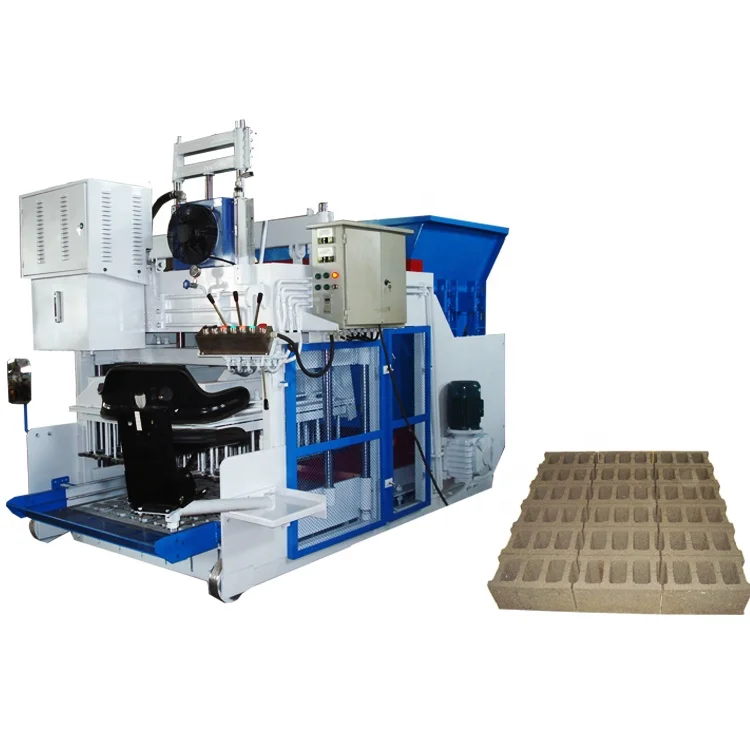
Line-level configuration — every station from raw material feeding through to cured block handling is matched to the QMY18-15 cycle so the press is never left waiting.
Technical Specifications
| Parameter | Value |
|---|---|
| Model | QMY18-15 |
| Product Type | Mobile Cement Block Making Machine |
| Rated Power | 24 kW |
| Voltage & Frequency | Configured to buyer’s local industrial supply |
| Control System | PLC |
| Working Method | Hydraulic pressure |
| Output Capacity | About 34,000 pcs per shift based on 400×200×200mm hollow block (basis not stated in source for other formats) |
| Pallet Requirement | Not required — lays blocks directly on ground |
| Mould Format | Customizable to buyer’s required block types |
| Assembly State | Wheel-mounted mobile unit |
Application Suitability
| Application | Material or Output |
|---|---|
| On-site hollow block production for building contractors | Crushed stone, sand, cement, and water mixed locally |
| Housing project block supply without a fixed plant | Cement-bound aggregate laid directly on compacted ground |
| First-stage block plant for entrepreneurs | Local aggregate blended with cement at site-specific ratios |
What "34,000 Pieces per Shift" Actually Assumes for a Mobile Block Machine Production Line
Capacity is only meaningful when tied to a specific block format and mix design.
The QMY18-15 mobile block machine production line achieves its quoted output on 400×200×200mm hollow blocks under stable cycle conditions. Switch to a smaller solid block and the piece count rises, but the cubic meter volume of concrete consumed per shift stays bounded by the mixer throughput and hydraulic cycle time. I have seen buyers compare shift outputs across machines without checking which block size each number assumes — and then wonder why the daily tally falls short. Before any line configuration, the target format and local aggregate must be confirmed so the capacity calculation reflects reality [NEED_CITE: block format and cycle time relationship in mobile block production].
How Each Station Connects Around the Press
A mobile block machine production line is only as productive as its slowest station. The QMY18-15 hydraulic cycle dictates how fast raw material must arrive at the hopper, how quickly the mixer can deliver a fresh batch, and how the cured blocks are cleared from the ground path so the machine can advance. When any one of these stations lags, the press sits idle and the shift output drops regardless of its rated speed.
Matching Mixer Output to Hydraulic Cycle Demands
The 24 kW rated power of the QMY18-15 covers the hydraulic station and PLC control. The mixer feeding this mobile block machine production line must deliver a consistent batch within the window the hydraulic cycle allows. If the mixer is undersized, the press waits for material. If it is oversized, concrete begins to set before molding. We size the mixer to the cycle, not to a generic catalog rating [NEED_CITE: mixer sizing relative to block press cycle time].
Reading the Specs That Matter On-Site
The PLC control system governs vibration duration, hydraulic pressure hold, and mould descent — three variables that together determine block density and surface finish. The no-pallet design eliminates pallet purchase and maintenance, but it demands a level, compacted ground surface so that each block cures uniformly. The wheel-mounted assembly lets the unit advance along a production lane, yet the lane must be planned for curing space, block clearance, and forklift access. Voltage and frequency are configured before production so that the hydraulic pump delivers its rated pressure from the first cycle onward.
The Hidden Cost of Ignoring Line-Level Balance
When supporting equipment is left out of the scope, buyers end up feeding the mixer by hand, moving blocks with wheelbarrows, and curing output in disorganized piles. The press may be capable, but the effective output collapses because every manual handoff introduces delay and breakage. We have walked onto sites where half the shift was spent on material handling rather than block production — a cost that never appears in a machine-only quotation [NEED_CITE: on-site material handling losses in block production].
Why This Line Scope Exists
Block machinery is our single focus, which means the QMY18-15 is specified alongside its mixer, feeder, and curing handling as one matched system. Each line layout we provide states the block format assumed in the capacity calculation, so buyers can verify daily output before committing. Mould design covers the formats the buyer’s local market actually demands, with custom drawings available. The automation level is selectable, allowing a semi-automatic start with a defined upgrade path. Installation support includes operator training on the specific PLC language and hydraulic settings for the buyer’s mix.
Documentation & Verification
- Line layout with capacity calculation stating the assumed hollow block format
- Hydraulic and electrical schematic matched to confirmed voltage and frequency
- Mould drawing and format list for each block type in the order
- Factory test record on the buyer’s specified aggregate blend before dispatch
- PLC display language confirmation documented prior to production
- Packing photographs and customs documentation support for shipment
Installation, Commissioning & Support
- Ground preparation guide specifying compaction level for no-pallet block laying
- Power supply checklist confirming voltage, frequency, and dedicated circuit for the 24 kW system
- Wheel-mounted unit positioning and lane planning for continuous curing flow
- First-run parameter setting on PLC for vibration time and hydraulic hold matched to local mix
- Operator training covering mould change procedure and daily hydraulic inspection
- Wear parts list with mould and hydraulic seal replacements identified by part number
What to Share Before Quoting
To configure a mobile block machine production line that holds its rated output across the shift, we need to know your target block format, the local aggregate type and source, and your site’s voltage and frequency. Share your daily output goal, available curing area dimensions, and whether existing handling equipment will be integrated. This information lets us match every station to the press cycle before the line ships.
Frequently Asked Questions
Q: How is the 34,000 pcs/shift capacity verified, and what block format does it assume?
A: The figure is based on continuous production of 400×200×200mm hollow blocks under stable hydraulic cycle conditions. When the format changes to a smaller solid or paving block, piece count rises but concrete volume per shift remains bounded by mixer output. We provide a capacity table listing each format in your order with its specific cycle time and shift total.
Q: What supporting equipment is included in the line scope?
A: The scope covers the raw material feeder, mixer sized to the QMY18-15 cycle, and ground-level curing handling equipment. Each station is selected so the press is never starved of material or blocked by uncleared output. A line layout document shows station positions and material flow before production begins.
Q: How are voltage, frequency, and PLC language confirmed before shipment?
A: We collect your site’s power supply rating and preferred PLC display language during the configuration stage. These values are written into the production order and verified during the factory test. The electrical schematic and PLC program backup are included in the documentation package shipped with the line.
Q: How does the no-pallet layout change curing area planning compared to a stationary line?
A: Without pallets, blocks cure directly on compacted ground, eliminating pallet storage and return loops. The curing lane must be level and long enough for the machine’s daily advance, with forklift access on one side for cleared block removal. We include a site preparation drawing showing lane dimensions and compaction requirements.


