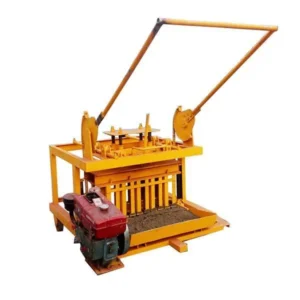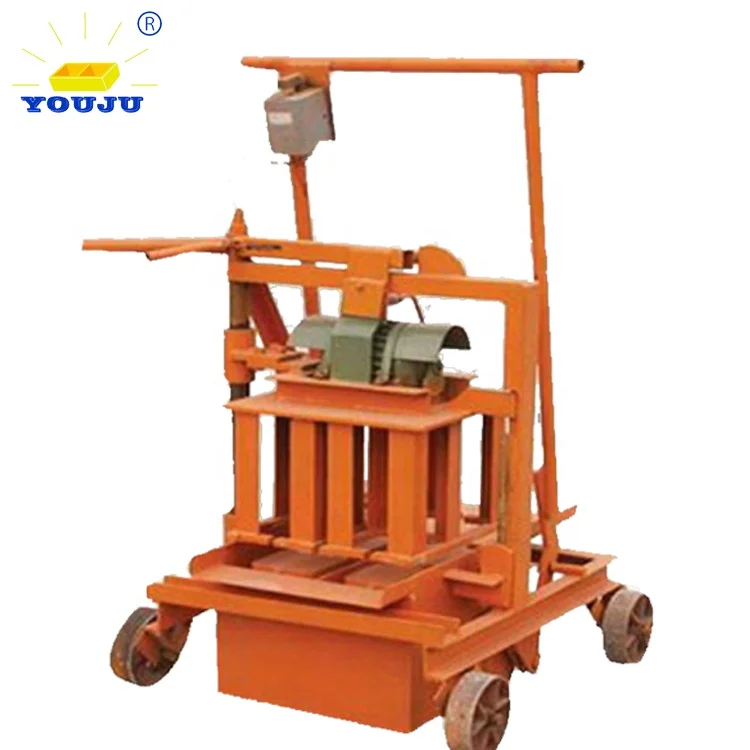
Line-First Engineering — We treat the QMJ2-45 not as a standalone press, but as the heartbeat of a coordinated block production setup where upstream mixing, curing footprint, and manual handling flow are all balanced to its 25-30 second ground-laying cycle.
Technical Specifications
| Parameter | Value |
|---|---|
| Product Type | Mobile Cement Brick Machine |
| Model | QMJ2-45 |
| Operation Type | Hand-pushed, egg-laying design (no pallets required) |
| Moulding Cycle Time | 25-30 seconds per cycle |
| Output Capacity | 160 pcs/h (based on 400×200×200mm hollow block, 2 pcs/mould) |
| Output Capacity | 240 pcs/h (based on 400×150×200mm hollow block, 3 pcs/mould) |
| Output Capacity | 320 pcs/h (based on 400×100×200mm hollow brick, 4 pcs/mould) |
| Daily Output (8hr) | 1280 pcs (based on 400×200×200mm hollow block) |
| Daily Output (8hr) | 2560 pcs (based on 400×100×200mm hollow brick) |
| Labor Requirement | 1 to 3 workers |
| Power Source | Manually operated (no external electric or diesel power required) |
| Mould Heat Treatment | Carburization technology applied |
| Control System | Manual operation (no PLC or electrical panel) |
| Certification | ISO9001:2000, CE |
Application Suitability
| Application | Material or Output |
|---|---|
| On-site housing project production | Hollow blocks laid directly on leveled ground soil or concrete slab |
| Remote or off-grid construction sites | Production without reliance on grid electricity or diesel generators |
| First-time block plant entrepreneurship | Minimal capital setup with zero pallet inventory requirements |
| Building material distributor outreach | Mobile production serving multiple dispersed customer locations |
Why "Pieces Per Hour" Means Nothing Without the Rest of the Line
A mobile block machine production line fails when the mixer or curing crew cannot keep pace with the press.
Buyers often purchase a hand-pushed egg-laying machine based on a single catalogue number, only to find that the 25-30 second cycle is faster than their manual mixing setup can supply, or slower than their crew can clear and prepare the next ground section. The press sits idle either waiting for wet mix or waiting for space. The entire mobile block machine production line must be specified as a continuous loop of material flow, not just a press purchase [NEED_CITE: bottleneck analysis in manual construction material production].
Matching the 25-30 Second Cycle to Upstream Mixing
The QMJ2-45 completes a moulding cycle in 25-30 seconds, which sets the non-negotiable beat for the entire egg-laying block machine supporting equipment array. A manual pan mixer or small drum mixer must discharge a usable batch within that same window, otherwise the operator is left standing at the handles with an empty hopper. We map the mixer discharge time against the press cycle during layout planning so that material arrives exactly when the hopper needs it, eliminating the dead time that destroys real-world daily tonnage.
Planning the Ground-Laying Path and Curing Footprint
Since this machine lays blocks directly on the ground without pallets, the curing area is not a rack system but a vast expanse of flat, level floor space that must be prepared before production begins. The daily output of 1280 pieces (based on 400×200×200mm hollow block) translates to a specific square-meter requirement that grows every hour the machine runs. If the site is uneven or the ground is soft, blocks laid early in the shift will settle unevenly, compromising dimensional accuracy before curing even starts [NEED_CITE: ground preparation standards for egg-laying block machines]. The egg-laying block machine supporting equipment list must therefore include ground leveling tools, curing covers, and manual carts for moving raw mix to the machine’s changing position.
What the Specs Actually Mean for Your Shift Layout
The 1 to 3 worker requirement defines the human configuration of the mobile block machine production line, not just the press station. One worker typically pushes and positions the QMJ2-45, another feeds the hopper from a wheelbarrow or manual cart, and a third manages the raw material batching at the mixer. The carburization-treated moulds resist abrasion from local aggregates, which matters because a mobile setup often uses whatever crushed stone or sand is available on-site rather than a controlled supply chain. The absence of electrical requirements (no voltage, no frequency, no PLC) means the machine can operate anywhere, but it also means every action is human-powered and human-paced.
The Cost of Treating the Press as an Island
When a buyer focuses only on the QMJ2-45 and ignores the egg-laying block machine supporting equipment, the consequences appear within the first week of production. Blocks laid too close together on the ground cure unevenly and stick when moved. A mixer that is too small forces the press operator to wait, turning a 25-30 second cycle into a two-minute cycle. Workers assigned to both mixing and pushing burn out, and the daily output drops well below the 1280 pcs (based on 400×200×200mm hollow block) figure that justified the purchase. These are not machine failures; they are line design failures that no amount of press maintenance can fix [NEED_CITE: common causes of low output in manual block production].
Why We Spec the Line Around This Machine
Our approach to the QMJ2-45 starts with the buyer’s actual site conditions and target block format, not a catalogue default. We treat block machinery as a single-focus discipline, meaning the mixer, the manual carts, the curing covers, and the ground preparation guidance are specified as one matched system. Mould design covers the hollow brick formats the buyer’s local market actually purchases, and the line layout drawing shows exactly where the mixer sits relative to the machine’s laying path. Capacity calculations are stated per block format with the assumed cycle time, so the buyer knows what to expect before the machine ships.
Documentation & Verification
- Line layout drawing showing mixer placement, curing area dimensions, and ground-laying flow path for the QMJ2-45
- Capacity calculation sheet stating daily output per block format with the 25-30s cycle time assumption
- Mould drawing and format list confirming included hollow brick sizes and any separate mould orders required
- Curing area planning guide sized to the stated daily output for ground-laid block protection
Installation, Commissioning & Support
- Site leveling guidance ensuring the ground path is flat enough for the hand-pushed QMJ2-45 to lay dimensionally accurate blocks
- First-shift supervision to align the mixer discharge rhythm with the 25-30 second moulding cycle
- Operator training on hopper feeding technique to maintain consistent block density without electrical vibration
- Wear parts list covering carburization-treated mould components with lead times for first replacement orders
What We Need to Spec Your Line
To build a realistic mobile block machine production line around the QMJ2-45, we need to know which hollow brick format your local market demands and what daily volume you are targeting. Tell us about your available raw materials and the condition of your production site, including the space you have for ground-level curing. If you already own a mixer or material handling carts, share those details so we can confirm whether they match the press cycle.
Frequently Asked Questions
Q: How do I verify the real daily output of the QMJ2-45 for my specific block format?
A: Real daily output depends entirely on which hollow brick format you run and whether your mixing and curing setup can sustain the 25-30 second cycle without interruption. We provide a capacity calculation that states the output per specific format, such as 1280 pcs based on 400×200×200mm blocks over an 8-hour shift, so you can plan your line around a verified number rather than a generic catalogue claim.
Q: What supporting equipment do I actually need beyond the press itself?
A: Beyond the QMJ2-45, you need a mixer that can discharge a batch within the press cycle window, manual carts or wheelbarrows for moving wet mix to the machine’s changing position, and curing covers to protect ground-laid blocks from weather. The egg-laying block machine supporting equipment list is minimal compared to a pallet-based line, but each item must be matched to the cycle speed.
Q: How much ground space do I need for curing when blocks are laid directly on the earth?
A: The curing area must be large enough to hold one full day’s output of 1280 pieces (based on 400×200×200mm hollow block) without stacking blocks on top of each other before they gain initial strength. We provide a curing area planning guide that calculates the required square meters based on your chosen format and daily target, including spacing for air circulation.
Q: What happens when the mould or wear parts need their first replacement?
A: The carburization-treated moulds on the QMJ2-45 resist abrasion from local aggregates, but eventual wear is inevitable. We supply a wear parts list with the machine, and replacement mould components are manufactured to the same drawings as the originals. Lead times for spares should be confirmed at the time of your initial order so you can plan maintenance without extended downtime.