
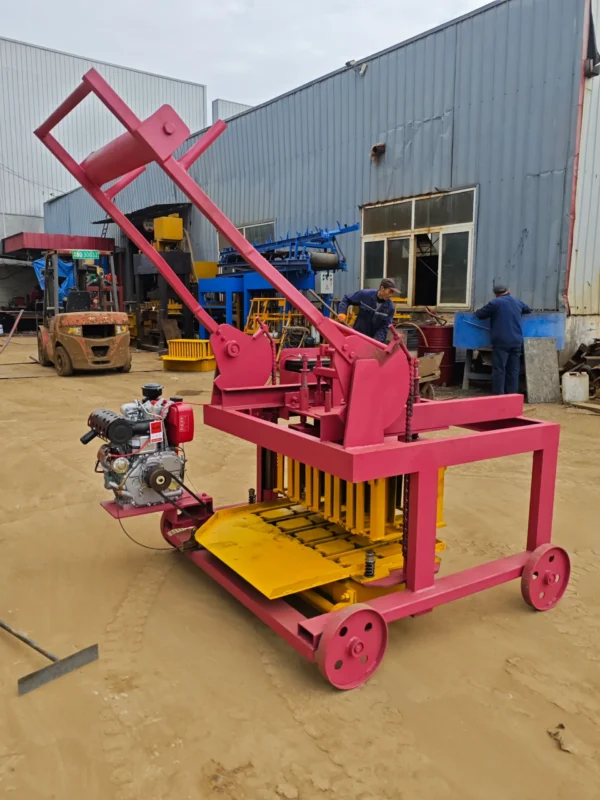
Integrated Press, Mixer and Trolley — QMR4-45 ships as one matched mobile block machine production line so cycle times align from batching through laying, rather than three separate purchases left to coordinate on-site.
Technical Specifications
| Parameter | Value |
|---|---|
| Model | QMR4-45 |
| Product Type | Mobile Diesel Block Making Machine |
| Power Source | Diesel Engine |
| Rated Power | 8 hp |
| Molding Cycle | 45 s (basis to be confirmed by block format) |
| Molding Form | Vibration and Pressure |
| Vibration Force | 60 KN |
| Overall Dimensions | 2420 × 1320 × 1650 mm |
| Net Weight | 800 kg |
| Pallet Requirement | No pallet needed (egg-laying type) |
| Mould Format | Paver brick, hollow block, concrete block, solid brick, fly ash brick (basis not stated in source — confirm block format / material / thickness) |
| Output Capacity | Basis not stated in source — confirm block format / material / thickness |
| Automation Level | Manual / egg-laying mobile type |
| Stacking Method | Manual — blocks laid directly on ground |
| Basic Equipment Included | JZC350 Diesel Concrete Mixer or JQ350 Diesel Concrete Mixer (Electric Generating Unit); Trolley |
| Assembly State | Fully assembled, mobile |
Application Suitability
| Application | Material or Output |
|---|---|
| On-site block production at building projects | Crushed stone, sand, cement blends mixed in the paired diesel mixer |
| Small-scale hollow block manufacturing | Cement and local aggregate, laid directly on leveled ground |
| Paver brick runs for driveways and walkways | Fine aggregate and cement with pigment, swapped by mould change |
| Solid brick for load-bearing walls | Dense aggregate mix pressed with 60 KN vibration force |
| Fly ash brick production near thermal plants | Fly ash, lime and gypsum blends, cured in open yards |
Why the Generator Question Must Precede the Order
Confirming the local power reality avoids a three-week electrical standstill after arrival.
A mobile egg-laying block machine supporting equipment setup only earns its name when the mixer and press both run on the fuel or power actually available at the job site. I once specified a diesel press for a project in West Africa without verifying the generator set the contractor already owned. The unit arrived, the generator could not sustain the hydraulic startup surge, and we spent weeks rewinding the control cabinet while the foundation crew waited. That delay cost more than the generator upgrade would have. [NEED_CITE: typical voltage and frequency mismatches reported in sub-Saharan construction projects]
How the Press, Mixer and Trolley Connect as One Line
The QMR4-45 operates as a mobile block machine production line only when the JZC350 mixer finishes a batch within the same window the press consumes it. If the mixer lags, the operator stands idle and the 45-second molding cycle loses meaning. The trolley bridges the gap, carrying fresh mix to the hopper while the press completes its current mold. Matching these three stations is where most small site setups fail.
Ground Conditions That Decide Block Density
An egg-laying machine deposits blocks directly on the earth, so ground preparation becomes part of the production process. A soft or uneven surface absorbs vibration energy that should compact the mix, producing blocks with lower density on one side. We ask buyers to send photos of their curing area before dispatch so we can advise on the minimum compaction and leveling required for the 60 KN vibration force to transfer fully into the block.
Reading the Numbers That Matter
The 60 KN vibration force paired with mechanical pressure determines how tightly the aggregate locks together before curing begins. Insufficient vibration leaves void paths through the block; excessive vibration without matching pressure simply liquefies the fines and weakens the surface. The 8 hp diesel engine must deliver continuous torque through the full 45-second cycle, not just peak power at startup, which is why the engine governor setting matters as much as the rated horsepower. [NEED_CITE: relationship between vibration amplitude and compressive strength in concrete masonry units] Mould change time dictates how many format switches are realistic in a single shift — if swapping takes half a morning, the buyer will run only one format regardless of how many moulds were purchased.
The Cost of Skipping the Line-Level View
Treating the press as a standalone purchase while sourcing the mixer and trolley locally often creates a bottleneck at the hopper. A mixer that delivers a batch every four minutes but feeds a press that consumes one every 45 seconds leaves the operator waiting, and the daily output collapses far below the quoted figure. Ground that was never leveled forces the buyer to hand-trim every block after curing, adding labor that the egg-laying design was supposed to eliminate. [NEED_CITE: field reports of output shortfalls in manually coordinated mobile block lines]
Why This Line Is Specified as a System
Block machinery is our single focus, so the QMR4-45 press, JZC350 mixer and trolley leave our yard as one matched mobile block machine production line rather than three separate purchases. Configuration is set against the buyer’s actual mix design and local aggregate, not a catalogue default. Moulds are supplied for the formats the buyer’s market sells, with custom drawings available when standard sizes do not match local building codes. The automation level remains selectable — a buyer can start with this manual egg-laying setup and move to a pallet-based semi-automatic line later without replacing the press core. Installation support includes operator training on the specific formats the buyer will run first.
Documentation & Verification
- Line layout showing mixer, press and trolley positions with cycle-time alignment for the selected block format
- Machine specification sheet listing the 8 hp diesel engine curve and 60 KN vibration rating
- Mould drawing and format list confirming every block size included in the shipment
- Factory test record run on the buyer’s specified aggregate blend before crating
- Operation and maintenance manual with daily grease points and engine service intervals
- Packing photographs and customs documentation support for the destination port
Installation, Commissioning & Support
- Level a compacted ground strip at least 30 m long and 3 m wide for the QMR4-45 egg-laying travel path
- Verify the optional electric generating unit voltage and frequency match the JQ350 mixer nameplate before first start
- Machine arrives fully assembled; only the trolley handle and mixer tilt lock require field fitting
- First-day commissioning includes test runs on the buyer’s local aggregate to set the vibration duration
- Operator training covers mould swap procedure and the 45-second cycle rhythm for each block format
- Wear parts list with first-replacement timeline for the vibration springs and mould liner plates
What to Include in Your Inquiry
Send the block formats your market actually sells, including dimensions and whether hollow or solid, so we can calculate a realistic daily figure tied to a specific mould. Confirm the power situation on site — grid availability, generator capacity or diesel-only — because the mixer variant changes with that answer. A photo of the ground where blocks will be laid helps us advise on surface preparation before the mobile egg-laying block machine supporting equipment arrives.
Frequently Asked Questions
Q: How is realistic daily output calculated and which block format does the 45-second cycle assume?
A: The 45-second figure is measured on a specific mould size and mix consistency; changing to a larger hollow block or a denser paver brick alters the fill and vibration time. We state the assumed format in the capacity calculation so buyers can compare lines on equal terms rather than on a best-case brochure number.
Q: How do the mixer, press and trolley connect as a line and where must cycle times match?
A: The JZC350 mixer must deliver a fresh batch within the window the QMR4-45 consumes it, and the trolley must shuttle that batch without interrupting the press cycle. We size the mixer drum and trolley capacity so none of the three stations waits on the others during continuous running.
Q: What site conditions does a mobile egg-laying line require?
A: The ground must be level, compacted and free of standing water so the 60 KN vibration transfers into the block rather than into soft soil. We ask for curing-area dimensions and surface photos before dispatch to confirm the site suits egg-laying production.
Q: Can the automation level be upgraded later from manual pallet-free to semi-automatic?
A: The QMR4-45 is built for manual egg-laying operation; moving to a pallet-based semi-automatic line later means a different press frame. We design the initial mobile block machine production line so the mixer and material handling can carry over, reducing the upgrade investment.
Q: What raw material mix and local aggregate does the vibration system need?
A: The 60 KN vibration force is tuned to a range of aggregate gradations, but extreme variations in sand fineness or fly-ash percentage require adjusting the vibration duration. We test the buyer’s local mix before shipment and record the settings in the commissioning manual.


