
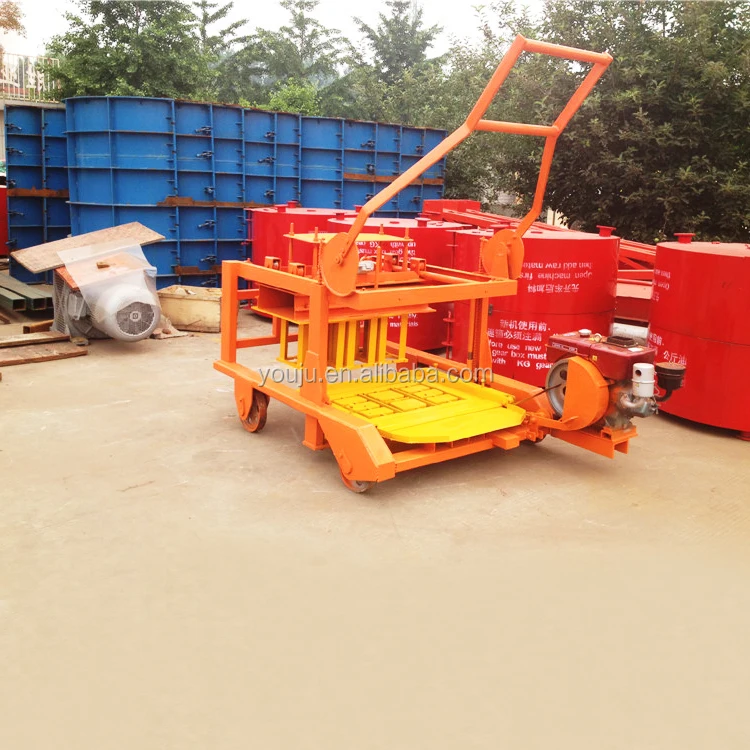
Matched System Planning — the QMR4-45 egg laying press is specified alongside the mixer output, ground curing area and power source so the mobile block machine production line runs without bottlenecks between stations.
Technical Specifications
| Parameter | Value |
|---|---|
| Product Type | Mobile Egg Laying Block Making Machine |
| Model | QMR4-45 |
| Overall Dimensions (L×W×H) | 2420 × 1320 × 1650 mm |
| Moulding Cycle | 40–45 seconds |
| Pallet Requirement | No pallet required (egg laying) |
| Net Weight | 810 kg |
| Rated Power | 6 kW |
| Diesel Engine Option | 6 kW or 6–8 HP |
| Voltage & Frequency | 220V or 380V (frequency to be confirmed) |
| Output Capacity | 3000 pcs/day (basis not stated in source — confirm block format) |
| Mould Formats Included | 400×200×200 mm (4 pcs/mould), 400×150×200 mm (5 pcs/mould), 400×120×200 mm (6 pcs/mould) |
| Automation Level | Semi-automatic |
| Stacking Method | Manual (egg laying on ground) |
| Certification | CE |
| Warranty | One year for the whole machine |
Application Suitability
| Application | Material or Output |
|---|---|
| On-site hollow block production for housing projects | Crushed stone, sand, cement, water |
| Remote construction sites with limited grid power | Diesel-driven pressing with manual batching |
| First-stage block plant for entrepreneurs | Hollow blocks in three standard formats |
| Existing cement product yards adding block output | Egg laying directly on prepared ground |
Why the Curing Area Dictates Your Real Output
A mobile block machine production line only produces as fast as the ground space allows blocks to cure and be moved.
I remember a mobile brick maker shipped to a site in West Africa where the buyer cleared a small patch of ground behind the press. The machine laid blocks steadily for the first hour, then the operator had nowhere to walk without stepping on fresh output. Half the shift was spent relocating hardened blocks by hand before the next pass. The egg laying block machine supporting equipment was never planned, so the press spent more time idle than running. [NEED_CITE: site layout planning for mobile egg laying block production]
How the Press Fits Into the Wider Line
The QMR4-45 eliminates pallet feeding, return and cleaning stations from the layout entirely. That simplification is only useful if the mixer batch size and feed method are timed to the 40–45 second moulding cycle, so the hopper never runs dry between batches. A mobile block machine production line without that timing match turns the press into the slowest station.
Ground Preparation and Curing Logistics
Egg laying means every block cures exactly where it is formed. The curing area must be level, compacted and large enough to hold at least one full day’s output before blocks can be stacked and relocated. The forklift or hand cart capacity on site determines how quickly cured blocks clear the ground for the next shift. [NEED_CITE: ground curing area requirements for egg laying block machines]
Reading the Specs That Actually Matter on Site
The 6 kW rated power and 6–8 HP diesel option are not interchangeable choices — they define whether the rest of the line runs on grid electricity or fuel. A diesel-driven press paired with an electric mixer creates a dependency on two power sources at a remote site. The three mould formats (4 pcs, 5 pcs and 6 pcs per cycle) mean cycle time stays constant while block count per cycle shifts, which directly affects how much ground area each format consumes per hour of operation.
What Happens When the Handling Chain Breaks Down
A buyer who quotes a mobile press without specifying the mixer throughput and ground area ends up with a machine that waits between batches and blocks that pile up faster than they can be moved. The result is a shift where operators spend more time hauling cured stock than running the press. Daily throughput falls well below the figure on the quotation, and the buyer blames the machine rather than the line gap. [NEED_CITE: throughput loss from mismatched line stations in block production]
Why This Supplier Approaches the Line Differently
Block machinery is the single focus here, so the QMR4-45 is never quoted as a standalone press. Machine, mould and handling are specified as one matched system against your actual mix design and local aggregate. Mould design covers the hollow block formats your market actually sells, and custom drawings are available when standard sizes do not fit. Automation level is selectable, meaning you can start with manual stacking and add handling stations later. Installation support includes operator training so your crew understands the cycle-to-curing relationship from day one.
Documentation & Verification
- Line layout showing mixer batch size matched to the 40–45 second moulding cycle
- Capacity calculation stated separately for each of the three hollow block formats
- Mould drawing and format list confirming included and optional block sizes
- Voltage, frequency and control language confirmation recorded before dispatch
- Factory test record on your specified mix and block format prior to shipment
- CE declaration and operation manual supplied with the machine
Installation, Commissioning & Support
- Level compacted ground area sized for at least one day’s egg laid output before relocation
- Electrical supply confirmed at 220V or 380V with frequency matching the destination grid
- Diesel engine option requires on-site fuel storage and engine maintenance schedule
- 810 kg net weight allows transport on a standard flatbed without heavy crane hire
- Mould change procedure trained on site so format switches do not consume shift time
- Wear parts and mould replacement list supplied with the initial shipment
Before You Send the Inquiry
To match the QMR4-45 and its egg laying block machine supporting equipment to your site, we need the hollow block format your market sells, the daily output you are targeting, and whether your site has reliable grid power or requires diesel operation. Ground area dimensions and existing mixer capacity help us confirm the line will not bottleneck at any station.
Frequently Asked Questions
Q: How is daily output verified per block format, and what curing area does egg laying need?
A: Output differs across the three hollow block formats because cycle time is constant while block count per mould changes. We state capacity separately for 400×200×200, 400×150×200 and 400×120×200 mm blocks. The curing area must hold a full day’s production on level ground before blocks are relocated, and its size depends directly on the format you run most often.
Q: How does diesel versus electric drive affect the rest of the line?
A: A diesel-driven QMR4-45 removes the electrical upgrade as a bottleneck for the press, but the mixer, water pump and any feed conveyors still need power. If those remain electric, the site must supply both fuel and grid connection. We confirm the full power picture across every station before the line is finalised.
Q: What supporting equipment must match the 40–45 second moulding cycle?
A: The mixer must deliver a fresh batch to the hopper within the moulding cycle so the press never idles waiting for material. Manual feed methods work at lower volumes, while a small conveyor or skip hoist keeps pace at higher output. We calculate mixer capacity against your chosen block format to confirm the match.
Q: How is voltage and frequency confirmed before shipment?
A: We record your site voltage, frequency in hertz and preferred control language during the confirmation stage before production begins. This prevents commissioning delays caused by incompatible motors or unreadable displays once the machine arrives on your site.
Q: What mould formats are included, and how long does a mould change take?
A: The standard quotation covers the three hollow block sizes listed in the specifications. Mould change time on site depends on operator familiarity after training. We supply the mould drawing and format list with the quotation so you know exactly which sizes ship with the machine and which are optional additions.


