
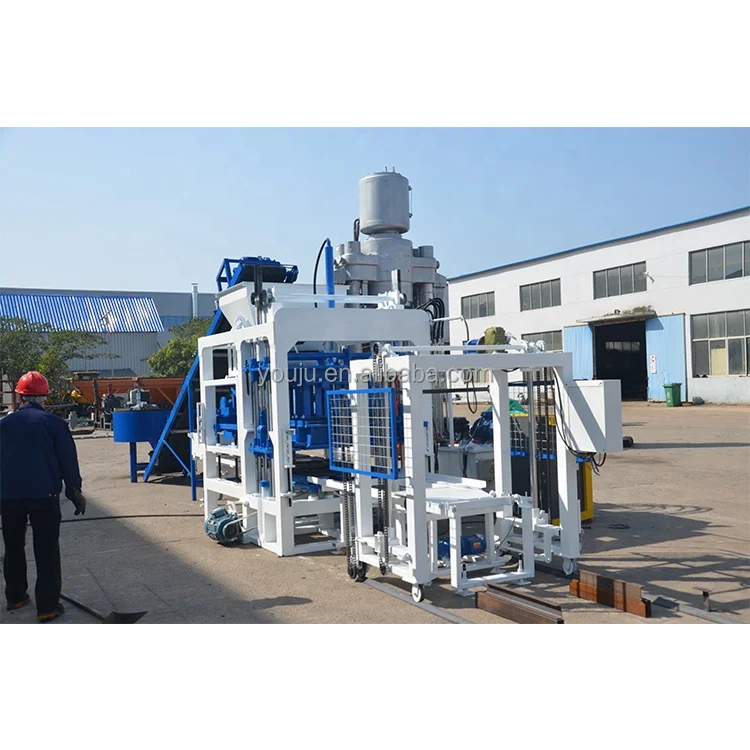
Integrated line coordination — Mixer output, conveyor speed, and press cycle are calculated together so the QT4-18 never sits idle waiting for material or pallets.
Technical Specifications
| Parameter | Value |
|---|---|
| Model | QT4-18 |
| Product Type | Automatic Concrete Block Making Machine |
| Overall Dimensions | 2500 × 1750 × 2200 mm |
| Rated Pressure | 16 MPa |
| Vibration Form | Platform Vibration |
| Pallet Size | 950 × 550 mm |
| Molding Cycle | 18–25 s (basis to be confirmed) |
| Overall Power | 27.5 kW |
| Control System | PLC control with frequency converter |
| Electrical Components | Schneider brand |
| Mold Lifting Mechanism | Double-sided synchronous gears |
| Material Feeder | Distribution belt hopper |
| Supporting Equipment | JQ500 concrete pan mixer, 8 m belt conveyor (6 m optional), stacker, block clamper, trolley |
| Optional Equipment | Cement silo, batching plant |
| Assembly State | Requires foundation preparation and installation |
Application Suitability
| Application | Material or Output |
|---|---|
| Hollow block production | Crushed stone, sand, cement, and lightweight aggregates |
| Solid block production | Dense aggregates with standard cement ratios |
| Paving block production | Fine aggregate mixes with higher cement content for surface durability |
| Construction contractor on-site plants | Portable raw material feeds with locally sourced sand and gravel |
What the Molding Cycle Figure Does Not Tell You About Daily Output
Cycle time alone does not determine what leaves the curing yard each day.
A buyer I worked with specified a machine based on an 18-second cycle quoted in a brochure. The figure assumed solid blocks, but the plant ran hollow blocks all day — the actual output dropped nearly in half because the vibration and stripping phases take longer for hollow formats [NEED_CITE: block format impact on effective cycle time]. When the press, mixer, and stacker are not balanced around your specific format, the bottleneck simply shifts downstream. The QT4-18 automatic block making machine production line addresses this by stating the assumed block format in the capacity calculation before the order is placed.
How the Stations Connect Across the QT4-18 Line
The JQ500 pan mixer feeds into the 8-meter belt conveyor, which delivers mixed material to the distribution belt hopper above the press. Each station’s throughput must match the molding cycle so that the press completes one mold and the next batch of material is already in position. When the conveyor is too slow or the mixer batch size too small, the press waits — and that idle time accumulates across a full shift. This automatic block making machine production line specifies each station’s capacity relative to the target block format, not a generic catalogue figure.
Pallet Flow and Why It Controls the Real Output Ceiling
After pressing, wet blocks on pallets move to the stacker, then to the curing area via trolley. The 950 × 550 mm pallet size determines how many blocks fit per mold and how the curing racks must be configured [NEED_CITE: pallet size compatibility with curing rack systems]. If the pallet dimensions do not match the buyer’s existing forklift or curing yard layout, blocks end up stacked by hand — cancelling out the automation investment. The line layout drawing provided before shipment shows station spacing and pallet flow paths so the buyer can verify clearance and handling equipment compatibility on site.
Reading the Core Specifications in Context
The 16 MPa rated hydraulic pressure works together with platform vibration to compact the mix into the mold cavity. For hollow blocks, insufficient pressure leaves thin webs that crack during stripping, while excessive pressure on a dry mix causes premature wear on the mold liner. The double-sided synchronous gear mechanism for mold lifting keeps the upper and lower mold halves aligned during the stripping phase, reducing edge chipping on the finished block. The PLC control with frequency converter allows the vibration duration and intensity to be adjusted per mix design — a lean mix with more coarse aggregate needs longer vibration than a rich paving mix. Schneider electrical components are specified for the control panel, meaning replacement contactors and relays are available through standard industrial distributors in most export markets rather than requiring a proprietary supply chain.
The Hidden Cost of Sizing Only the Press
When buyers focus on the press specification and treat the mixer, conveyor, and stacker as afterthoughts, the result is a line that technically runs but never reaches its nameplate capacity. An undersized mixer forces the operator to wait between batches. A conveyor that is too short requires manual wheelbarrow feeding. A missing stacker means two workers spend the entire shift moving pallets by hand [NEED_CITE: labor allocation in semi-automatic block plants]. These gaps are not visible in a quotation that lists only the press — they appear on the first day of production when the daily tally falls short of the target.
Why Source the Complete Line From One Supplier
Block machinery is our single focus, so the QT4-18 press, JQ500 mixer, belt conveyor, and stacker are specified as one matched system rather than assembled from separate vendors. The configuration is set against the buyer’s actual mix design, local aggregate gradation, and target block format — not a catalogue default. Mould design covers the formats the buyer’s market sells, and custom mould drawings are available when standard options do not match local demand. Voltage, frequency, and PLC display language are confirmed before production begins, avoiding commissioning delays after the container arrives. Installation support includes on-site operator training covering mould change procedures, daily maintenance checkpoints, and mix adjustment for different block formats.
Documentation & Verification
- Line layout drawing showing station spacing and material flow for the QT4-18 configuration
- Capacity calculation stating the specific block format assumed for the 18–25 s molding cycle
- Hydraulic and electrical schematic with Schneider component references for local sourcing
- Voltage, frequency, and PLC display language confirmation document before shipment
- Factory test record on the buyer’s specified block format before container loading
Installation, Commissioning & Support
- Foundation drawing with levelness tolerances and cement pouring specifications for the 2500 × 1750 mm machine footprint
- Dedicated 27.5 kW power circuit with voltage and frequency matching confirmed before dispatch
- Machine arrives in dismantled state requiring on-site assembly, alignment, and mold installation
- Commissioning includes first-run parameter adjustment for the buyer’s local aggregate and mix design
- Operator training covers PLC interface navigation, mold change sequence, and double-sided gear mechanism maintenance
- Wear parts list with hydraulic seal and gear specifications for local reorder planning
What to Include With Your Inquiry
Send the target block format and dimensions, daily output requirement, and the type of aggregate available locally. Include the workshop floor area, ceiling height, and existing voltage and frequency at the site. If you already operate a mixer or curing racks, provide their specifications so the conveyor length and pallet size can be matched to your current setup.
Frequently Asked Questions
Q: How do I verify the QT4-18 daily output is realistic for my block format?
A: The 18–25 second molding cycle varies depending on whether you run hollow, solid, or paving blocks. Request a capacity calculation that names your exact block dimensions and mix type. The quotation should state the assumed format so you can compare it against your actual production target rather than relying on a generic cycles-per-hour figure.
Q: What supporting equipment must be included to prevent the press from idling?
A: The JQ500 pan mixer, belt conveyor, and distribution hopper must deliver mixed material at a rate that matches the press cycle. The stacker and trolley must clear finished pallets before the next mold is ready. A line layout drawing shows how these stations connect and where material accumulates if any station is undersized.
Q: Can I start with a basic configuration and add automation later?
A: The QT4-18 supports a semi-automatic start with manual pallet handling, and automatic stacking or pallet feeding can be added as separate stations afterward. The PLC control system and frequency converter are already in place, so adding automation modules requires field wiring and parameter updates rather than a full control replacement.
Q: What foundation and power requirements should I prepare before delivery?
A: The machine requires a level concrete foundation matching the footprint dimensions, with anchor bolt positions shown on the supplied drawing. A dedicated power circuit must match the confirmed voltage and frequency, and the 27.5 kW total load must be accounted for in the site’s electrical panel capacity.


