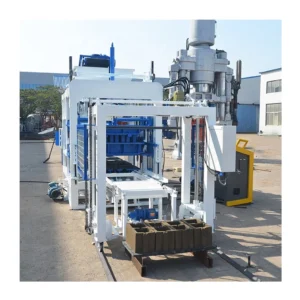
Integrated Block Line Configuration — Every station from the JS500 mixer through the automatic stacker is specified as one matched system against the QT6-15 cycle time, so the press never waits on upstream or downstream equipment.
Technical Specifications
| Parameter | Value |
|---|---|
| Model | QT6-15 |
| Product Type | Automatic Concrete Block Making Machine |
| Molding Method | Vibration and hydraulic pressing |
| Rated Hydraulic Pressure | 21 MPa |
| Molding Cycle | 15 s – 20 s |
| Pallet Size | 900 × 700 mm |
| Main Machine Weight | 6,000 kg |
| Output — Hollow Block 400×200×200 mm | 1,440 pcs/h (11,520 pcs / 8 h shift) |
| Output — Paving Brick 200×100×60 mm | 5,040 pcs/h (40,320 pcs / 8 h shift) |
| Output — Solid Brick 240×115×53 mm | 7,680 pcs/h (61,440 pcs / 8 h shift) |
| Compatible Raw Materials | Cement, sand, fly ash, stone powder, slag |
| Supporting Equipment Options | JS500 mixer, 8 m conveyor belt, automatic stacker, cement silo, screw conveyor, cement scale, batching machine, pallet loader, block and pallet separator |
| Voltage | Customizable to local voltage |
| Warranty | 1 year (excluding wearing parts) |
Application Suitability
| Application | Material or Output |
|---|---|
| Hollow block masonry for residential and commercial walls | Crushed stone, sand, cement and fly ash blends |
| Paving brick for driveways, walkways and public plazas | Fine aggregate with pigment for color pavement bricks |
| Solid brick for load-bearing partitions | High-density cement and stone powder mixes |
| Interlocking brick for retaining walls and landscaping | Graduated aggregate with controlled moisture content |
| Curbstone for road and kerb construction | Coarse aggregate with reinforced vibration pressing |
What "1440 Pieces per Hour" Actually Means for Your Block Production Line Equipment
The figure only holds when the mixer, conveyor and stacker all match the press cycle — and when the block format stays at 400×200×200 mm hollow.
I have stood next to concrete block making line setups where the press cycled perfectly every 18 seconds, but the JS500 mixer discharged a batch only every 45 seconds. The stacker sat idle half the shift. Real daily output collapsed to barely a third of the quoted number. A concrete block making line is only as fast as its slowest station, and the quotation rarely spells out which block format the hourly figure assumes [NEED_CITE: common mismatch between quoted cycle capacity and actual daily output in block production]. Before you compare machines, ask for a station-by-station cycle time table tied to your target block format.
Matching Every Station to the Press Cycle
The QT6-15 completes a molding cycle in 15 to 20 seconds, which sets the pace the rest of the concrete block making line must follow. The JS500 mixer is sized so a fresh batch reaches the hopper before the press calls for it, and the 8 m belt conveyor is angled and speeded to keep the feed bin topped up without overflow. When these three stations are specified together, the block production line equipment runs without the micro-stops that quietly erode daily tonnage.
Pallet Flow and Curing Rack Alignment
The 900 × 700 mm pallet size is not an arbitrary choice — it must match the curing rack spacing and the forklift tine width already on site. If pallets arrive and the curing racks were built for a different dimension, blocks stack by hand on the floor and the automatic stacker becomes an expensive platform. We confirm pallet dimensions, rack slot pitch and forklift capacity before the QT6-15 enters production, so the concrete block making line delivers cured racks ready for transport instead of a bottleneck at the curing yard [NEED_CITE: pallet size compatibility with existing curing infrastructure in block plants].
Reading the Pressure and Vibration Numbers
Rated hydraulic pressure at 21 MPa works together with the vibration motor to compact the mix into a dense, consistent block. Higher pressure alone does not guarantee strength — if the mix is too dry, vibration cannot distribute particles evenly; if too wet, hydraulic squeeze-out causes weak edges. The right setting depends on the local aggregate gradation and cement ratio the buyer actually sources, not a catalogue default. Pallet weight after pressing and green block compressive strength at 24 hours are the two shop-floor indicators that the pressure-vibration balance is correct for a given mix [NEED_CITE: relationship between hydraulic pressure, vibration force and concrete block compressive strength].
When the Line Configuration Costs More Than the Machine
A buyer once specified only the QT6-15 press, assuming the mixer and pallet handling were "standard." They arrived at the site to find the quotation covered the press alone. Hand-carrying 900 × 700 mm pallets loaded with wet blocks quickly exhausted the crew, and daily output stalled well before the press reached its cycle count. Adding batching, pallet loading and block-pallet separation after the fact meant re-routing power, re-pouring foundations and waiting weeks for retrofitted components — costs that would have stayed inside the original budget if the full line had been scoped upfront [NEED_CITE: hidden cost of excluding pallet handling and stacking from block machine quotations].
Why Source the Whole Line Here
Block machinery is the single production focus, so the QT6-15, its moulds, pallets and every handling station are engineered as one system rather than assembled from separate suppliers. The configuration is built around the buyer’s actual mix design and local aggregate, not a generic catalogue page. Automation level is selectable: a plant can start with the JS500 mixer, 8 m conveyor and automatic stacker, then bolt on a cement silo, batching machine and pallet loader as volume grows. Mould design covers hollow, paving, solid and interlocking formats on the same 900 × 700 mm pallet, giving format flexibility without a second press. Installation, commissioning and operator training are delivered on site so the crew knows the machine before the engineer leaves.
Documentation & Verification
- Line layout with capacity calculation stating the block format assumed for each output tier figure
- Machine specification sheet with hydraulic and electrical schematic for the 21 MPa circuit
- Mould drawing and format list covering hollow, paving, solid and interlocking brick
- Pallet specification confirmed against the buyer’s existing curing rack and forklift dimensions
- Voltage, frequency and PLC display language confirmation sheet before production release
- Factory test record on the buyer’s chosen mix before dispatch
Installation, Commissioning & Support
- Foundation plan drawn for the 6,000 kg main machine weight and vibration isolation pads
- Dedicated power circuit sized for the press and all supporting motors at the confirmed local voltage
- Machine dismantled into container-load sections with marked reassembly drawings
- On-site commissioning with cycle time verification across mixer, conveyor, press and stacker
- Operator training covering mould change procedure and daily maintenance checkpoints
- Wear parts list and first-shipment spare package including hydraulic seals and vibration rubbers
What to Send with Your Inquiry
Tell us the block formats your market sells, the daily output you need per format, and the raw materials available within hauling distance of your site. Include your existing curing rack dimensions and forklift model so the 900 × 700 mm pallet can be verified before the block production line equipment enters build. Confirm local voltage, frequency and preferred control language to keep commissioning on schedule.
Frequently Asked Questions
Q: How are cycle times across mixer, conveyor, press and stacker matched so no station becomes the bottleneck?
A: Each station is specified against the QT6-15 molding cycle of 15 to 20 seconds. The JS500 mixer discharge interval, belt conveyor speed, and stacker indexing rate are all calculated so the press never waits. We supply a station-by-station timing chart with the line layout.
Q: What pallet size and material are specified, and does it fit my existing curing area and forklift?
A: The line uses 900 × 700 mm pallets. We confirm pallet material — bamboo, PVC or steel — against your curing temperature and humidity, and check the dimensions against your existing rack slot pitch and forklift tine width before production begins.
Q: Which supporting equipment stations are included in the quotation and which are optional add-ons?
A: The base quotation covers the QT6-15 press, JS500 mixer, 8 m conveyor belt and automatic stacker. Cement silo, screw conveyor, cement scale, batching machine, pallet loader and block-pallet separator are optional and can be added individually or as a package.
Q: Can I start with a simple line and add automatic batching and pallet loading later?
A: Yes. The QT6-15 is configured so the JS500 mixer, conveyor and stacker form a working line on their own. Pallet loader, batching machine and separator bolt on with the same control interface, so the concrete block making line grows without a full rewiring or foundation change.
Q: What block format is assumed in the capacity calculation, and how does output change when I switch moulds?
A: The quoted hourly figures assume specific block sizes — 400×200×200 mm hollow, 200×100×60 mm paving or 240×115×53 mm solid. When you switch to a different format, the molding cycle and cavity count change, so we provide a revised capacity table tied to the format you actually sell.