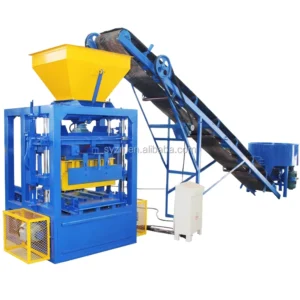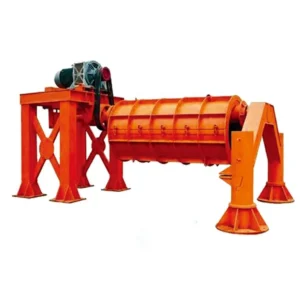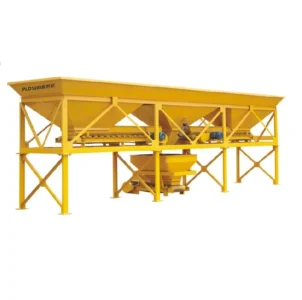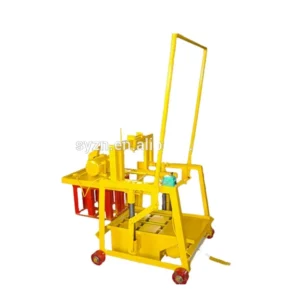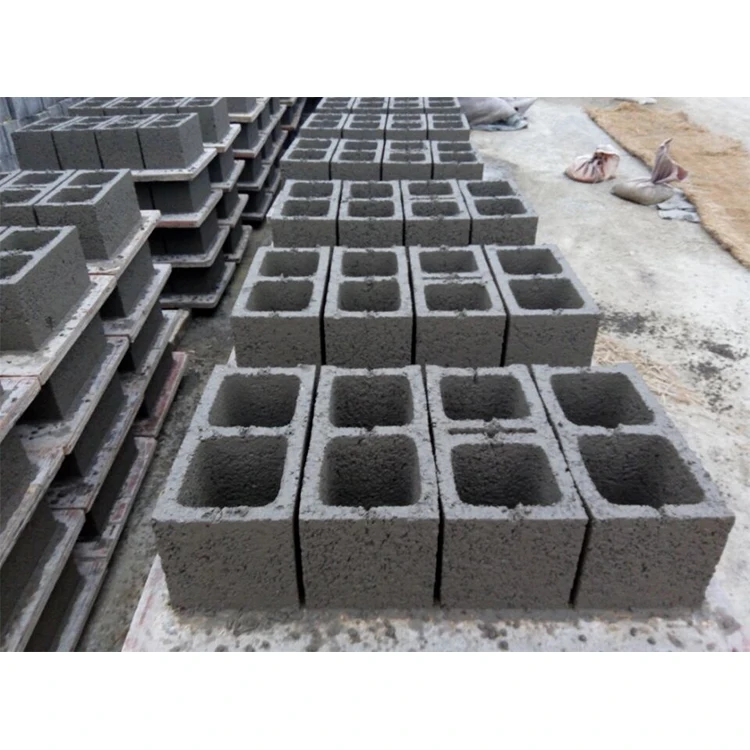
Matched System Lineup — the QTJ4-26 press is specified alongside mixer output, pallet feed rate and curing layout so no station starves the next.
Technical Specifications
| Parameter | Value |
|---|---|
| Product Type | Small Scale Concrete Block Making Machine |
| Model | QTJ4-26 |
| Overall Dimensions (L×W×H) | 2060 × 1700 × 2650 mm |
| Rated Vibration Force | 35.5 kN |
| Vibration Form | Platform vibration |
| Vibration Frequency | 4200 r/min |
| Pallet Size | 900 × 450 mm |
| Molding Cycle | 26 s (basis not stated in source — confirm block format and material) |
| Overall Power | 12.75 kW |
| Total Mass | 3600 kg |
| Demolding Method | Vibration |
| Recommended Factory Area | 260 m² |
| Applied Products | Hollow block, solid block, paver, interlocking block, kerbstone, colored paver |
| Raw Materials | Crushed stone, sand, cement, fly ash, gravel, slag, dust |
| Automation Level | Semi-automatic |
| Warranty | 1 year |
Application Suitability
| Application | Material or Output |
|---|---|
| Hollow block production for low-rise masonry | Crushed stone, sand and cement with fly ash replacement |
| Solid block production for load-bearing walls | Gravel, sand and cement at higher density |
| Paver and interlocking block for driveways and walkways | Fine aggregate with cement and pigment |
| Kerbstone for road edge detailing | Coarse aggregate with cement under extended cycle |
| On-site block production by building contractors | Locally sourced aggregate and sand |
What a "26-Second Cycle" Actually Means on a Full Line
A press cycle only delivers daily output when every upstream and downstream station is timed to match it.
In the field, I have watched QTJ4-26 lines stall because the pan mixer could not discharge fast enough, leaving the press idle for minutes at a time while workers waited for the next batch. Other times, pallets run short because the curing rack area is too small to release them back to the feeder in time [NEED_CITE: line cycle balance principles for small block plants]. A realistic small scale block production line turnkey calculation must state the block format assumed, the mixer batch size, the pallet count in circulation and the curing rack capacity — otherwise the 26-second figure stays on paper.
Balancing Every Station Around the Press
A small scale block production line turnkey layout starts with the press at the center and works outward. The mixer must deliver a batch within the time the press consumes the previous one, the pallet feeder must return a clean pallet before the next mold closes, and the stacking area must clear finished blocks before they block the exit path. When any one of these stations is undersized, the press waits and actual output drops well below the quoted figure.
Pallet Circulation as the Hidden Constraint
The 900 × 450 mm pallet is the unit that travels through every station. In a semi-automatic setup, pallets are handled manually between the press exit and the curing racks. If the curing area cannot hold enough pallets to cover the full curing time, pallets do not return to the feeder fast enough. Planning the pallet count requires knowing the curing duration, the rack footprint and the shift length — variables that change from site to site and must be stated in the line calculation [NEED_CITE: pallet circulation planning for concrete block curing].
How Vibration and Pressure Shape Block Density
The platform vibration at 4200 r/min combined with 35.5 kN of force compacts the mix inside the mold. For lightweight hollow blocks made with fly ash, this level of vibration is generally adequate. For solid blocks with coarse gravel, the same force may not achieve the density needed for load-bearing applications, requiring either a longer cycle or a mix adjustment. The vibration setting must therefore be matched to the buyer’s specific aggregate and target block format rather than left at a factory default.
The Cost of a Line That Does Not Talk to Itself
When the mixer and press are sourced from different suppliers with no single party responsible for line balance, the gap between stations becomes the buyer’s problem. Mixer discharge height may not match the press hopper inlet, forcing a manual transfer step that slows every cycle. Pallet dimensions ordered separately may not fit the press rails, requiring on-site fabrication. These integration failures do not show up in individual machine specifications but they consume real production hours every shift [NEED_CITE: equipment integration failures in small block plants].
Why a Matched Line Matters Here
Block machinery is our single focus, so the QTJ4-26 press, its mold, pallets and supporting handling equipment are specified as one system rather than assembled from separate quotes. We set the configuration against your actual mix design and local aggregate, not a catalog default. Pallet size and material are chosen with your curing area and forklift in mind. Voltage, frequency and control language are confirmed before production so commissioning is not delayed after arrival. A line layout drawing shows every station from raw material in to cured blocks out, with capacity stated per block format.
Documentation & Verification
- Line layout drawing with mixer, pallet feeder and press positions for QTJ4-26
- Capacity calculation stating block format assumed for the 26-second cycle
- Pallet specification sheet confirming 900 × 450 mm size, material and load rating
- Voltage and control language confirmation record signed before production
- Factory test record on your target block format before dispatch
- Packing photographs showing dismantling points for container loading
Installation, Commissioning & Support
- 260 m² factory area with level concrete floor to support 3600 kg press mass
- Electrical supply matched to 12.75 kW total line load with dedicated circuit breaker
- Press shipped partially assembled with mold and platform vibration unit pre-fitted
- On-site commissioning includes cycle timing verification across mixer, feeder and press
- Operator training covers mold change procedure and vibration adjustment for local mix
- Wear parts list covering vibration springs, mold liners and pallet guide rails
Before You Request a Line Quote
Tell us the block format you plan to produce most, the daily output you need and the raw materials available at your site. Share your existing curing area dimensions and any forklift or pallet racks already on hand. Confirm your local voltage and frequency so the line electrical panel is built correctly before shipment.
Frequently Asked Questions
Q: How is daily output calculated for the QTJ4-26, and which block format does the cycle assume?
A: Daily output depends on the block format produced because each mold fills and compacts differently. A 26-second cycle on a small hollow block yields more pieces per shift than the same cycle on a large solid block. We provide a written capacity calculation that names the exact format, mixer batch time and pallet circulation count so you can verify the figure before ordering.
Q: What supporting equipment is needed around the press to avoid idle time?
A: The mixer must discharge a fresh batch before the press hopper empties, the pallet feeder must return cured pallets on time, and the stacking area must clear finished blocks continuously. We specify mixer capacity, pallet count and rack layout so each station’s cycle matches the press and no station waits on another.
Q: How should I choose pallet size and material for my curing setup?
A: The 900 × 450 mm pallet must fit your curing racks and be liftable by your forklift. Wooden pallets are lighter but wear faster under vibration; bamboo or PVC pallets last longer but cost more upfront. We match pallet material to your shift volume and curing environment so replacements are not needed prematurely.
Q: What electrical supply does the complete line require before shipment?
A: The QTJ4-26 line draws 12.75 kW across the press, mixer and feeder motors. Voltage, frequency and control panel language must match your site supply exactly. We confirm these values in writing before production begins so the line arrives ready for connection without on-site electrical modification.
Q: Can I start with the press only and add automation later?
A: Yes. The QTJ4-26 can run as a standalone press with manual pallet handling, and pallet feeding or stacking stations can be added later as production volume grows. We design the line layout with future station positions reserved so upgrades do not require relocating the press or re-pouring foundations.