
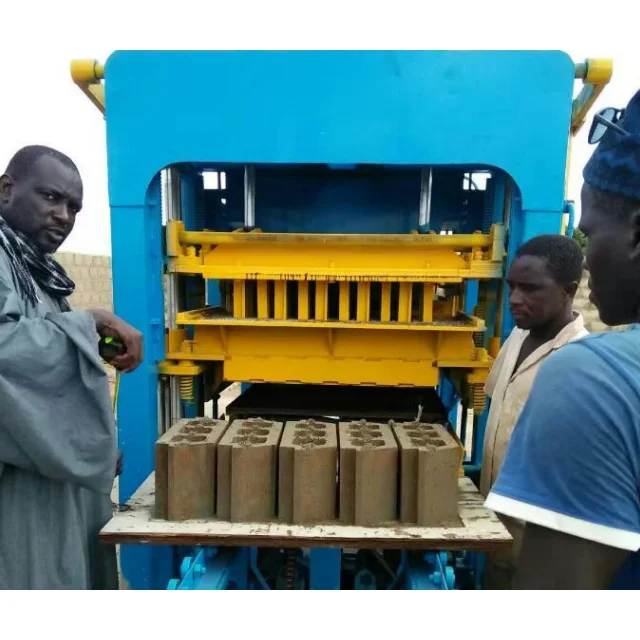
Matched Line Stations — every conveyor, pallet feeder and curing rack is sized against the QT4-15 press cycle so no station waits on another.
Technical Specifications
| Parameter | Value |
|---|---|
| Model | QT4-15 |
| Product Type | Automatic Concrete Block Making Machine |
| Overall Dimensions (L×W×H) | 7100 x 1600 x 2610 mm |
| Rated Pressure | 16 MPa |
| Vibration Form | Platform Vibration |
| Pallet Size | 1020 x 570 mm |
| Molding Cycle | 15–25 s (basis not stated in source — confirm block format / material / thickness) |
| Overall Power | 27.5 kW |
| Control System | PLC (electronic console) |
| Automation Level | Automatic (pallet feeder, material feeder, block conveyor integrated) |
| Line Components | Mixer, pallet conveyor, molding machine, block conveyor, hydraulic station, electronic console (PLC) |
| Mould Format Options | Hollow block, interlocking paver, paving block |
| Mould Change Method | Manual bolt removal (M24 side bolts, upper mould bolts) |
| Stacking Method | Manual or machinery convey to curing yard |
Application Suitability
| Application | Material or Output |
|---|---|
| Hollow block production for building walls | Crushed stone, sand, cement and water mix |
| Interlocking paver production for driveways and walkways | Fine aggregate with cement binder |
| Solid paving block manufacturing | Coarse aggregate blended with cement |
| Medium-capacity block yard operation | Automated pallet feeding with manual stacking option |
Why "Cycle Time" Means Nothing Without the Rest of the Line
A press that completes a cycle every 15–25 seconds is only as fast as the slowest station feeding it or clearing its output.
Buyers often compare block machines on molding cycle alone, then discover that pallet feeding, material delivery and block conveying were never part of the quotation. The press sits idle while an operator drags pallets into position by hand, or finished blocks pile up on the conveyor because no one budgeted for a receiver table. I have watched entire concrete block production line turnkey projects stall at the press because the pallet recycle path was an afterthought [NEED_CITE: common causes of block line commissioning delays]. The real question is whether every station from mixer to curing yard has been sized so the press never waits.
How the Pallet Feeder Keeps the Press Cycle Honest
The hydraulic-driven pallet feeder on this line pushes a fresh pallet onto the vibrating platform and ejects the finished block onto the conveyor in one stroke. That single motion synchronises pallet recycle with the press cycle, removing the operator from the most repetitive and timing-critical task on the floor. When pallet feed falls out of sync, the press either idles or the mould closes on a misaligned pallet, damaging both the mould and the block.
Where the Block Conveyor Ends Determines Your Real Output
The motor-driven block receiver with idler wheels moves finished product clear of the press so the next cycle is not delayed by manual clearing. But the conveyor is only useful if someone has planned what happens at its far end — whether blocks transfer to curing racks, how the forklift accesses them, and how empty pallets return to the feeder. On a concrete block production line turnkey project, these hand-off points are where capacity calculations either hold up or collapse [NEED_CITE: block plant layout and curing yard spacing standards].
Reading the Specs That Actually Shape Your Line
The 16 MPa rated pressure and platform vibration work together to compact the mix. Higher pressure without sufficient vibration leaves voids inside the block; vibration without adequate pressure produces a block that crumbles before curing. The mix design and local aggregate must be matched to these two forces, not assumed from a catalogue default.
The 1020 x 570 mm pallet size determines how many blocks fit per cycle, but it also dictates the curing rack spacing and the forklift tine width you need on site. Choosing a pallet from a brochure without checking your existing curing area leads to costly rack modifications after the line arrives.
The 27.5 kW overall power draw covers mixer, hydraulic station, conveyor motors and the PLC console. The electrical supply must be confirmed for voltage and frequency before production starts — a mismatch delays commissioning by weeks, not days.
The PLC control console manages cycle sequencing across all stations, but the display language must be confirmed before dispatch. An operator staring at alarm codes in a language they cannot read turns a minor fault into a full shift of downtime.
The Cost of Leaving Stations Out of the Quotation
When pallet handling and stacking are excluded from the line quotation, the buyer discovers after arrival that output is stacked by hand at the end of the conveyor. Labour costs climb, and the press cycle slows to match the speed of the slowest manual station. I have seen yards where the curing yard layout was never drawn, so pallets were carried across a muddy lot by wheelbarrow — turning a 25-second press cycle into a five-minute round trip [NEED_CITE: manual handling bottlenecks in block production].
Why Source the Full Line From One Specification Point
Machine, mould, pallet and handling are specified as one matched system rather than assembled from separate suppliers, so cycle times align across every station from day one.
The line layout is set against your actual mix design and local aggregate, not a catalogue default, which means hydraulic pressure and vibration force are tuned to the material you can actually source.
Mould design covers the block formats your market sells, with custom drawings available when standard formats do not match local demand.
Automation level is selectable — the QT4-15 integrates automatic pallet feeding and block conveying, and stacking can be added later as volume grows.
Installation and commissioning support includes operator training on the PLC console and mould change procedure, so the line reaches stable production without extended trial-and-error.
Documentation & Verification
- Line layout drawing showing station spacing, pallet recycle path and curing yard area for the QT4-15 footprint
- Capacity calculation stating which hollow block or paver format the daily output assumes
- Mould drawing and format list confirming cavity count per pallet for each block type
- Voltage, frequency and PLC display language confirmation sheet before dispatch
- Factory test record run on the buyer’s specified pallet size and mould format
- Hydraulic and electrical schematic for on-site troubleshooting after commissioning
Installation, Commissioning & Support
- Foundation plan sized to the 7100 x 1600 mm press footprint and vibration load
- Dedicated electrical circuit rated for 27.5 kW overall draw with voltage confirmation
- Station-by-station alignment of mixer, pallet feeder, press and conveyor during assembly
- PLC parameter setting and cycle timing verification across all line components on first run
- Operator training on M24 bolt mould change procedure and pallet feeder timing
- Wear parts list covering hydraulic seals and vibration components with reorder intervals
What to Include With Your Inquiry
Share the block formats you sell most — hollow, interlocking or paving — along with your target daily output and the raw materials available locally. Include your workshop dimensions, curing yard area, and the forklift model you already use, so pallet size and conveyor length are matched to your site. Confirm your local voltage, frequency and preferred PLC display language to avoid delays after the equipment arrives.
Frequently Asked Questions
Q: How is line capacity verified when pallet feeding, press cycle and conveyor speed must all match?
A: Each station is timed against the QT4-15 molding cycle during factory testing. The pallet feeder stroke, material fill duration and conveyor transfer speed are recorded together, not in isolation. A capacity calculation is then issued stating the specific block format assumed, so daily output reflects the product you actually manufacture rather than a theoretical maximum.
Q: What happens at the block conveyor end — is stacking and curing rack handling included?
A: The standard line delivers finished blocks to the conveyor end via motor-driven idler wheels. Stacking method is specified during quotation as either manual transfer or machinery-assisted convey to the curing yard. Curing rack spacing is designed around your pallet size and forklift, so the hand-off from conveyor to rack is planned before the line ships.
Q: How is the installation foundation designed so mixer, press and conveyor do not interfere?
A: An installation plane layout is drawn showing the 7100 x 1600 mm press footprint, mixer position, pallet feed path and conveyor route. Station spacing accounts for operator walkways and forklift turning radius. The foundation specification addresses the vibration load from platform vibration and the static load of the hydraulic station to prevent settling that would misalign stations.
Q: Can pallet size be matched to the curing area and forklift already on site?
A: Yes. The standard 1020 x 570 mm pallet is a starting point, not a fixed choice. During quotation we confirm your curing rack dimensions, forklift tine width and yard layout. The pallet size and material are then selected so finished blocks move from press to curing rack without requiring new racks or a different forklift.
Q: What is the voltage, frequency and PLC language confirmation process before the line ships?
A: Before production begins, a confirmation sheet listing your site voltage, frequency and preferred PLC display language is signed off. The electronic console is configured and tested at those settings during the factory run. This prevents the common situation where a line arrives on site and commissioning is delayed because the control panel displays alarms in an unfamiliar language.


