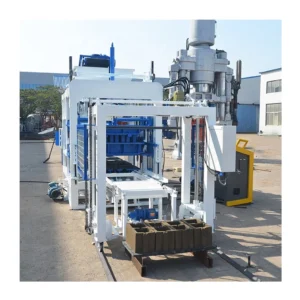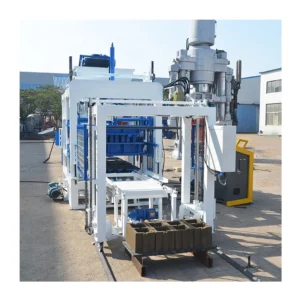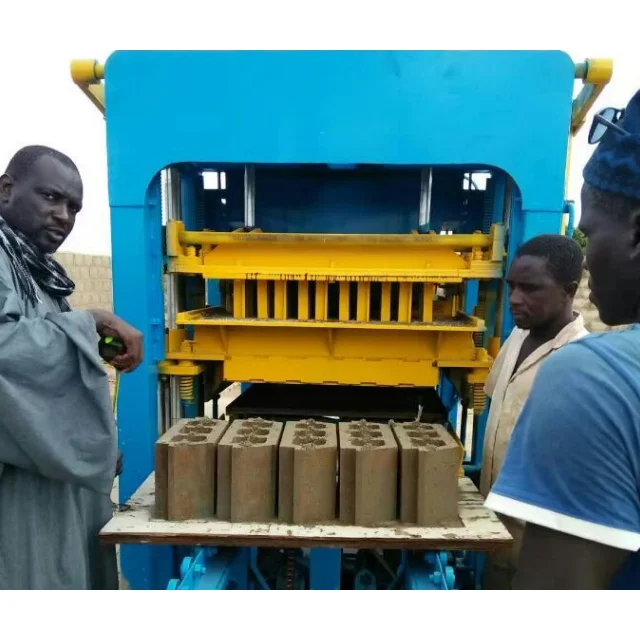
Line-Synchronized Cycle Match — The QT4-15 press cycle is timed against the mixer discharge and pallet conveyor feed rate so no station sits idle during continuous production.
Technical Specifications
| Parameter | Value |
|---|---|
| Model | QT4-15 |
| Product Type | Automatic Concrete Block Making Machine |
| Overall Dimensions (L×W×H) | 7100 × 1600 × 2610 mm |
| Rated Hydraulic Pressure | 16 MPa |
| Vibration Form | Platform Vibration |
| Pallet Size | 1020 × 570 mm |
| Molding Cycle | 15–25 s (basis not stated in source — confirm block format, material, and thickness) |
| Overall Power | 27.5 kW |
| Control System | PLC Electronic Console |
| Line Components | Mixer, Pallet Conveyor, Molding Machine, Block Conveyor, Hydraulic Station, Electronic Console |
| Automation Level | Automatic (hydro-cylinder pallet feed, material feeder with hopper and feeding box, motor-driven block receiver) |
| Block Formats Supported | Hollow block, interlocking block, paving block (basis not stated in source — confirm mould list and per-format capacity) |
| Mould Change Method | Manual bolt removal and repositioning using pallets and forklift (mould change time not stated in source) |
| Block Output Handling | Conveyed to front idler wheels, then transported to curing yard manually or by machinery |
Application Suitability
| Application | Material or Output |
|---|---|
| Hollow block production for masonry walls | Crushed stone, sand, cement, and water mix |
| Interlocking brick manufacturing for paving and retaining walls | Fine aggregate with cement binder |
| Paving block production for walkways and yards | Coarse aggregate blended with cement and pigment |
| Fixed-plant block line for construction contractors | Continuous output from raw material mixing through curing yard delivery |
| On-site concrete product manufacturing | Locally sourced aggregate matched to regional strength requirements |
Why the Line Stops When One Station Lags Behind
A block press only runs as fast as its slowest supporting station allows.
When buyers compare an automatic block making machine production line on paper, the quoted cycle time almost always refers to the press alone. The mixer takes longer to discharge a batch than the press needs to consume it. The pallet conveyor hesitates because the hydro-cylinder timing was never matched to the demould stroke. Finished blocks pile up at the receiver because nobody specified what happens after the idler wheels [NEED_CITE: typical bottleneck analysis in concrete block production lines]. The result is a line that technically runs at the rated cycle but produces far fewer saleable blocks over a full shift.
How Each Station Feeds the Next Without Dead Time
The QT4-15 line is specified as a sequence of stations where output from one becomes input to the next. The mixer discharges into the material feeder hopper, which meters concrete into the feeding box above the mould cavity. The hydro-cylinder pushes a fresh pallet onto the vibrating platform at the exact moment the finished block is ejected onto the block receiver conveyor. This synchronization is the core of what makes an automatic block making machine production line function as a single system rather than a collection of independent machines.
Where Cycle-Time Mismatches Show Up on the Floor
The most common mismatch appears between the pallet conveyor and the press. If the hydro-cylinder extends too early, the pallet collides with the mould before it has fully lifted. Too late, and the press sits through an empty cycle waiting for the platform to load. The material feeder faces a similar constraint: the feeding box must traverse the mould cavity and return before the vibration sequence begins, otherwise the fill is uneven and block density varies across the pallet [NEED_CITE: vibration timing and material fill consistency in hydraulic block presses]. Every one of these timings must be set during commissioning against the actual mix design the buyer intends to run.
What the Pressure and Vibration Numbers Mean for Block Density
The 16 MPa rated hydraulic pressure works together with platform vibration to compact the concrete mix inside the mould cavity. Hydraulic pressure alone compresses the material from above, while vibration rearranges aggregate particles so that finer material fills voids between larger stones. Neither mechanism is sufficient on its own — pressure without vibration leaves air pockets, and vibration without adequate pressure produces blocks that crumble during handling. The 1020 × 570 mm pallet size determines how many block cavities fit per cycle and must match the curing rack dimensions and forklift fork spacing the buyer already uses on site.
What Happens When the Curing Yard Was Never Part of the Quote
Buyers who receive a press without a matched block receiver quickly discover that freshly moulded blocks are too fragile to move by hand during the first hours after demoulding. The motor-driven conveyor and idler wheels on this line carry pallets away from the press continuously, giving the operator time to transfer them to curing racks at a manageable pace. Without this mechanical handoff, workers crowd the press outlet, pallets stack against each other, and block edges chip before the cement has set [NEED_CITE: early-stage block handling damage rates in manual versus conveyor-assisted lines]. The curing yard layout must also accommodate the pallet size, since racks built for a different dimension force the buyer to either replace the racks or run a pallet size that does not fit the press.
Why Sourcing the Line as One Package Matters
The mixer, pallet conveyor, press, block receiver, and hydraulic station are specified together so that conveyor heights, pallet dimensions, and electrical interlocks are confirmed before any single component enters production. Each station is tested as part of the complete sequence at the factory rather than shipped individually and adjusted on arrival. Voltage, frequency, and PLC display language are confirmed against the buyer’s site conditions before the control panels are wired. Foundation drawings cover the full line footprint including mixer placement, pallet storage area, press position, conveyor run, and curing yard access so that no station interferes with another during operation.
Documentation & Verification
- Line layout showing station spacing and capacity per block format
- Pallet specification matched to buyer’s curing rack and forklift dimensions
- Hydraulic and electrical schematic with confirmed voltage and frequency
- Factory test record running the buyer’s target block format
- Operation and maintenance manual in confirmed PLC display language
- Wear parts and mould list with replacement intervals
Installation, Commissioning & Support
- Foundation plan covering the full 7100 mm line length with station clearances
- Dedicated electrical circuit sized for 27.5 kW total connected load
- Hydro-cylinder timing calibrated against actual demould stroke during commissioning
- PLC parameter set confirmed in the buyer’s chosen display language before wiring
- Mixer discharge rate matched to press cycle during live production trial
- Mould change procedure trained using buyer’s specific block format drawings
What to Prepare Before Requesting a Quote
To size this automatic block making machine production line accurately, share the block formats your market demands along with the daily output you need for each format. Confirm the local aggregate types available and the mix proportions you currently use or plan to adopt. Provide your existing pallet dimensions if you intend to reuse curing racks, or state the curing area footprint so that matching pallets and racks can be included in the line proposal.
Frequently Asked Questions
Q: How are mixer output, pallet feed rate, and press cycle time matched so no station waits?
A: Each station’s operating speed is calculated against the slowest cycle in the sequence. The mixer batch size is set so that one full discharge fills the material feeder hopper for exactly the number of press cycles before the next batch is ready. The hydro-cylinder pallet feed is timed to the demould stroke so a fresh pallet arrives the instant the platform clears.
Q: What pallet size does the line require, and does it match my existing curing racks?
A: The QT4-15 line uses 1020 × 570 mm pallets. Before the order is confirmed, your existing curing rack dimensions and forklift fork spacing are checked against this size. If your racks were built for a different pallet, the proposal includes either matched replacement racks or an adjusted pallet specification that fits both the press and your current equipment.
Q: Is block output conveyed mechanically to the curing yard, or must pallets be moved by hand?
A: Finished blocks exit the press onto a motor-driven conveyor with idler wheels that carries pallets away continuously. From the conveyor end, pallets are transferred to curing racks either by forklift or by a secondary handling system depending on the line configuration you select.
Q: What foundation and floor space does the complete line require?
A: The line spans approximately 7100 mm in length and requires a level concrete foundation with station-specific mounting points. The foundation drawing provided before shipment details mixer placement, press anchoring, conveyor supports, and clearance zones so that installation proceeds without on-site modifications.
Q: How is voltage and PLC language confirmed before the line ships?
A: Voltage, frequency, and PLC display language are confirmed during the quotation stage and written into the production order. The control panels are wired and programmed to these specifications, then tested at the factory with the confirmed language displayed on the electronic console before dispatch.