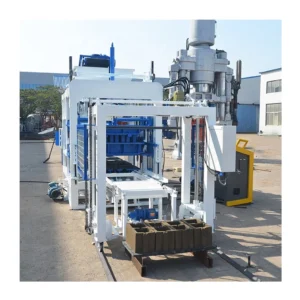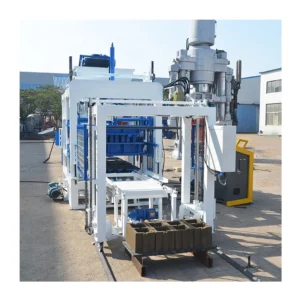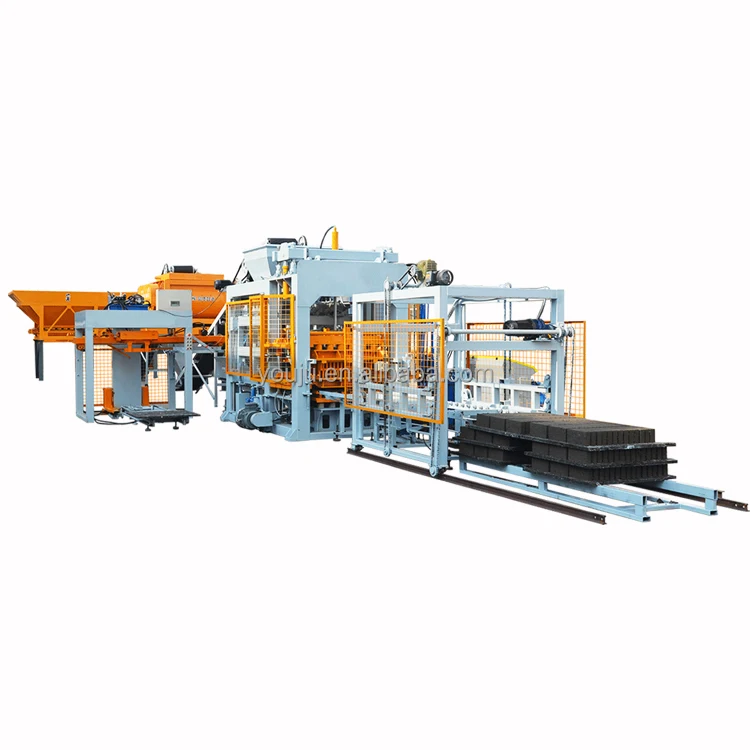
Matched Line Integration — Every station from raw material batching to stacking is configured around the QT 8-15 press rhythm, eliminating idle time between cycles and manual pallet handling.
Technical Specifications
| Parameter | Value |
|---|---|
| Model | QT 8-15 |
| Product Type | Fully Automatic Interlocking Concrete Block Making Machine |
| Control System | PLC with touch screen Human Machine Interface |
| Rated Power | 37 kW |
| Overall Dimensions (L×W×H) | 8300 × 1860 × 3000 mm |
| Vibration Form | Platform Vibration |
| Vibration Frequency | 2800–4500 RPM |
| Pallet Size | 950 × 900 mm |
| Moulding Cycle | 15–25 s (20–25 s with color feeding) (basis not stated in source) |
| Brick Height Range | 50–200 mm |
| Hydraulic System | Independent integrated hydraulic station |
| Output Capacity (Hollow Block) | 1912 pcs/h (based on 400×200×200 mm, 8 pcs/mould) |
| Output Capacity (Solid Block) | 4320 pcs/h (based on 240×115×90 mm, 18 pcs/mould) |
| Output Capacity (Paver) | 3000 pcs/h (based on 225×112.5×60 mm, 18 pcs/mould) |
| Host Components | Pallet feed machine, block molding machine, storage hopper, conveyor, hydraulic unit, PLC cabinet |
| Raw Materials | Fly ash, slag, gangue, industrial waste, river sand, gravel, cement |
Application Suitability
| Application | Material or Output |
|---|---|
| Hollow Block Production | Fly ash, slag, crushed stone, and cement mixes |
| Solid and Porous Brick Manufacturing | River sand, gravel, and industrial waste aggregates |
| Interlocking Paver and Kerbstone | Cement-bound mixes with optional color layer feeding |
| Slope and Grass Block Forming | Permeable concrete mixes for civil and landscaping projects |
| On-Site Construction Production | Local aggregate and cement adapted to project specifications |
What a Block Production Line Quotation Often Leaves Unspecified
A press capacity figure means little if upstream mixers cannot deliver and downstream pallet handling is left to manual labor.
When plant owners evaluate block production line equipment, they often see a single output number for the host machine without the supporting stations being quoted. The mixer batch size, pallet feeding speed, and stacking mechanism must all align with the press cycle. Without this alignment, the host machine sits idle waiting for material, or finished blocks pile up on the floor because no automatic stacker was included. [NEED_CITE: block line cycle time matching standards]
This QT 8-15 configuration addresses that gap by treating the entire line as one system, from cement silo through to the stacker and forklift transfer.
Raw Material Feeding and Mixing Coordination
The batching machine and mixer must output enough material to fill the host storage hopper before each press cycle completes. If the mixer capacity is undersized, the press stops between cycles, and daily output drops far below the rated figure. This block production line equipment setup specifies the mixer and conveyor so they match the 15–25 second moulding rhythm.
Pallet Feeding, Stacking, and Curing Transfer
The pallet size of 950 × 900 mm must fit the buyer’s existing curing racks and forklift dimensions. When pallets are too large for the curing area, blocks cure unevenly or must be restacked by hand. The automatic stacker and pallet return system in this line keep the press running continuously without operator intervention at the discharge end. [NEED_CITE: pallet handling automation in concrete block plants]
Hydraulic Isolation and Vibration Matching
The independent hydraulic station sits apart from the main press vibration zone, protecting seals and valves from dust and shock. Platform vibration at 2800–4500 RPM works with hydraulic pressure to compact the mix evenly. When these two forces are not balanced to the buyer’s local aggregate, blocks crack during curing or fail compressive strength tests. The PLC coordinates both systems through the touch screen interface, adjusting pressure and vibration duration per block format.
The Hidden Cost of Incomplete Line Specifications
Buyers who purchase the press alone often discover after installation that pallet feeding and stacking were never quoted. The result is a high-capacity machine producing blocks that workers must carry by hand to the curing yard. Fatigue and handling damage reduce usable output, and the labor cost erases the efficiency the machine was supposed to deliver. Voltage and control language mismatches further delay commissioning, leaving the line idle for weeks after arrival. [NEED_CITE: industrial equipment commissioning delays due to voltage mismatch]
Why Source the Complete Line from One Supplier
Configuration starts from the buyer’s actual mix design and target block format, not a catalogue default. Every supporting station — batching, mixing, pallet feed, stacking — is specified against the press cycle so no station bottlenecks another. Mould design covers the formats the buyer’s market demands, with custom drawings available for non-standard sizes. The automation level can begin semi-automatic and expand later, protecting the initial investment. Line layout drawings and capacity calculations state the block format assumed, so buyers can verify daily output before ordering.
Documentation & Verification
- Line layout drawing with capacity calculated per block format
- Machine specification sheet confirming pallet size and hydraulic rating
- Mould drawing and format list matching buyer’s product range
- Voltage, frequency, and PLC display language confirmation record
- Factory test record on buyer’s specified block dimensions
- Operation manual covering host and all supporting stations
Installation, Commissioning & Support
- Foundation plan sized for 8300 × 1860 mm host footprint
- Power circuit rated for 37 kW total connected load
- Dismantled shipping configuration for container loading
- First-run parameter setting for local aggregate and mix design
- Operator training on PLC touch screen and mould change procedure
- Wear parts list covering hydraulic seals and vibration components
What to Prepare Before Your Inquiry
Provide the block formats you currently sell or plan to produce, along with daily output targets stated per format. Confirm your available curing area dimensions and the forklift you will use, so pallet size and stacking height can be matched. Share your local voltage and frequency, plus the language your operators need on the PLC display. If you already have a mixer or batching station, note its model and capacity so the line can integrate rather than duplicate.
Frequently Asked Questions
Q: How are upstream mixer capacity and downstream pallet handling matched to the QT 8-15 press cycle time?
A: The mixer batch volume and conveyor speed are calculated so fresh material reaches the host hopper before each 15–25 second cycle completes. Downstream, the pallet feeder and stacker operate at the same cadence, preventing block accumulation on the discharge conveyor and keeping the press running without idle gaps.
Q: What is included in the line quotation versus what is left for manual handling?
A: The quotation covers the cement silo, batching machine, mixer, host press, pallet feeder, stacker, and forklift transfer. Pallet feeding and automatic stacking are specified so blocks move from press to curing rack without manual carrying. Any station not included is clearly marked in the line layout.
Q: How do I confirm pallet size and material against my existing curing area and forklift?
A: The standard pallet measures 950 × 900 mm. Before production, we verify this against your curing rack spacing and forklift fork width. If your facility uses a different dimension, the pallet feeder and stacker are adjusted to match, avoiding restacking after the press.
Q: What voltage, frequency, and control language must be confirmed before shipment?
A: Your local supply voltage, phase configuration, and frequency must be confirmed so motors and the PLC are built to match. The touch screen language is set to your operator’s preference. These details are documented in the confirmation record before production begins, preventing commissioning delays on arrival.
Q: How does the line configuration change if I add color feeding for layered paving blocks?
A: Adding color feeding extends the moulding cycle to 20–25 seconds and requires a second hopper and separate conveyor for the colored face mix. The batching and mixing stations are upgraded to handle two material streams, and the PLC program is adjusted to coordinate both feeds within each press cycle.