
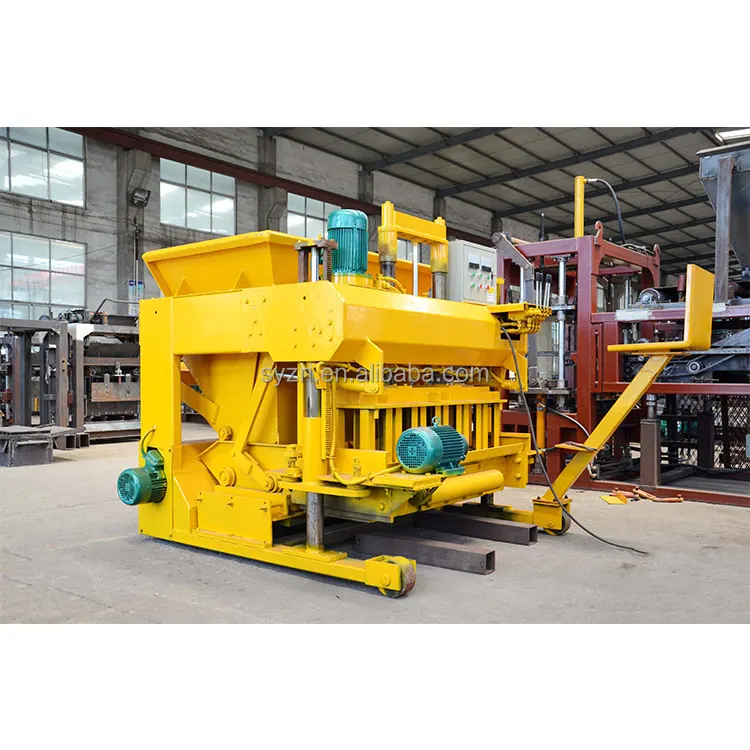
Matched System Design — The QMY6-25 mobile block machine is specified alongside its feeding, mixing, and curing logistics so the press never sits idle waiting for upstream stations to catch up.
Technical Specifications
| Parameter | Value |
|---|---|
| Model | QMY6-25 |
| Product Type | Mobile Hydraulic Block Making Machine |
| Main Vibration Form | Three-dimensional excitation |
| Overall Power | 9.6 kW |
| Moving Method | Automatic movement with hydraulic steering |
| Overall Dimensions | 2000 × 2100 × 1650 mm |
| Moulding Cycle | 25–30 s |
| Vibration Frequency | 3200 Hz |
| Pallet Requirement | No pallet needed (egg-laying type) |
| Output Capacity | 1080 pcs/h based on 400 × 200 × 200 mm hollow block, 6 pcs/mould |
| Output Capacity | 1260 pcs/h based on 400 × 150 × 200 mm hollow block, 7 pcs/mould |
| Output Capacity | 1620 pcs/h based on 400 × 120 × 200 mm solid block, 9 pcs/mould |
| Output Capacity | 1800 pcs/h based on 400 × 100 × 200 mm solid block, 12 pcs/mould |
| Shift Output | 8600 pcs/shift based on 400 × 200 × 200 mm hollow block, 8 hours |
| Shift Output | 10000 pcs/shift based on 400 × 150 × 200 mm hollow block, 8 hours |
| Shift Output | 12960 pcs/shift based on 400 × 120 × 200 mm solid block, 8 hours |
| Shift Output | 14400 pcs/shift based on 400 × 100 × 200 mm solid block, 8 hours |
| Operator Requirement | Single-person operation |
| Block Format Compatibility | Hollow blocks and large solid blocks |
| Voltage & Frequency | Basis not stated in source — confirm with buyer’s site supply |
| Control System | Basis not stated in source — confirm PLC or relay logic |
| Hydraulic Pressure | Basis not stated in source — confirm against manufacturer catalog |
| Mould Change Time | Basis not stated in source — confirm against manufacturer catalog |
| Net Weight | Basis not stated in source — confirm against manufacturer catalog |
| Warranty | 1 year for whole machine (excluding spare parts) |
| Standards | CE declaration available where applicable |
Application Suitability
| Application | Material or Output |
|---|---|
| On-site housing project block production | Hollow blocks from crushed stone, sand, and cement laid directly on prepared ground |
| Infrastructure contractor yard casting | Large solid blocks from local aggregate blends for retaining walls and foundations |
| Entrepreneur first block plant | Hollow and solid formats with minimal supporting infrastructure and no pallet inventory |
| Supplement to fixed plant capacity | Mobile deployment to remote project sites producing blocks where transport costs are prohibitive |
What a Mobile Block Machine Production Line Supporting Equipment Plan Actually Covers
A mobile press that moves between positions demands that every upstream and downstream station keeps pace without a fixed layout.
I have watched contractors bring a QMY6-25 onto a site and watch it sit idle because the pan mixer could not discharge fast enough, or the cured blocks had nowhere to go. The machine itself completes a cycle every 25–30 seconds, but that number means little when the raw material feed stalls or the ground-level curing area is not organized for continuous laying. A mobile block machine production line supporting equipment plan must account for feeding logistics that follow the press, mixing capacity that matches cycle throughput, and a curing layout that clears blocks before the machine returns to the same position [NEED_CITE: on-site block curing logistics for egg-laying machines].
Feeding and Mixing Around a Press That Moves
The QMY6-25 travels across the production floor on its own hydraulic steering, which means raw material cannot simply be piped to a fixed hopper. A wheel loader or small conveyor must deliver batched aggregate and cement to a mobile mixer positioned within reach of the machine’s current working zone. The 9.6 kW overall power draw is modest, but the mixer serving this mobile block machine production line supporting equipment setup must discharge a full batch within the 25–30 second moulding cycle window to prevent idle time between presses.
Curing Logistics Without Pallets
Because this egg-laying machine deposits blocks directly onto the ground, the supporting equipment conversation shifts from pallet return conveyors to ground preparation and curing-area management. The production surface must be level, compacted, and swept between passes. Curing logistics involve water supply for misting, cover materials for sun protection in hot climates, and clear pathways so the machine can advance without running over freshly laid output. This mobile block machine production line supporting equipment approach eliminates pallet storage entirely but demands disciplined floor planning [NEED_CITE: ground curing standards for mobile egg-laying block machines].
Reading the Numbers That Actually Matter
The 3200 Hz vibration frequency with three-dimensional excitation is what consolidates the concrete mix into a dense block before the machine lifts away. Without sufficient vibration energy, the block slumps or cracks at the edges before the cement sets. The hydraulic steering system does more than move the machine — it provides the pressing force that, combined with vibration, determines whether the block holds its shape during the critical first minutes on the ground. The single-person operation spec means no dedicated pallet feeder or stacker operator is needed, but it also means that one person is simultaneously monitoring mix consistency, machine position, and mould condition.
When Upstream Equipment Cannot Keep Up
The most common failure I see on mobile block sites is not the press itself — it is the gap between what the QMY6-25 can produce and what the supporting stations can supply. A mixer that is too small forces the operator to pause between batches, and those pauses add up across an eight-hour shift. The quoted shift outputs — for example, 8600 pieces per shift based on 400 × 200 × 200 mm hollow blocks — assume uninterrupted material supply. When the line is mismatched, actual output drops noticeably, and the contractor blames the machine instead of the layout [NEED_CITE: production line bottleneck analysis for mobile block equipment].
Why This Configuration Approach Works for Mobile Lines
Every supporting station around the QMY6-25 is selected against the machine’s actual cycle time and movement pattern, not pulled from a generic catalog. The mixer, feeding conveyor, and curing-area plan are matched to the block format and daily target the buyer has confirmed. Voltage and control language are locked in before production so the machine arrives ready to run on the buyer’s site power supply. Mould options are confirmed against the formats the buyer’s local market actually purchases, not a default set. Documentation includes a line layout that shows exactly where each supporting station sits relative to the machine’s travel path. Factory testing runs the full cycle sequence before dispatch so capacity figures are verified, not estimated.
Documentation & Verification
- Line layout drawing showing mixer and feeding positions relative to QMY6-25 travel path
- Capacity calculation sheet stating the exact block format behind each output figure
- Mould dimensional drawings for every format included in the order
- Voltage, frequency, and control language confirmation record before production begins
- Factory test record capturing full cycle sequence with the ordered mould installed
- CE declaration documentation where applicable for the destination market
Installation, Commissioning & Support
- Ground leveling and compaction guidance for the QMY6-25 production surface based on machine dimensions of 2000 × 2100 × 1650 mm
- Power supply verification matching the 9.6 kW overall power requirement to site voltage and frequency
- Mould installation and alignment check during first commissioning run on the buyer’s chosen block format
- Operator training covering hydraulic steering controls, single-person workflow, and mould change procedure
- Wear parts list with recommended first-order quantities for vibration components and hydraulic seals
- Maintenance schedule tied to the 25–30 second moulding cycle intensity and local operating conditions
What to Share With Your Inquiry
To build an accurate mobile block machine production line supporting equipment proposal, share the block formats and dimensions your market requires, the daily output target in pieces per shift, and the raw materials available locally including aggregate type and cement grade. Confirm your site voltage, frequency, and the control display language your operators need. Describe the production area dimensions and ground conditions so the curing layout can be planned before the machine ships.
Frequently Asked Questions
Q: How does raw material feeding connect to a mobile machine that changes position?
A: The QMY6-25 moves via hydraulic steering, so material feeding relies on a mobile mixer or a loader delivering batched mix to the machine’s current zone. The feeding plan must match the 25–30 second moulding cycle so the press never waits for the next batch. We map mixer placement and refill routes during the line layout stage.
Q: What curing setup is needed when blocks are laid directly on the ground?
A: Egg-laying production requires a level, compacted surface and organized curing zones with water access for misting. Blocks cure in place while the machine advances to the next position. The layout must leave clear travel paths so the QMY6-25 can return without disturbing freshly laid output that has not yet reached initial set.
Q: How do I verify the daily output I will actually achieve?
A: Each output figure is tied to a specific block format. For instance, 1080 pieces per hour applies to 400 × 200 × 200 mm hollow blocks at six per mould, while 1800 pieces per hour applies to 400 × 100 × 200 mm solid blocks at twelve per mould. Share your target format and we provide a matching shift calculation.
Q: What electrical details must be confirmed before the machine ships?
A: Voltage and frequency are not preset defaults — they must match your site supply exactly. The control system language also needs confirmation so your operators can read the display. We lock these details in writing before production to avoid commissioning delays when the QMY6-25 arrives on site.
Q: Which supporting equipment is included and what must I arrange locally?
A: The QMY6-25 package covers the press, moulds, and hydraulic steering system. Raw material mixers, feeding conveyors, and ground preparation are typically arranged separately but specified in our line layout. We confirm which items are included in the quotation and which the buyer sources locally based on the agreed production plan.


