
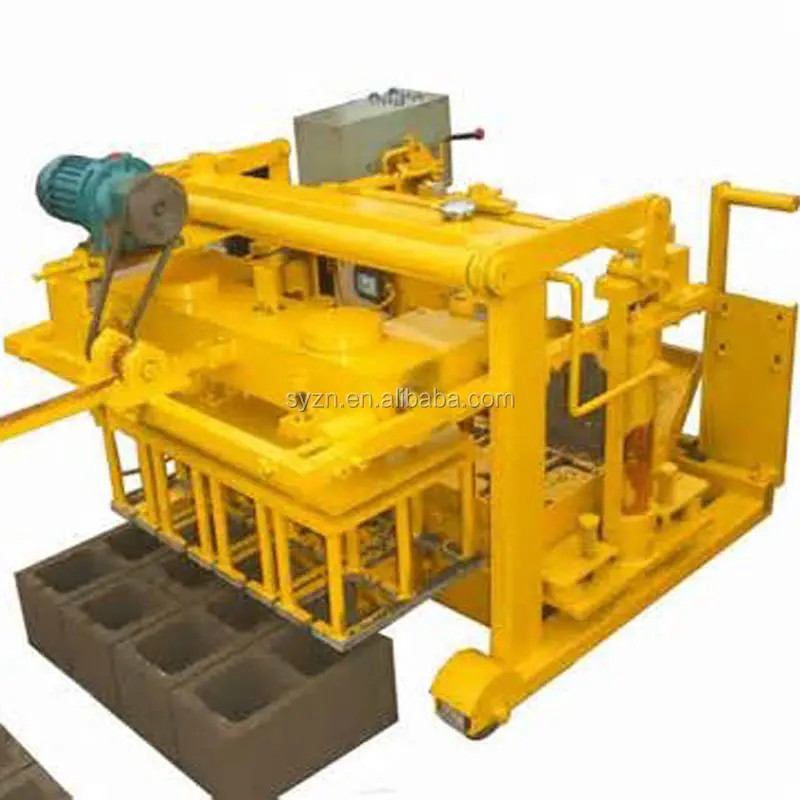
Integrated line configuration — The QMY4-30 mobile egg laying block machine and its supporting mixing, feeding and curing stations are specified as one matched workflow, not isolated components.
Technical Specifications
| Parameter | Value |
|---|---|
| Model | QMY4-30 |
| Product Type | Mobile Egg Laying Concrete Block Making Machine |
| Hydraulic Method | Mould vibration |
| Demold Method | Hydraulic |
| Molding Cycle | 25–30 seconds |
| Total Power | 5.95 kW |
| Output Capacity (Hollow Block) | 3840 pcs per 8-hour shift (based on 400×200×200 mm block, 4 pcs/mould) |
| Output Capacity (Solid Block) | 6720 pcs per 8-hour shift (based on 400×100×200 mm block, 7 pcs/mould) |
| Pallet Size | Not required (pallet-free egg laying design) |
| Automation Level | Mobile, manual operation |
| Stacking Method | On-ground egg laying (no pallet, no stacking system) |
| Voltage & Frequency | Configurable to target market (basis to be confirmed) |
| Control System | Manual operation (basis to be confirmed) |
| Certification | ISO9001:2000, CE |
Application Suitability
| Application | Material or Output |
|---|---|
| On-site housing projects | Hollow and solid concrete blocks from local aggregate and cement |
| Remote infrastructure works | Interlocking and standard blocks in mountainous or desert terrain |
| Small-scale block yards | Multiple block formats produced sequentially without a fixed plant footprint |
| Contractor self-supply | Job-site production eliminating transport of purchased blocks |
Why the Press Cycle Means Nothing Without the Feed and Curing Plan
The mobile block machine production line and supporting equipment must be paced as a single system, or the press spends half the day idle.
A QMY4-30 completes a moulding cycle every 25 to 30 seconds, which sounds productive until you watch it on site. I have stood on projects where the machine sat waiting for the next batch of mixed material because a single small mixer could not keep up, and then sat again while workers moved fresh blocks out of the curing path by hand. The daily tally fell to a fraction of what the brochure suggested [NEED_CITE: typical field output versus rated capacity in mobile block operations]. The mobile block machine production line and supporting equipment only delivers its rated output when every station before and after the press has been sized to the same cadence.
What a Pallet-Free Line Actually Looks Like
The QMY4-30 lays blocks directly on the ground, which removes the pallet feeder, pallet return conveyor and stacking station from the mobile block machine production line and supporting equipment layout. The trade-off is that raw material delivery and curing area logistics become the critical path. Your mixer output, wheelbarrow or conveyor feed route and ground-level curing space must be planned before the press arrives.
Keeping Pace with a 30-Second Cycle
Each cycle consumes a measured volume of fresh concrete. A pan mixer or drum mixer must discharge into the press hopper before the next moulding stroke. If the mixer batch size is too small or the mixing time too long, the press idles. We map mixer capacity against the 25–30 second cycle and the specific block format you intend to run, so the feed rate and the press rate never fall out of step [NEED_CITE: mixer sizing methodology for mobile egg laying block machines].
How Vibration, Hydraulic Pressure and Mix Design Interact
The QMY4-30 relies on mould vibration rather than a fixed press frame to compact the concrete. Vibration force and hydraulic demolding pressure must match your local aggregate grading and cement ratio — a mix that is too dry will not consolidate, while one that is too wet will collapse when the mould lifts. The 5.95 kW total power draw keeps generator requirements manageable on remote sites, but the mix design still needs to be verified with a short trial run before full production starts. Block strength is a function of this three-way match, not the machine alone.
When Supporting Equipment Gets Left Out of the Quote
A buyer receives a competitive price for the press and signs the order, only to discover on arrival that there is no mixer specification, no feed method and no curing plan. The machine runs for an hour, then the crew spends two hours rearranging blocks on the ground to clear a path for the next run. Daily output drops, cement batches go to waste, and the contractor blames the machine [NEED_CITE: common causes of output shortfall in mobile block projects]. Specifying the full mobile block machine production line and supporting equipment at the quotation stage prevents this gap.
Why Buyers Come Back for the Second Line
Block machinery is our single focus, so the QMY4-30 is never quoted as a standalone press — mixer, feed route and curing footprint are part of the same proposal. Configuration is set against your actual mix design and local aggregate, not a catalogue default. Moulds are supplied for the formats your market sells, and custom drawings are available when standard formats do not match. The automation level is selectable, allowing a buyer to begin with manual egg laying and add semi-automatic handling later. Installation support includes operator training on the specific block format and cycle time you will run.
Documentation & Verification
- Line layout and capacity calculation stating which block format each figure assumes
- Machine specification sheet with confirmed voltage, frequency and control language
- Mould drawing and format list for every block type in your order
- Factory test record showing cycle time on your specified block format before dispatch
- Operation and maintenance manual covering mixer-to-press feed coordination
Installation, Commissioning & Support
- Ground preparation guidance for level egg laying surfaces suited to the QMY4-30 footprint
- Generator or grid power sizing based on the confirmed 5.95 kW total draw and site voltage
- Mixer placement and feed route planning to maintain the 25–30 second cycle pace
- On-site commissioning with trial runs on each ordered mould format
- Operator training covering mix consistency, cycle rhythm and curing area rotation
- Wear parts list with recommended on-site stock levels for remote project locations
What We Need to Size Your Line
To prepare a layout that reflects your actual conditions, share the block formats you plan to produce, the target daily output, the aggregate and cement available locally, and the power supply type at your site — grid or generator, with voltage and frequency. If you already own mixers or material handling equipment, include those details so we can integrate them into the feed plan rather than duplicate them.
Frequently Asked Questions
Q: How is daily output verified for each block format, and what does the capacity calculation assume?
A: Each output figure states the exact block format, mould cavity count and cycle time it assumes — for example, 3840 pieces per 8-hour shift based on the 400×200×200 mm hollow block at 4 pieces per mould and a 30-second cycle. We provide a written capacity table covering every format in your order so there is no ambiguity between quoted and achievable output.
Q: What mixing capacity and feed method keep pace with the 25–30 second moulding cycle?
A: The mixer must discharge a full batch into the press hopper within or before each cycle window. We calculate required batch volume from the block format and confirm whether a pan mixer, drum mixer or a two-mixer alternating setup is needed. Feed method — wheelbarrow, belt conveyor or direct chute — is matched to site terrain and crew size.
Q: How is voltage and frequency confirmed for sites with generator or unstable grid power?
A: Before production, we collect your site voltage and frequency specification or your generator nameplate data. The motor and control components on the QMY4-30 are then matched to that supply. For sites with known voltage fluctuation, we recommend a stabiliser and note this in the electrical schematic provided with the machine.
Q: What curing area layout is needed when blocks are laid directly on the ground without pallets?
A: Since the QMY4-30 leaves blocks on the ground, you need a flat, level surface large enough for the day’s output plus rotation space for the previous day’s cured stock. We include a curing area footprint diagram in the line layout, showing row spacing, sprinkling access and protection from direct sun or rain during the initial set period.


