
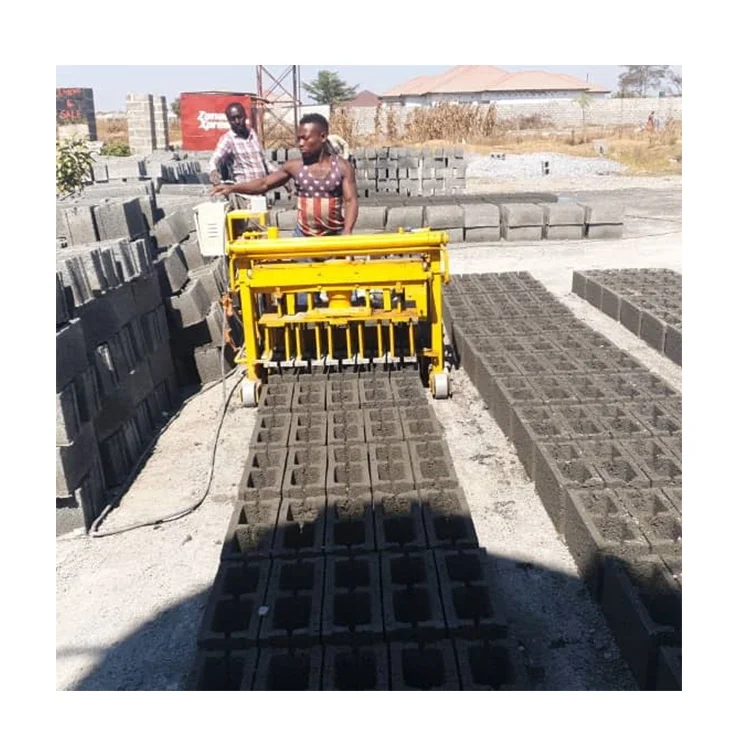
Matched System Planning — The QMY4-30 mobile block machine is specified together with its upstream mixer, batching feed and ground-curing layout so the press never sits idle waiting for the next batch of mix.
Technical Specifications
| Parameter | Value |
|---|---|
| Model | QMY4-30 |
| Product Type | Mobile Hydraulic Concrete Block Making Machine |
| Rated Power | 5 kW |
| Molding Cycle Time | 30 seconds |
| Overall Dimensions (L×W×H) | 1200 × 1200 × 1100 mm |
| Net Weight | 950 kg |
| Output Capacity | 480 pcs/hour (basis: 400×200×200 mm hollow block, 4 pcs/mold) |
| Output Capacity | 600 pcs/hour (basis: 400×150×200 mm hollow block, 5 pcs/mold) |
| Output Capacity | 840 pcs/hour (basis: 400×100×200 mm hollow block, 7 pcs/mold) |
| 8-Hour Shift Output | 3,840 pcs (basis: 400×200×200 mm hollow block) |
| 8-Hour Shift Output | 4,800 pcs (basis: 400×150×200 mm hollow block) |
| 8-Hour Shift Output | 6,720 pcs (basis: 400×100×200 mm hollow block) |
| Mould Format | Hollow block and solid brick, moulds changeable |
| Automation Level | Mobile / egg-laying type, manual operation |
| Raw Materials | Cement, sand, crushed stone, slag |
| Pallet Requirement | Not applicable (blocks laid directly on ground) |
| Voltage & Frequency | To be confirmed before dispatch |
| Control System | To be confirmed (PLC or relay logic) |
| Warranty | One year (verify scope and exclusions with supplier) |
Application Suitability
| Application | Material or Output |
|---|---|
| On-site hollow block production for building contractors | Crushed stone, sand and cement mix laid on prepared ground |
| First-stage block plant for entrepreneurs | Cement, sand and slag with minimal material handling infrastructure |
| Phased housing project block supply | Hollow and solid brick formats changed on-site to match construction phases |
| Remote site production without fixed plant access | Mobile egg-laying operation eliminating pallet circulation and curing racks |
What "480 Pieces per Hour" Leaves Out About a mobile block making machine production line
The cycle time is only honest if the mixer and batching feed can keep up with the press.
I spent a week on a project site in the Philippines where a QMY4-30 class mobile press sat idle for nearly half of every hour. The quoted capacity assumed a steady supply of mix, but the upstream pan mixer was undersized and the manual wheelbarrow feed could not bridge the gap. The operator spent more time waiting than pressing [NEED_CITE: typical output shortfall when upstream feed is not matched to press cycle time]. A mobile block making machine production line only delivers its stated throughput when every station before and after the press is timed to the same 30-second cycle.
Upstream Feed Must Match the 30-Second Press Cycle
The QMY4-30 completes a moulding cycle every 30 seconds, which means the mixer must discharge a fresh batch at least that fast. If the mixer takes 45 seconds per batch and the operator still needs to wheel the mix to the hopper, the press is starved for material and the mobile block making machine production line drops well below its rated output. Sizing the mixer drum volume and discharge gate to the press hopper is the first step in closing this gap.
Ground Curing Layout Determines How Far the Machine Can Travel
Because this egg-laying press deposits blocks directly on the ground, the curing area must be flat, compacted and long enough for a full shift of output. On a site producing 6,720 units of 400×100×200 mm hollow blocks per shift, the blocks will cover a substantial strip of ground. Planning the travel path and next-day stripping sequence before the first block is laid prevents the machine from boxing itself into a corner by mid-afternoon [NEED_CITE: curing area planning for egg-laying mobile block machines].
Raw Material Compatibility and Local Aggregate Matching
The press accepts cement, sand, crushed stone and slag, but the actual mix proportions must suit the aggregate available near the project site. A mix designed for well-graded river sand will not compact the same way with angular crushed stone, and the resulting block density and strength will differ. Confirming the mix design with the supplier against locally sourced material avoids costly reformulation after the machine arrives.
Reading the Key Specifications for Real-World Impact
The 5 kW rated power covers both the vibration motor and the hydraulic pump on a compact mobile unit. This modest power draw means the machine can run from a portable generator on sites without grid connection, though voltage and frequency must be confirmed before the generator is rented. The 950 kg net weight keeps the machine movable by a small forklift or crane between project phases, but it also means the vibration force is limited compared to stationary presses — block density will reflect this trade-off. The interchangeable mould system allows a switch between hollow block and solid brick formats, though the mould change time is not published and should be verified with the supplier before committing to a multi-format schedule. The absence of a pallet system eliminates one entire handling stage, which simplifies the line but shifts all curing logistics to the ground surface [NEED_CITE: vibration force and block density relationship in mobile egg-laying machines].
The Hidden Cost of an Unplanned Supporting Line
When a mobile block making machine production line is ordered as a standalone press, the buyer often discovers that raw material batching, mixing and block handling were never included in the scope. The result is a crew of labourers shovelling mix into the hopper by hand and carrying freshly laid blocks to a makeshift curing area — exactly the kind of bottleneck that erases the capacity advantage of the machine itself [NEED_CITE: labour and output losses from incomplete line scope in mobile block production]. The QMY4-30 is compact enough to pair with a small pan mixer and a belt conveyor, but that pairing must be planned before the machine ships.
Why Source the Full Line Here
Block machinery is the sole focus of Shandong Shiyue Intelligent Machinery, so the QMY4-30 is never quoted as a standalone press disconnected from its upstream and downstream stations. The line layout and capacity calculation state which block format each output figure assumes, removing the guesswork that inflates expectations. Mould drawings are provided for the formats your market actually sells, and custom mould design is available when standard sizes do not match. Voltage, frequency and control language are confirmed before production, preventing commissioning delays when the machine reaches your site. Installation guidance covers ground preparation, mixer placement and feed timing so the entire mobile block making machine production line runs as one coordinated system.
Documentation & Verification
- Line layout showing mixer, feed conveyor and press positions with cycle time alignment
- Capacity calculation sheet stating block format and mould configuration assumed
- Mould drawing and format list matched to your target block dimensions
- Voltage, frequency and control panel language confirmation before dispatch
- Factory test record run on your specified raw material mix
- Operation and maintenance manual covering mould change and daily checks
Installation, Commissioning & Support
- Ground must be level and compacted over the full curing travel path before first operation
- 5 kW power requirement needs a dedicated circuit or correctly rated portable generator
- Machine arrives as a single mobile unit; no fixed foundation or pallet system to install
- First commissioning includes mixer-to-press feed timing adjustment on your mix design
- Operator training covers 30-second cycle pacing, mould change procedure and daily greasing
- Wear parts list identifies vibration motor brushes and hydraulic seals for first reorder
What to Include in Your Inquiry
Provide the hollow block or solid brick dimensions your project requires, the daily output you need to meet your construction schedule, and the raw materials you can source near the site. Include your local voltage and frequency so the electrical system is built correctly before shipping. If you already have a mixer or conveyor on site, share the model and capacity so the mobile block making machine production line can be planned around your existing equipment.
Frequently Asked Questions
Q: How is real daily output calculated for the QMY4-30, and which format does each figure assume?
A: Daily output is based on an 8-hour shift at a 30-second cycle. For 400×200×200 mm hollow blocks at 4 pieces per mould, the figure is 3,840 pieces. For 400×150×200 mm blocks at 5 per mould it is 4,800 pieces, and for 400×100×200 mm blocks at 7 per mould it reaches 6,720 pieces. These assume uninterrupted material feed.
Q: What mixer and feed setup is needed so the press is never left waiting for mix?
A: The pan mixer must discharge a full batch within the 30-second press cycle, and the feed method — whether belt conveyor or manual barrow — must bridge the distance to the hopper in the same window. We calculate mixer drum volume and discharge gate size against your mix design to confirm the feed rate before the line ships.
Q: How should the curing area be prepared for an egg-laying mobile block machine?
A: The ground must be flat, compacted and cleared of debris over the full travel path for one shift of output. Blocks cure in place until the next day, so the area must be long enough that the machine does not overlap freshly laid blocks. We include a curing area layout in the line plan.
Q: What voltage and frequency details must be confirmed before the machine ships?
A: Your site voltage, frequency and whether the supply is single-phase or three-phase must be confirmed so the motor and control panel are wired correctly. If you plan to run the machine from a generator, the generator rating and output waveform should also be shared to avoid commissioning delays.
Q: How long does a mould change take, and what formats can one machine cover?
A: The QMY4-30 accepts interchangeable moulds for hollow block and solid brick formats. The exact change time depends on the mould locking mechanism and should be confirmed with the supplier. One machine can cover multiple formats on a single site, provided the schedule allows time for the swap and re-alignment.


