
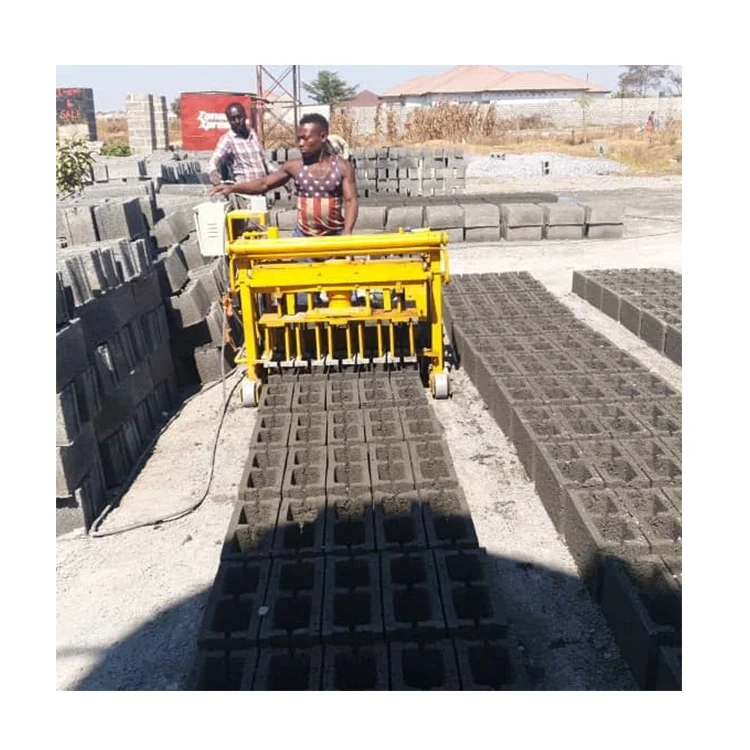
Complete Line Integration — the QMY4-30 mobile block making machine is specified alongside its mixer, curing area and material feed so the press never waits for the next batch.
Technical Specifications
| Parameter | Value |
|---|---|
| Product Type | Mobile Block Making Machine |
| Model | QMY4-30 |
| Rated Power | 5 kW |
| Cycle Time | 30 seconds |
| Overall Dimensions | 1200 × 1200 × 1100 mm |
| Net Weight | 950 kg |
| Raw Materials | Cement, sand, crushed stones, slag |
| Output Capacity | 480 pcs/hour based on 400×200×200mm hollow block, 4 pcs/mold |
| Output Capacity | 600 pcs/hour based on 400×150×200mm hollow block, 5 pcs/mold |
| Output Capacity | 840 pcs/hour based on 400×100×200mm hollow block, 7 pcs/mold |
| Daily Output | 3,840 pcs/8 hours based on 400×200×200mm hollow block |
| Daily Output | 4,800 pcs/8 hours based on 400×150×200mm hollow block |
| Daily Output | 6,720 pcs/8 hours based on 400×100×200mm hollow block |
| Mould Format | Hollow block and solid brick, molds changeable |
| Pallet System | Not required (mobile egg-laying type) |
| Automation Level | Manual / mobile egg-laying |
| Voltage & Frequency | Not stated in source — confirm with supplier |
Application Suitability
| Application | Material or Output |
|---|---|
| On-site construction block production | Hollow blocks from crushed stone, sand and cement at the building site |
| Housing and development projects | Solid bricks and hollow blocks laid directly on the ground without pallet circulation |
| First block plant for entrepreneurs | Start-up hollow block and solid brick runs with low initial capital |
| Remote or rural infrastructure work | Small-batch production relocated across a job site as needs shift |
Why Quoted Output Per Hour Rarely Matches Your First Day on Site
A machine’s cycle time only tells you what the press can do — not what the rest of the line can keep up with.
I have stood on sites in the Gulf where a mobile block making machine was rated for a certain hourly figure, yet the mixer was two minutes behind on every batch. The operator spent half the shift waiting for concrete. The line was never planned as a system, only as a press sold in isolation. [NEED_CITE: typical line bottleneck causes in small block plants]
That gap between quoted capacity and actual daily throughput is where most first-time buyers lose money. The press itself may be capable, but if raw material feeding, mixing and curing area are not sized to match, the machine sits idle more often than it runs.
Matching the Mixer to the Press Cycle
The QMY4-30 completes a cycle in 30 seconds. For a mobile block making machine of this output tier, the upstream mixer must deliver a fresh batch within that same window or the press waits. A pan mixer or twin-shaft mixer sized to the batch volume of four to seven blocks per cycle keeps material flowing without overstocking wet mix that begins to set before compaction. The production line layout must state the mixer model and batch capacity alongside the press so throughput is calculated as a system, not as a standalone number.
Curing Area Planning for Egg-Laying Production
An egg-laying machine drops blocks directly onto the ground, which means the curing area must be prepared before the first cycle begins. The footprint required depends on the daily output you plan to sustain. For the QMY4-30 producing 3,840 hollow blocks per eight-hour shift based on 400×200×200mm format, the ground area must accommodate that volume plus walkways for watering and eventual collection. [NEED_CITE: curing area calculation methods for mobile block machines] If the site surface is uneven or poorly compacted, blocks laid directly will crack or deform before they gain initial set strength, and no amount of press adjustment will correct that.
Reading the Numbers That Matter
The 5 kW rated power reflects a machine designed for low-energy mobile operation rather than high-pressure stationary compaction. Vibration force and hydraulic pressure are not stated in the source data, which means the buyer must confirm with the supplier whether the compaction method suits their local aggregate gradation. The 950 kg net weight and 1200 × 1200 × 1100 mm footprint allow the unit to be moved by a standard site forklift or small crane as the project advances, which is the operational advantage of this class over a fixed plant. The 30-second cycle time is consistent across mould formats, but the actual output per hour changes depending on how many cavities each mould carries — four for the largest hollow block, seven for the narrowest.
What Happens When the Line Is Not Planned as a System
Pallet handling and stacking are often excluded from mobile machine quotations because egg-laying machines do not use pallets — but curing, ground preparation, water supply for curing and block collection logistics are still required. Buyers who overlook these downstream steps end up with blocks damaged during manual collection or insufficient curing time before transport. [NEED_CITE: block breakage rates from inadequate curing on construction sites] The result is output that technically left the machine but never reached the wall as a sellable unit.
Why Procurement Here Reduces Line Gaps
Block machinery as a single focus means the QMY4-30 is not treated as a standalone item but as the center of a matched line configuration. Machine, mould and supporting equipment are specified together against the buyer’s actual mix design and site conditions rather than shipped from a catalogue default. Mould design covers the hollow block and solid brick formats the buyer’s market demands, with changeover possible on site. Automation level is selectable, so a buyer starting with this mobile unit has a defined upgrade path to a stationary line with pallet handling later. Installation support and operator training address the most common cause of early output inconsistency — incorrect mix proportioning for local aggregate.
Documentation & Verification
- Line layout showing mixer position, curing area dimensions and block collection route for your site
- Machine specification sheet with cycle time stated per hollow block format
- Mould drawing and format list for every block type the machine will produce
- Voltage and frequency confirmation document matched to your local supply before dispatch
- Factory test record on your target block format using a confirmed mix proportion
- Operation and maintenance manual covering mould change and daily inspection intervals
Installation, Commissioning & Support
- Level and compacted ground surface required across the curing area before the 950 kg machine begins egg-laying production
- Dedicated 5 kW power circuit with voltage and frequency confirmed in writing prior to shipment
- Machine arrives assembled and mobile; on-site setup covers mould installation and test runs
- First-day commissioning includes mix proportion adjustment against the buyer’s local sand and aggregate sample
- Operator training covers 30-second cycle pacing, mould change procedure and daily vibration assembly inspection
- Wear parts list identifies mould liners and vibration components with reorder intervals
Before You Send an Inquiry
To configure a line around the QMY4-30, the supplier needs to know your target block format and the daily volume your market absorbs. Share a sample or lab report of your local sand and aggregate so the mix design is validated before the machine ships. Confirm your site voltage, frequency and the ground area available for curing so the production line layout is complete before production begins.
Frequently Asked Questions
Q: How is the output capacity figure verified for each block format?
A: The QMY4-30 output is calculated from the 30-second cycle time multiplied by the number of cavities in each mould — four for 400×200×200mm hollow blocks, five for 400×150×200mm and seven for 400×100×200mm. Daily throughput is then based on an eight-hour shift. The supplier should provide a written capacity table stating the exact format assumed for each figure so buyers can cross-reference against their market demand.
Q: What supporting equipment completes the line around this mobile machine?
A: A mixer matched to the batch volume per cycle, a reliable water supply for curing, and a prepared ground area large enough for the planned daily output are the minimum requirements. Raw material storage and a method for collecting cured blocks must also be planned. The supplier should include these in the line layout so nothing is left to improvise on site.
Q: How does the 30-second cycle match with upstream mixing and downstream curing?
A: The mixer must deliver a fresh batch within or faster than the 30-second press cycle to avoid idle time. Downstream, blocks laid on the ground need a clear curing area that can absorb the full shift output without overlapping fresh and semi-cured units. If either station falls behind, the bottleneck reduces actual daily throughput below the quoted figure.
Q: What voltage and frequency options apply for different export markets?
A: Voltage and frequency are not stated in the source specification and must be confirmed with the supplier before production. Buyers should provide their local supply standard in writing so the motor and any control components are wound correctly. Arriving on site with a mismatched electrical configuration delays commissioning and risks motor damage.
Q: What is the upgrade path from this mobile machine to a stationary line?
A: The QMY4-30 serves as an entry point with low initial investment. When volume grows, the buyer can transition to a stationary line with pallet circulation, automatic stacking and curing rack handling. The supplier should outline which components from the mobile setup — such as the mixer or certain moulds — carry over to reduce the cost of that transition.


