
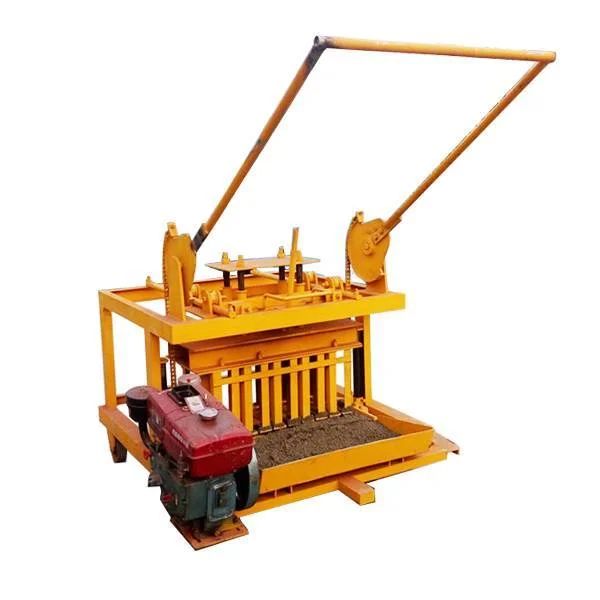
Matched Line Design — Feeder, mixer and mobile egg laying block making machine production line specified as one system so the press never waits for material between cycles.
Technical Specifications
| Parameter | Value |
|---|---|
| Model | QMR4-45 |
| Product Type | Mobile Egg Laying Block Making Machine |
| Engine Type | Diesel Engine |
| Automation Level | Manual / Portable |
| Machine Type | Mobile / Egg Laying |
| Control System | Manual operation |
| Pallet Size | Not applicable (egg laying type produces directly on ground) |
| Voltage & Frequency | Not applicable (diesel engine driven) |
| Assembly State | Portable / Mobile |
| Output Capacity | basis not stated in source |
| Cycle Time | basis not stated in source |
| Vibration Force | basis to be confirmed |
| Mould Format | basis to be confirmed |
| Standards | CE, ISO 9001 |
Application Suitability
| Application | Material or Output |
|---|---|
| On-site block production without a fixed plant | Crushed stone, sand, cement and water mix |
| Small-scale block and brick manufacturing | Local aggregate with cement binder |
| Construction sites producing blocks locally | Site-sourced sand and gravel |
| Remote or off-grid locations without stable electricity | Diesel-driven operation independent of grid power |
What "Output Per Hour" Actually Means on a Mobile Line
The cycle figure only matters when the mixer and feeder keep pace with the press.
A mobile egg laying block making machine production line sounds straightforward until the press sits idle waiting for the next batch of concrete. I have seen contractors quote a cycle time from the machine plate, multiply it by an eight-hour shift, and wonder why daily output falls short. The gap is never the press itself — it is the gap between the mixer discharge rate and the press cycle, or the time a worker spends shovelling material into the hopper by hand [NEED_CITE: typical idle time caused by feeder-press mismatch on small block lines]. When we spec this QMR4-45 line, we start from the block format you actually sell and work backwards to the mixer batch size and feeder belt speed.
Keeping the Press Fed Without a Fixed Batching Plant
The QMR4-45 moves along the production floor as it lays blocks directly on the ground, so the raw material supply must move with it. A stationary mixer at one end of the yard means wheelbarrow runs that grow longer as the curing area expands. We match a portable pan mixer or drum mixer to the press cycle so that a fresh batch arrives before the hopper empties, keeping the mobile egg laying block making machine production line running at its natural pace.
Ground Conditions That Decide Block Quality Before the Press Starts
Egg laying machines leave every block where it falls, which means the ground becomes the pallet. A dusty or uneven surface pulls moisture out of the bottom course before vibration finishes compacting, and the result is a weak bottom edge that crumbles on handling. We ask for a photo of your curing area before shipment so we can recommend whether a light broom-finish concrete apron or a compacted sand bed suits your soil [NEED_CITE: ground preparation standards for egg laying block production].
Reading the Specs That Actually Matter
Diesel engine output on the QMR4-45 determines whether the vibration motor and hydraulic pump can both run at rated speed simultaneously. If the engine is sized only for the vibration motor, the hydraulic pressure drops during the compaction stroke and block density varies from the first piece to the last. Vibration force and hydraulic pressure must be matched to your specific mix design — a sand-rich mix needs different force settings than a gravel-heavy one. Manual operation means the operator controls the mould fill, vibration duration and lifting sequence, so cycle consistency depends on training rather than PLC logic. The portable frame carries the full weight of the engine, hopper and mould assembly, which is why net weight and wheel rating matter when you move the machine across soft ground.
The Cost of Skipping the Line-Level Conversation
Buying the press alone and sourcing the mixer locally often leads to a batch size that is either too small — causing the operator to wait — or too large, leaving concrete sitting in the drum until it begins to set. I once visited a site where the local diesel fuel had a higher wax content than the engine filter was rated for, and the machine stalled every forty minutes until we swapped to a different filter element. Those are the details that never appear on a spec sheet but decide whether the line runs or stands still [NEED_CITE: diesel fuel specification mismatches in export equipment].
Why Buyers Source the Full Line Here
Block machinery is our single focus, which means the QMR4-45, its mould, the feeder and the mixer are specified as one matched system rather than assembled from separate suppliers. We set the configuration against your actual mix design and local aggregate, not a catalogue default. Mould design covers the formats your market sells, and custom drawings are available if your buyers need a non-standard size. The automation level is selectable — you can start with the manual QMR4-45 and add a semi-automatic line later without replacing the mould inventory. Installation support includes operator training on cycle sequence and basic engine maintenance so your crew is producing on day one.
Documentation & Verification
- Line layout showing mixer placement relative to the mobile press travel path
- Machine specification sheet listing vibration force and cycle time per block format
- Supporting equipment list confirming mixer model, feeder type and handling tools
- Diesel engine data sheet with fuel grade and filter specification for your region
- Factory test record on your target block format before dispatch
- Operation manual covering engine start-up, mould change and daily maintenance
Installation, Commissioning & Support
- Level compacted ground or concrete apron prepared before the QMR4-45 arrives on site
- Diesel fuel grade and filter type confirmed against local supply before first engine start
- Mixer positioned within one wheelbarrow run of the press travel area to minimise idle time
- Mould fitted and test run completed on your local sand and cement mix during commissioning
- Operator trained on manual fill, vibration duration and lifting sequence for consistent blocks
- Wear parts list with mould liner and vibration spring part numbers supplied at handover
What We Need to Spec Your Line
Tell us the block format your market moves fastest — hollow, solid, paving or interlocking — and the daily volume you need to hit. Share a sample or photo of your local sand and aggregate so we can match the mixer and vibration settings before the QMR4-45 leaves the factory. Let us know whether any auxiliary equipment on your site runs on grid power, and we will confirm voltage and frequency for those items while the press itself stays diesel-driven.
Frequently Asked Questions
Q: How is daily output calculated and which block format does the capacity figure assume?
A: Daily output depends on the block format, mix workability and operator pace. We calculate capacity per format — a hollow block takes a longer vibration cycle than a solid paver — and state the assumption in the line layout so your projection matches reality.
Q: What supporting equipment is needed to keep the mobile press running without idle time?
A: A mixer sized to discharge one full hopper load within the press cycle, plus a feeder or wheelbarrow route that keeps material moving. We spec the mixer batch size and placement against your QMR4-45 cycle to prevent the operator from waiting.
Q: Can the diesel engine be replaced with an electric motor if grid power becomes available later?
A: The QMR4-45 is built around a diesel drive, and swapping to an electric motor requires a different mounting frame and control panel. We can quote the conversion kit if your site gains grid access after the initial setup.
Q: What ground surface conditions are required for egg laying production and block curing?
A: A flat, compacted surface free of loose dust is the minimum. A thin concrete apron gives the most consistent bottom edge and allows blocks to cure in place without moisture loss into the soil beneath.


