
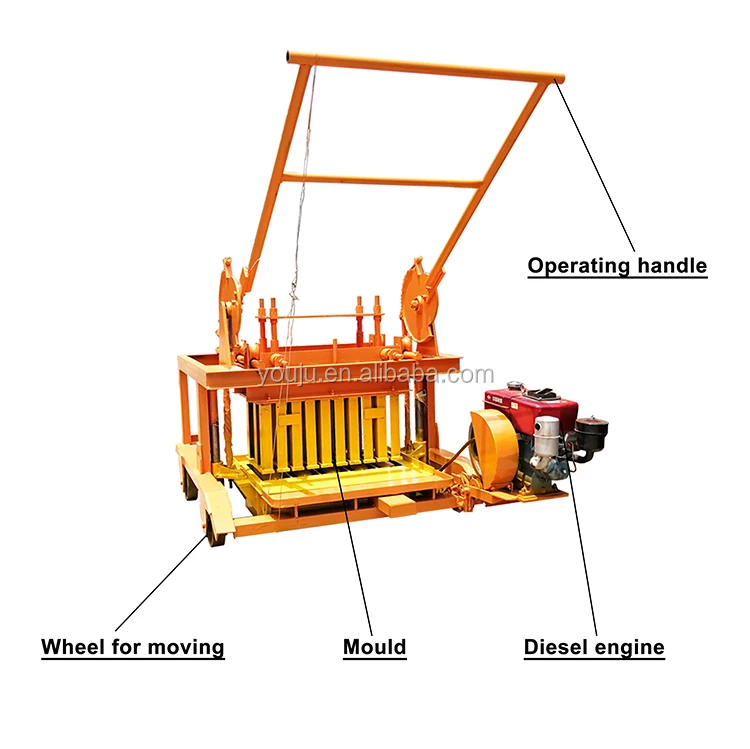
Matched System Layout — the QMR4-45 mobile egg laying block machine is specified alongside mixer capacity, curing area dimensions, and material feed rhythm so the press never waits for the next batch.
Technical Specifications
| Parameter | Value |
|---|---|
| Model | QMR4-45 |
| Product Type | Mobile Egg Laying Block Making Machine |
| Overall Dimensions (L×W×H) | 2420×1320×1650mm |
| Net Weight | 810kg |
| Rated Power | 6kW |
| Diesel Engine Option | 6kW or 6-8HP |
| Voltage | 220V, 380V, or client local voltage (frequency to be confirmed) |
| Control System | Semi-automatic |
| Moulding Cycle | 40-45s |
| Pallet Requirement | No pallet required (egg laying type) |
| Mould Formats (Standard) | 400×200×200mm (4pcs/mould), 400×150×200mm (5pcs/mould), 400×120×200mm (6pcs/mould) |
| Output Capacity | 3000 pcs/day (400×200×200mm hollow block, 8-hour shift); 3500 pcs/day (400×150×200mm, 8-hour shift); 4500 pcs/day (400×120×200mm, 8-hour shift) |
| Hydraulic Pressure | basis not stated in source |
| Vibration Force | basis not stated in source |
| Assembly State | Fully assembled, mobile unit |
| Warranty | One year guarantee for the whole machine |
Application Suitability
| Application | Material or Output |
|---|---|
| On-site housing project production | Crushed stone, sand, and cement hollow blocks laid directly on prepared ground |
| Remote job sites with unreliable grid | Diesel-powered hollow block production where 380V three-phase supply is unavailable |
| First-stage entrepreneur plant | Small mixer output feeding the QMR4-45 with manual ground-level curing |
| Secondary location for existing manufacturers | Mobile hollow block production without duplicating stationary line infrastructure |
Why "3000 Pieces Per Day" Is Only Half the Story
The daily output figure only holds when the mixer batch size, curing area turnover, and material feed path are calculated as one continuous rhythm around the press.
Many buyers receive a quotation stating a daily capacity number without the supporting line context. The QMR4-45 mobile block making machine production line achieves 3000 pieces per day based on 400×200×200mm hollow blocks over an 8-hour shift — but that assumes the mixer delivers fresh concrete at a rate matching the 40-45 second moulding cycle, and that cured blocks are cleared from the ground-level curing area fast enough to free space for the next shift. When these stations are not designed together, the press sits idle between batches and actual daily output falls far short of the quoted figure [NEED_CITE: common causes of output shortfall in mobile block production].
How the Egg Laying Design Reshapes the Line Layout
The egg laying block machine supporting equipment layout starts from one fundamental difference: no pallets. That single fact removes the pallet feeding station, pallet return conveyor, and pallet storage racks from the line drawing entirely. Instead, the QMR4-45 deposits each moulded block directly onto the ground surface and moves forward on its own wheels to the next position. This means the line layout focuses on three elements rather than six or seven — a mixer positioned to feed the hopper, the mobile press path across a level production floor, and the curing zone where blocks remain until they gain sufficient strength for handling.
Matching Mixer Batch Size to the Press Cycle
Every 40-45 seconds the QMR4-45 completes one moulding cycle and moves to the next position. The supporting equipment line must deliver a fresh batch of mixed concrete to the hopper at least as fast as the press consumes it. If the mixer is too small, the press operator waits between cycles and the daily output calculation collapses. If the mixer is too large, concrete begins to set in the hopper before it can be pressed. The correct mixer capacity is calculated from the mould volume, the number of cycles per hour, and the mix density for the local aggregate being used [NEED_CITE: mixer sizing methodology for mobile block presses].
What the Specifications Actually Mean for Production
The 810kg net weight keeps the QMR4-45 mobile — two operators can reposition it across a site without a forklift — but it also means the vibration force transmitted into the mould is limited compared to heavier stationary presses, making mix design and aggregate grading more critical to block strength. The 6kW rated power, or the 6-8HP diesel engine alternative, determines whether the machine needs a stable grid connection or can run independently on remote job sites. The semi-automatic control system keeps the operator count low while still requiring manual intervention for hopper loading and machine advancement, which shapes how many workers the supporting line configuration demands.
What Happens When the Curing Area Is Undersized
A curing area that is too small forces operators to stack blocks before they have reached adequate strength, resulting in corner damage and structural failure rates that erode the profit margin on every shift. The QMR4-45 lays blocks directly on the ground, so the curing area must be large enough to hold at least one full day’s production — 3000 blocks of 400×200×200mm format requires a substantial floor area — before the first blocks can be moved to storage. When buyers overlook this spatial requirement during site planning, production stalls on the second day because there is nowhere to lay the next shift’s output [NEED_CITE: curing area planning for egg laying block machines].
Why This Machine Is Specified as Part of a Line
Block machinery as a single focus means the QMR4-45 is not quoted as a standalone press but configured against the buyer’s local aggregate, target block format, and available site space as part of a matched system. The configuration is set against the actual mix design the buyer can source locally, not a catalogue default that may require costly material substitution. Mould design covers the hollow block formats the buyer’s market actually sells, with changeover procedures documented so format flexibility is real rather than theoretical. Automation level is selectable, so a buyer can begin with the semi-automatic QMR4-45 and add supporting equipment as production volume grows. Installation support includes operator training so the crew understands the relationship between mixer timing, press rhythm, and curing area management from day one.
Documentation & Verification
- Line layout drawing showing mixer placement, material feed path, and curing area dimensions matched to stated daily output per block format
- Capacity calculation sheet listing output per hollow block format with the 8-hour shift assumption clearly written
- Voltage and frequency confirmation document including diesel engine specification where grid power is unavailable
- Mould format list with interchange procedure so format changeover fits within the shift plan
- Factory test record on buyer-specified block format before dispatch
- Operation and maintenance manual with wear parts and mould replacement schedule
Installation, Commissioning & Support
- Level production floor required for egg laying path, with curing area sized to hold full daily output of the selected hollow block format
- 6kW electrical supply at confirmed voltage and frequency, or diesel engine fuel supply for off-grid operation
- Fully assembled mobile unit arrives ready to operate — no foundation bolts or fixed installation required
- First-day commissioning covers mixer batch timing matched to the 40-45 second moulding cycle
- Operator training on hopper loading rhythm, machine advancement, and curing area rotation
- Wear parts list and mould interchange procedure reviewed with maintenance crew before handover
What to Include in Your Inquiry
Provide the hollow block format your market sells, the daily output target with shift length, and the local aggregate and cement type available on your site. Include the voltage and frequency at your location, or confirm whether the diesel engine option is required. State the available floor area for both the production path and the curing zone so the supporting line can be sized correctly.
Frequently Asked Questions
Q: How is daily output calculated per block format, and what shift length is assumed?
A: The stated capacities — 3000, 3500, and 4500 pieces per day — are each based on an 8-hour shift producing a single hollow block format continuously. The 400×200×200mm format yields 3000 pieces, the 400×150×200mm yields 3500, and the 400×120×200mm yields 4500. These figures assume the mixer and curing area are sized to support uninterrupted operation throughout the shift.
Q: What supporting equipment is needed to keep the QMR4-45 running continuously?
A: At minimum, a pan mixer sized to deliver concrete faster than the 40-45 second moulding cycle, a water supply for mix consistency, and a ground-level curing area large enough to hold one full day’s output. The egg laying block machine supporting equipment configuration may also include a small loader for raw material feeding and hand carts for moving cured blocks to storage.
Q: How does the diesel engine option affect line layout compared to the electric version?
A: The diesel engine removes the need for a grid connection and dedicated electrical circuit, which simplifies setup on remote sites. The line layout remains the same — mixer, press path, curing area — but the fuel storage and refueling schedule become part of the daily operation plan instead of voltage and frequency confirmation.
Q: What curing area size matches the stated daily output for each format?
A: For the 400×200×200mm format at 3000 pieces per day, the curing area must accommodate that volume on the ground surface with spacing for air circulation. The exact dimensions depend on the layout pattern and the number of days blocks remain in curing before being moved to storage or dispatched.
Q: Can the line be upgraded later without replacing the mixer?
A: If the mixer is already sized to support continuous production volume, it can continue feeding a pallet-based stationary press when the operation grows beyond what a mobile egg laying unit can handle. The material handling and mixing infrastructure remains relevant; only the press and pallet system change.


