
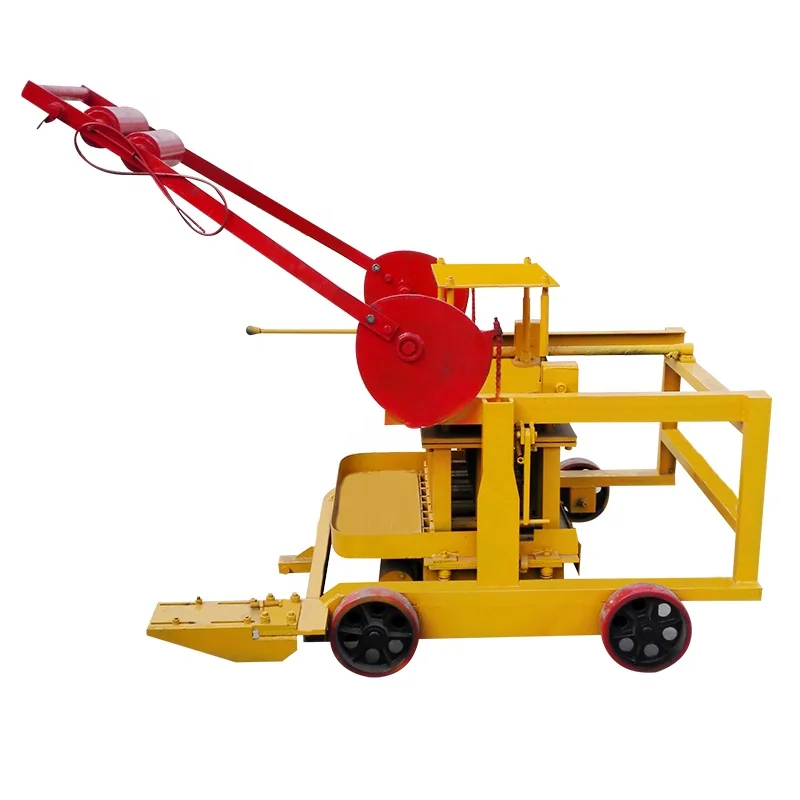
Complete Line Match — Mixer, trolley, and press specified as a single mobile production cell so the QMR4-45 produces from day one without separate sourcing.
Technical Specifications
| Parameter | Value |
|---|---|
| Model | QMR4-45 |
| Product Type | Mobile Egg-Laying Block Making Machine |
| Overall Dimensions (L×W×H) | 1100 x 950 x 2100 mm |
| Net Weight | 810 kg |
| Molding Cycle | 30–45 s |
| Output Capacity | 2560 pcs/day (basis not stated in source — confirm block format / material / thickness) |
| Power Source | Diesel / Petrol Engine / Electric |
| Pallet Requirement | None (egg-laying design) |
| Basic Equipment Included | JZC350 or JQ350 Diesel Concrete Mixer, Trolley |
| Structure | Linear type, simple construction |
| Operating System | High-pressure double crank for die opening and closing |
| Automation Level | Semi-manual / mobile operation |
| Warranty | 1 Year |
Application Suitability
| Application | Material or Output |
|---|---|
| On-site hollow block production for housing projects | Crushed stone, sand, cement blends |
| Solid brick making at remote construction sites | Fly ash, river sand, cement mixes |
| Paver brick laying for internal roads and walkways | Aggregate and cement combinations |
| Small-scale startup block production | Local sand and gravel with cement binder |
| Fly ash brick production near thermal plants | Fly ash, lime, gypsum, and sand |
Why "Blocks per Day" Means Nothing Without the Format
The QMR4-45 mobile block machine production line quotes 2,560 pieces per day, but that figure is meaningless until you tie it to a specific block format and wall thickness. A hollow block and a solid paver brick of the same footprint consume vastly different press cycles, vibration durations, and curing footprints. I have watched contractors in West Africa receive an egg-laying press and discover on the first morning that their primary product — a 200 mm hollow block — cuts the quoted daily number nearly in half because the cycle extends and the curing ground space runs out before the shift ends.
When a supplier does not state which block dimensions their capacity figure assumes, the buyer absorbs the gap. In my time commissioning lines across South Asia, I have seen project schedules slip by weeks because the output shortfall forced a second shift or a second machine. [NEED_CITE: block format impact on daily output calculation for egg-laying machines] Always ask for the capacity table broken down by every format you intend to run.
How the Line Fits Together Without a Fixed Plant
The mobile block machine production line begins with the JZC350 or JQ350 mixer blending raw material beside the press position. Mixed concrete travels by trolley to the QMR4-45 hopper, where the double-crank system compacts and extrudes the block directly onto the prepared ground surface. Because no pallets circulate through the system, there is no pallet return conveyor, no pallet stacker, and no pallet storage rack to maintain.
The ground itself becomes the curing rack. This eliminates a major cost item for first-time block producers and keeps the entire operation relocatable. For a housing contractor who needs blocks at multiple points along a long site, the press simply moves forward as work progresses.
Ground Preparation and Curing Space Reality
An egg-laying machine demands a flat, compacted surface that will not settle under the weight of wet blocks. [NEED_CITE: ground bearing requirements for mobile egg-laying block production] In practice, this means a compacted laterite or sand-cement screed, not bare soil. Blocks remain on the ground for the full initial curing period before they can be moved, so the curing area must be several times larger than the press footprint.
I have visited sites in East Africa where the contractor cleared a dirt patch, started pressing, and found that blocks on soft ground cracked at the base within hours. Planning the curing sweep radius around the machine’s travel path before the first block drops avoids this problem entirely.
Reading the Specs That Actually Matter
The 30–45 second molding cycle range tells you how the press responds to different mix stiffness and block heights. A thin solid brick completes its vibration and compression phase at the shorter end, while a tall hollow block with deep cores requires the longer cycle to achieve full compaction through the double-crank mechanism. The cycle time directly governs your daily throughput, so matching it to your dominant product format is essential.
The 810 kg net weight is low enough for the trolley and a small crew to relocate the machine, yet heavy enough to provide the frame mass that absorbs vibration reaction forces during compaction. Power source selection — diesel, petrol, or electric — determines your site infrastructure. A diesel-powered setup with the JZC350 mixer operates completely off-grid, which is a practical requirement for remote housing developments or road-side paver projects where grid power is absent or unreliable. [NEED_CITE: diesel versus electric power trade-offs for mobile block production in developing regions]
What Happens When the Mixer and Press Are Mismatched
Buying the press alone and pairing it with a locally sourced mixer of unknown output is a common mistake. If the mixer cannot keep pace with the QMR4-45 cycle, the press sits idle waiting for the next batch, and your actual daily output falls well below the line’s designed rhythm. Conversely, a mixer that produces faster than the trolley can deliver creates wet mix sitting in the tub, losing workability before it reaches the hopper.
The QMR4-45 mobile block machine production line ships with a matched mixer and trolley so the three stations balance from the first day. [NEED_CITE: production line bottleneck caused by unmatched mixer output in small block plants] Skipping this balance check is one of the most frequent reasons a new small plant underperforms its quoted capacity.
Why Specifying the Line as One Unit Matters Here
Configuration is set against the buyer’s actual mix design and target block format, not a catalogue default. When a contractor in South Asia sends us a sample of their local river sand — which often carries high silt content — we adjust the vibration duration recommendation and suggest a cement ratio range before the machine ships.
Mould options cover hollow block, solid brick, paver brick, and fly ash brick formats the buyer’s local market actually sells, and custom mould drawings are available for non-standard sizes. The automation level is selectable, so an entrepreneur can start with semi-manual mobile operation and plan for an upgrade path. Installation support and operator training accompany every dispatch, because a mobile machine without trained crew still underperforms.
Documentation & Verification
- Line layout showing mixer, trolley path, press position, and curing sweep radius for your block format
- Machine specification sheet confirming power source variant and engine rating for your site
- Mould drawing and format list covering every block type you intend to produce
- Voltage and control confirmation for the electric variant before dispatch
- Factory test record on your chosen block format with cycle time measured
- Operation and maintenance manual with illustrated die opening sequence
Installation, Commissioning & Support
- Compacted ground preparation across the full curing sweep area before the 810 kg machine arrives on site
- Diesel engine or electric power connection matched to your selected QMR4-45 variant and local fuel or voltage availability
- Trolley rail or path alignment between mixer station and press hopper to maintain consistent feed rhythm
- First-run mould fitting and cycle time adjustment for your specific block dimensions and mix design
- Operator training on double-crank die operation, mould change procedure, and daily greasing points
- Wear parts list covering mould liners and crank bushings with reorder quantities
Before You Send the Inquiry
Tell us which block formats sell in your market — dimensions, wall thickness, and whether you need hollow, solid, or paver types. Confirm whether your site has reliable grid electricity or whether a diesel-powered mobile block machine production line is the practical choice. Share the local aggregate type and any lab test results for sand silt content or fly ash grade, so the configuration reflects the material you will actually feed.
Frequently Asked Questions
Q: The output is listed as 2,560 pieces per day — which block format is that based on?
A: That figure requires confirmation of the specific block format, wall thickness, and mix design assumed. A standard hollow block will yield a lower daily count than a thin solid brick due to longer cycle times and greater ground space per piece. Always request a capacity breakdown per format before placing your order.
Q: How do diesel, petrol, and electric power options affect my site setup?
A: Diesel with the JZC350 mixer allows completely off-grid operation, suited for remote housing or road projects. Petrol offers similar portability with wider fuel availability in some markets. Electric reduces running cost where stable grid power exists but requires voltage and frequency confirmation before dispatch to avoid commissioning delays.
Q: What block formats and moulds are available for the QMR4-45?
A: Compatible formats include hollow block, solid brick, paver brick, fly ash brick, and concrete block. Custom mould design to buyer drawings is available for non-standard sizes. Mould change time depends on the format and operator training; request the specific procedure for your product mix during the inquiry stage.
Q: What is included in the basic equipment, and what else do I need to plan for?
A: The QMR4-45 ships with a JZC350 or JQ350 diesel concrete mixer and a trolley as basic equipment. You must separately arrange the compacted ground surface for egg-laying, a water supply for curing, and adequate curing area. No pallets, pallet racks, or stackers are needed.
Q: What ground condition and curing space does an egg-laying machine require?
A: The surface must be flat and compacted — laterite, sand-cement screed, or hardened concrete — not bare soil. Blocks stay on the ground through the initial curing period, so plan a curing area several times the press footprint. Ground that settles under wet block weight will cause base cracking and product loss.


