
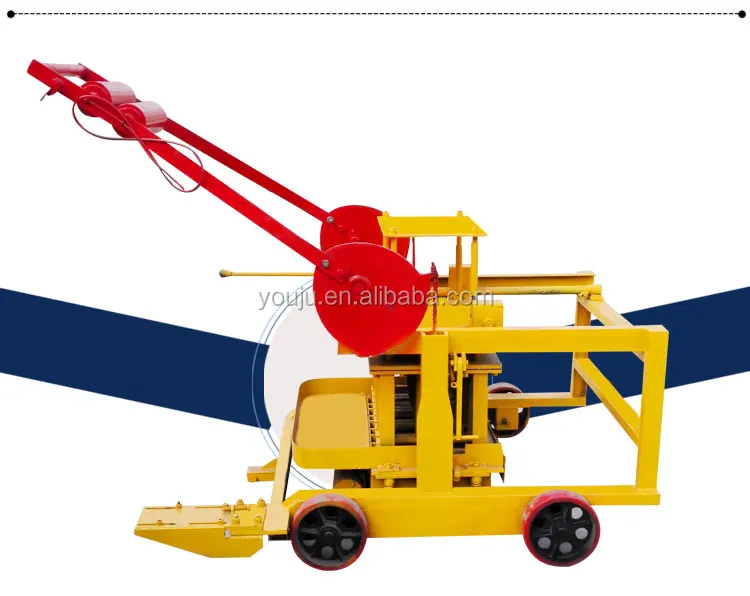
Diesel Drive Flexibility — the QMR4-45 egg laying press is configured within a matched small-scale line where mixer discharge, feeding intervals and curing area are sized to its 40-45 s cycle, so the press station is never left idle waiting for upstream or downstream gaps.
Technical Specifications
| Parameter | Value |
|---|---|
| Model | QMR4-45 |
| Product Type | Diesel Engine Egg Laying Block Making Machine |
| Overall Dimensions (L×W×H) | 2420×1320×1650 mm |
| Net Weight | 810 kg |
| Rated Power | 6 kW |
| Diesel Engine | 6 kW or 6-8 HP |
| Voltage & Frequency | 220 V or 380 V or according to client local voltage (frequency to be confirmed) |
| Moulding Cycle | 40-45 s |
| Pallet Size | No need pallet |
| Output Capacity | 3000 pcs/day (basis not stated in source — confirm block format / material / thickness) |
| Control System | To be confirmed (PLC / manual / MCC) |
| Automation Level | Manual / semi-automatic (to be verified) |
| Mould Format | Interchangeable moulds for hollow blocks, paving bricks, standard bricks |
| Cycle Time per Format | 400×200×200 mm: 4 pcs/mould, 40-45 s; 400×150×200 mm: 5 pcs/mould, 40-45 s; 400×120×200 mm: 6 pcs/mould, 40-45 s |
| Stacking Method | Manual (egg laying on ground) |
| Warranty | One year guarantee for the whole machine (verify against manufacturer catalog) |
| Certification | CE (source value — verify against manufacturer catalog) |
Application Suitability
| Application | Material or Output |
|---|---|
| On-site hollow block production for housing projects | Crushed stone, sand, cement, water |
| Off-grid or rural block production | Diesel-powered operation where grid supply is unavailable |
| Small business startup block plant | Interchangeable moulds for hollow blocks, multi-cellular bricks, paving bricks, standard bricks |
| Contractor self-supply at infrastructure sites | Egg laying on prepared ground without pallet infrastructure |
What "3000 Pieces per Day" Leaves Out About Your Line
Output figures only hold when every station around the press keeps pace.
A mobile egg laying block machine production line sounds straightforward until you stand on a site and watch the operator wait for the next batch of mixed concrete. The 40-45 s moulding cycle of the QMR4-45 means the mixer must discharge a fresh batch within that window, or the press sits idle and daily volume collapses. I have seen small block operations in West Africa where the press was rated for thousands of blocks per shift, but a single-bag mixer and manual wheelbarrow feed turned the whole operation into a bottleneck. [NEED_CITE: concrete mixing batch cycle matching block press rhythm]
Matching Mixer and Feed to the 40-45 s Press Cycle
The mobile egg laying block machine production line only sustains its rhythm when the upstream stations are specified against the press cycle, not chosen from a catalogue default. A pan mixer or single-shaft mixer must deliver a batch size that fills the mould hopper completely every 40-45 seconds, with enough reserve capacity to cover brief interruptions in raw material feeding.
Sizing the Raw Material Feed Around the Press
Raw material proportions — cement, sand, crushed stone and water — must be batched and delivered to the mixer at a rate that matches the press consumption curve. When the feed interval lags behind the press cycle, the operator either shortens the vibration time to compensate or lets the press idle, both of which affect block density. The QMR4-45 consumes material at a steady rate across its three hollow block formats, so the feeding station must be calibrated once and left to run. [NEED_CITE: raw material batching accuracy and block compressive strength]
Ground Preparation and Curing Layout for Pallet-Free Production
Because the QMR4-45 lays blocks directly on prepared ground without pallets, the curing area must be levelled and compacted before production begins. A rough or uneven surface causes blocks to settle unevenly during the first hours of curing, leading to dimensional inconsistency. The line layout must allocate enough flat ground adjacent to the press travel path so the operator can move the machine forward without disturbing freshly laid blocks.
Interpreting the Core Specifications
The diesel engine option at 6 kW or 6-8 HP removes dependence on grid availability, which is the deciding factor on remote construction sites in regions where voltage fluctuation or load shedding is routine. The 40-45 s moulding cycle across all three hollow block formats means the press does not slow down when switching from 400×200×200 mm to 400×120×200 mm, but the number of pieces per mould changes from four to six, shifting daily output accordingly. The net weight of 810 kg keeps the machine mobile — it can be towed or loaded onto a flatbed between sites — yet heavy enough that vibration during moulding does not cause the frame to walk across the curing ground. Voltage options at 220 V or 380 V allow the electric drive variant to match local grid standards, though frequency must be confirmed before the motor is wound at the factory. The no-pallet design eliminates an entire layer of logistics: no pallet purchase, no pallet return loop from the curing area back to the press, and no pallet storage eating into the site footprint.
The Hidden Cost of Treating the Press as a Standalone Purchase
When the quotation covers only the press and nothing around it, the buyer discovers on site that stacking, curing and material feed are entirely manual and unplanned. I have visited operations where blocks were carried by hand from the laying area to the curing zone because nobody specified a wheelbarrow route or a flat transfer path. The result is broken blocks, slow output and operator fatigue that compounds over the shift. [NEED_CITE: manual handling losses in small-scale concrete block production]
Why Source the Complete Line Configuration Here
Block machinery as a single focus means the QMR4-45 is not paired with a generic mixer from a different supplier — the mixer batch size and discharge rate are matched to the 40-45 s press cycle before the quotation is issued. Configuration is set against the buyer’s actual mix design and local aggregate, not a catalogue default that may require material substitutions on arrival. Mould design covers the hollow block formats that sell in the buyer’s market, including custom drawings when standard formats do not match local demand. The line layout specifies feeding, mixing and curing as connected stations, so the press is not left waiting between batches. Installation support extends to operator training on the full line workflow, not just the press controls.
Documentation & Verification
- Line layout drawing showing press travel path, mixer position and curing area dimensions for the QMR4-45 footprint
- Capacity calculation per block format stating the 40-45 s cycle and shift length assumed
- Voltage and frequency confirmation sheet matched to local grid before motor winding
- Factory test record on buyer’s target block format before dispatch
- Operation and maintenance manual covering the press and matched mixer station
- Wear parts list including mould wear surfaces and vibration components
Installation, Commissioning & Support
- Levelled and compacted ground preparation across the curing area to match the 2420×1320×1650 mm machine footprint and travel path
- Power supply confirmation at 220 V or 380 V with dedicated circuit for the 6 kW rated power draw
- Diesel engine option setup for sites without reliable grid, including fuel line and cooling checks
- First-run commissioning with mixer batch timing adjusted to sustain the 40-45 s moulding cycle without idle gaps
- Operator training covering mould change procedure, vibration adjustment and daily maintenance intervals
- Wear parts supply plan for mould surfaces and vibration system components
What to Include in Your Inquiry
Share your target block format, the aggregate and cement available locally, and the daily volume you need to sustain. Confirm your site voltage and frequency, or whether the diesel engine option is the better fit for your power conditions. Describe the ground conditions and curing space available so the line layout accounts for pallet-free egg laying from the start.
Frequently Asked Questions
Q: How is the daily output figure verified, and which block format does it assume?
A: The 3000 pcs/day figure requires confirmation of block format, shift length and material mix. Output changes across the three listed hollow block formats because pieces per mould differ. A capacity calculation stating the exact format and shift assumption should accompany any quotation.
Q: How should the mixer be sized so the 40-45 s cycle is not interrupted?
A: The mixer must discharge a complete batch within the 40-45 s window so the press hopper is refilled before the next moulding stroke. Batch volume and mixer discharge rate are specified against the press cycle during line configuration, not selected independently.
Q: When should the diesel engine option be chosen over electric drive?
A: The diesel engine is the practical choice on sites with no grid connection, frequent load shedding, or voltage instability that risks motor damage. Electric drive at 220 V or 380 V suits sites with stable power, subject to frequency confirmation before production.
Q: What ground preparation does an egg laying machine need for curing?
A: The ground must be levelled and compacted across the entire area where blocks will be laid, because uneven surfaces cause dimensional drift during early curing. The curing area must extend far enough from the press travel path to avoid disturbing fresh blocks.
Q: What supporting stations must be in the quotation to avoid bottlenecks?
A: Mixer, raw material feed station and a defined curing layout must all be specified alongside the press. Without these, the operator manages batching, transport and stacking by hand, and actual daily output falls well below the press cycle calculation.


