
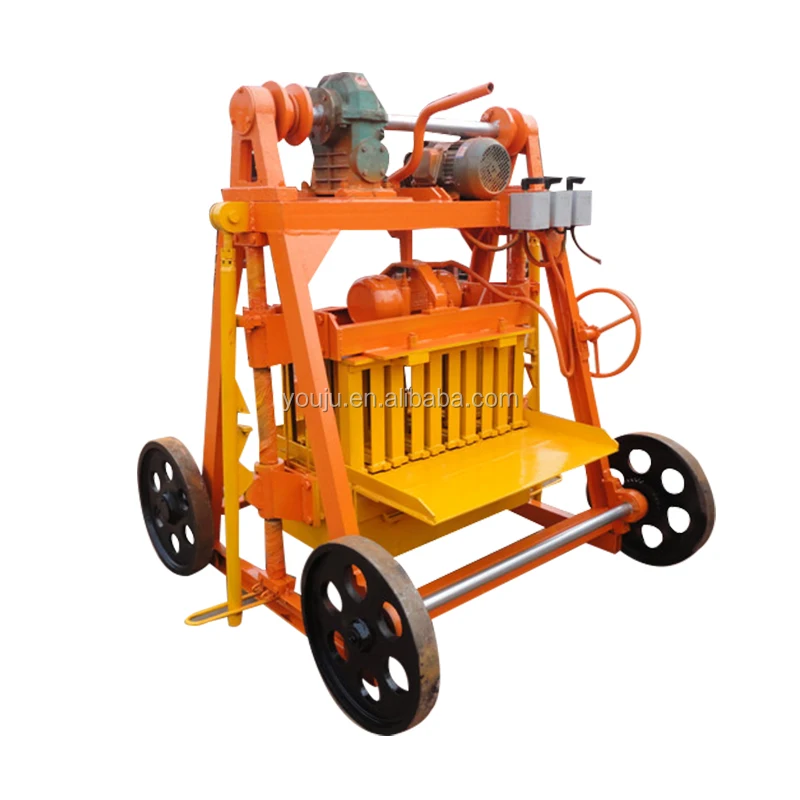
Matched Line Integration — The QMJ4-45 lays blocks directly on the ground, so mixer feed rate and curing-yard flow must match its cycle rhythm without pallet conveyors in between.
Technical Specifications
| Parameter | Value |
|---|---|
| Model | QMJ4-45 |
| Product Type | Mobile Egg-Laying Concrete Block Making Machine |
| Machine Type | Egg-laying mobile block making machine |
| Vibration System | Twice vibrations of molding core |
| Mobility | Self-propelled on-site movement |
| Automation Level | Manual |
| Pallet Requirement | None (blocks cured on ground) |
| Mould Compatibility | Interchangeable moulds for hollow, solid, and paving blocks; custom mould by buyer drawings |
| Output Capacity | Dependent on block format, mix design, and curing-yard space (basis to be confirmed) |
| Cycle Time | Dependent on block format (basis to be confirmed) |
| Certification | CE (company-level reference — verify model applicability), ISO 9001 (company-level) |
Application Suitability
| Application | Material or Output |
|---|---|
| On-site construction block production | Crushed stone, river sand, cement, and water mixed to local aggregate grading |
| Small-scale block plant startup | Locally sourced sand, gravel, and cement with minimal supporting equipment |
| Supplementary remote-project production | Standard concrete mixes laid on prepared ground without fixed-plant infrastructure |
| Paving block and kerbstone runs | Fine aggregate and cement blends with mould change on the same press |
What "Blocks Per Hour" Leaves Out When No Pallet System Exists
The real output of an egg-laying mobile block making machine production line is governed by curing-yard area and ground preparation, not just the press cycle.
Many quotations for mobile machines quote a cycle-time figure without clarifying that egg-laying units deposit blocks in rows across the yard. Once the available ground is full, production stops until the earliest blocks are strong enough to move. I have watched contractors in West Africa lose entire afternoons because the curing yard was half the size the machine could fill in a shift. The daily throughput therefore depends on how much level, compacted ground you can dedicate, how quickly blocks reach handling strength in your local climate, and how the mixer feeds material fast enough to keep the press moving [NEED_CITE: curing time variables for ground-laid concrete blocks in tropical climates].
How the QMJ4-45 Fits Into a Lean Block Line
From a line-integration standpoint, this machine removes three entire stations — pallet feeding, pallet return, and rack stacking — from the layout. What remains upstream is a mixer sized to deliver a batch before the press finishes its current row, and a raw-material feeding point that keeps sand, aggregate, and cement flowing without the operator walking away. The mobile block making machine production line built around the QMJ4-45 is therefore shorter, lower in capital outlay, and simpler to relocate when a project ends.
Ground Conditions That Decide Whether You Run or Stall
An egg-laying press deposits each block directly on the earth beneath it. If the surface is soft, uneven, or holds standing water after rain, blocks deform before they set and the machine sinks into ruts. I once spent two days on a site in South Asia re-grading a curing area because the yard sloped toward a drainage ditch and every block on the lower side slumped. Compacted gravel or a thin concrete screed across the yard keeps block dimensions consistent and lets the self-propelled chassis roll without dragging [NEED_CITE: ground preparation standards for egg-laying block production].
Reading the Specs That Actually Matter on Site
The twice-vibration molding core is the central forming action: a first vibration settles the mix into the mould cavity, and the second compacts it under pressure to improve density and strength uniformity across the block. Mould interchangeability means one QMJ4-45 can shift from hollow blocks to solid blocks or pavers by swapping the mould box, though the change itself is manual and the downtime depends on how well the operator has been trained. Because no pallets are involved, the curing-yard footprint must grow in proportion to daily output — a factor that rarely appears on a spec sheet but dominates your site planning. Block strength is a function of vibration energy, mix water content, and cement ratio working together; changing one without adjusting the others will show up as brittle edges or low crush-test results.
When the Yard and the Mixer Are Mismatched
If the mixer delivers faster than the operator can position and cycle the press, wet concrete sits in the hopper, begins to set, and clogs the feed. If the mixer is too slow, the operator stands idle while the machine waits for material, and the curing yard fills in uneven bursts. Both scenarios are common when the line is assembled from separate suppliers who did not coordinate cycle times. On small sites where a single worker manages both mixer and press, the rhythm is even harder to sustain [NEED_CITE: typical batch-to-cycle matching for manual mobile block lines].
Why Sourcing the Supporting Line Together Matters
Block machinery is our single focus, so the mixer, feed hopper, and water-supply arrangement are specified to match the QMJ4-45 cycle rhythm rather than pulled from a separate catalogue. Configuration is set against your actual mix design and local aggregate, not a default setting. Mould design covers the formats your market actually sells, and custom moulds are built from your drawings before the machine ships. The automation level is selectable: you can start with the manual egg-laying setup and add semi-automatic supporting stations later as demand grows. Installation support includes on-site commissioning and operator training so the first production run is not a learning experiment at your expense.
Documentation & Verification
- Line layout showing mixer, feed point, and curing-yard area matched to QMJ4-45 cycle assumptions
- Mould drawing and format list confirming exact block dimensions before shipment
- Voltage and control language confirmation sheet signed off before dispatch
- Factory test record on your specified block format and mix design
- Operation and maintenance manual with mould-change procedure and spare-parts list
Installation, Commissioning & Support
- Level and compact the curing yard to a minimum area matching your target daily output before the QMJ4-45 arrives
- Confirm local voltage and frequency with the electrical schematic before wiring the rated-power circuit
- Machine ships assembled; verify wheel alignment and steering on first site movement
- First-run mould setup and vibration timing adjusted against your local mix and aggregate
- Operator trained on mould change procedure, twice-vibration cycle sequence, and daily greasing points
- Wear parts list and mould spares identified for first replacement order
What to Share Before Requesting a Quote
To size the supporting line around the QMJ4-45, send the block formats you sell today and the daily volume each format requires. Include the local aggregate type, available water source, and the curing-yard area you can prepare. State your site voltage, frequency, and the language your operators read so the controls and manual arrive in the correct version.
Frequently Asked Questions
Q: What supporting stations does the QMJ4-45 still need in the line?
A: A mixer with batch capacity matched to the press cycle, a raw-material feed point for sand and aggregate, and a water-supply connection are still required. Pallet conveyors, stacking stations, and curing racks are eliminated because the machine lays blocks directly on the ground. The mixer output rate must align with press cycling to avoid material sitting or the press idling.
Q: How is realistic daily output calculated for an egg-laying machine?
A: Daily output depends on the block format being produced, the mix design, and the total curing-yard area available. Once the yard is full, production pauses until earlier blocks gain enough strength to be moved. A capacity calculation must state which block format is assumed and how much yard space is allocated, rather than quoting a single headline number.
Q: What curing-yard preparation is needed to match laying speed?
A: The ground must be level, compacted, and free of standing water. A gravel base or thin concrete screed prevents the machine wheels from sinking and keeps block dimensions uniform. Yard area must be large enough to hold one full day of production plus the curing time your local climate requires before blocks can be relocated.
Q: Which block formats can one QMJ4-45 produce, and how is the mould changed?
A: The machine accepts interchangeable moulds for hollow blocks, solid blocks, and paving formats. Custom moulds can be manufactured from buyer drawings. Mould change is a manual procedure; the operator removes the current mould box and bolts on the replacement. A mould drawing and format list are supplied before shipment so you know exactly which dimensions arrive with the machine.


