
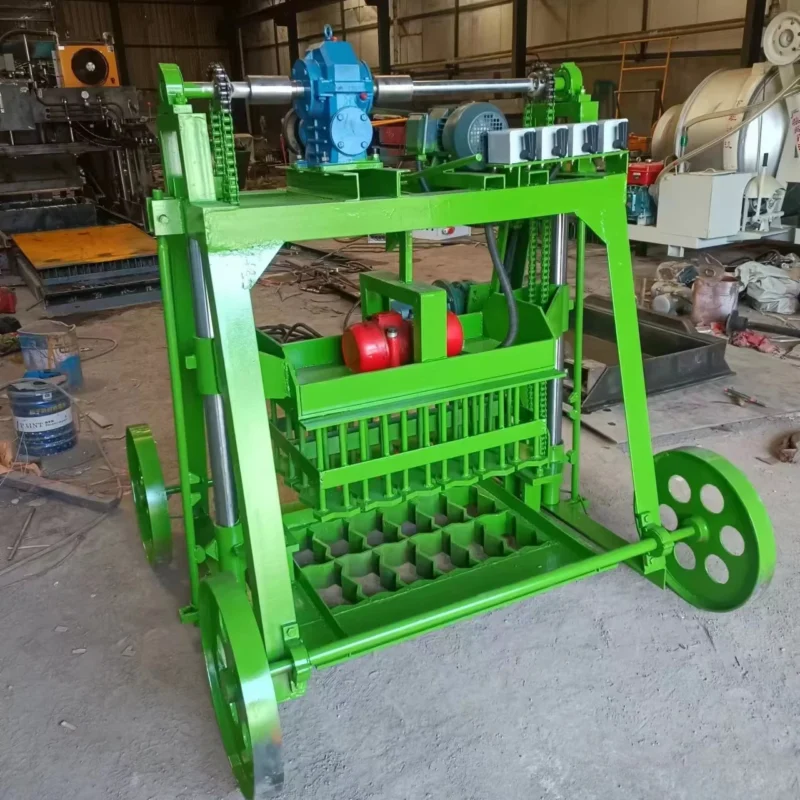
Matched System Lineup — the QMJ4-45 egg-laying press is specified alongside the mixer, feeding setup and ground-curing workflow as one coordinated line, not a standalone machine dropped into an unprepared site.
Technical Specifications
| Parameter | Value |
|---|---|
| Model | QMJ4-45 |
| Product Type | Mobile Egg Laying Concrete Block Making Machine |
| Moulding Capacity | 4 pcs/mould (based on 400×200×200mm hollow block format) |
| Moulding Cycle | 40-45 seconds |
| Vibration Frequency | 2400 r/m |
| Vibration Method | Mould vibration |
| Demould Method | Manual |
| Turning Method | Manual |
| Total Power | 6 kW |
| Power Source | Diesel or petrol engine (configurable) |
| Pallet Requirement | None — blocks laid directly on the ground |
| Hollow Block Output (400×200×200mm) | 3,000 pcs per 8-hour shift (basis: 4 pcs/mould, 40-45s cycle) |
| Hollow Block Output (400×150×200mm) | 3,500 pcs per 8-hour shift (basis: 5 pcs/mould, 40-45s cycle) |
| Hollow Block Output (400×120×200mm) | 4,500 pcs per 8-hour shift (basis: 6 pcs/mould, 40-45s cycle) |
| Daily Productivity | 2,600-4,000 pcs/day (basis not stated in source — confirm block format / material / thickness) |
| Automation Level | Manual egg-laying operation |
| Certification | CE (image reference — validity to be confirmed with documentation) |
Application Suitability
| Application | Material or Output |
|---|---|
| On-site hollow block production for building contractors | Crushed stone, sand and cement mixes laid on compacted ground |
| First block plant for entrepreneurs with minimal infrastructure | Standard concrete mix without pallet investment or fixed curing racks |
| Housing project block supply at remote development sites | Local aggregate and cement with diesel engine independence from grid power |
| Paving brick and standard brick runs on job sites | Interlocking and solid format moulds swapped on the same press |
What "3,000 Blocks a Day" Actually Means on a Remote Site
Output figures only hold when the mixer, feeding rhythm and ground conditions are all matched to the press cycle.
Buyers often see a daily capacity number and assume the mobile egg laying block machine production line will deliver it from day one. In practice, I have watched contractors lose entire shifts because the upstream mixer could not keep up with the 40-45 second moulding cycle, leaving the operator standing idle while the next batch finished [NEED_CITE: common upstream bottlenecks in small-scale block production]. The ground surface also matters — uneven or un-compacted curing areas cause freshly laid blocks to tilt before initial set, scrapping output that technically left the mould.
How the Press Fits Into the On-Site Workflow
An egg-laying machine eliminates the pallet loop entirely, which simplifies the line but shifts planning effort to the curing area. The operator walks the QMJ4-45 forward after each cycle, depositing blocks in rows directly on the ground. This means the mobile egg laying block machine production line must be laid out so that freshly produced blocks, raw material stockpiles and the mixer sit in a continuous loop — otherwise travel distance between stations eats into every 40-45 second cycle.
Feeding the Press Without Starving the Cycle
The 6 kW total power draw keeps the QMJ4-45 compact enough to run from a diesel or petrol engine, which is essential where grid connections are unavailable. However, engine-driven operation means the mixer must also be independently powered and timed. If the mixer delivers a batch every three minutes but the press consumes it in two, the mobile egg laying block machine production line spends one-third of each hour waiting [NEED_CITE: batch-to-cycle ratio planning for mobile block lines]. Matching mixer drum capacity to the QMJ4-45 mould volume per cycle prevents both starvation and mix slump from over-queuing.
Reading the Specs That Actually Shape Your Output
The 2400 r/m vibration frequency works with the manual mould design to compact concrete around the core pins, producing hollow blocks with consistent wall density across the 400 mm length. Mould vibration — as opposed to table vibration — concentrates energy directly into the cavity, which is important when the local aggregate is coarser and needs more force to settle. The manual demould and turning methods keep the machine mechanically simple and field-serviceable, but they also mean each mould change is a hands-on task. The 4-piece mould for 400×200×200mm blocks and the 6-piece mould for 400×120×200mm blocks share the same press frame, so format switching is a bolt-off, bolt-on procedure rather than a full teardown.
When the Mixer Choice Costs You More Than the Press
Specifying the QMJ4-45 without confirming the mixer output creates a hidden drag on the entire line. A mixer that is too small forces the operator to pause the mobile egg laying block machine production line every few cycles, and repeated start-stop sequences on a manual egg-laying press wear the vibration motor mounts faster than continuous operation [NEED_CITE: vibration motor wear patterns in intermittent-use block presses]. A mixer that is too large lets the concrete sit past its workable window before the press can accept it, producing blocks with lower early strength that crack during ground curing.
Why Sourcing the Line Together Matters
Block machinery is our single focus, so the QMJ4-45 press, its mould set, the engine specification and the upstream mixer are quoted as one matched system rather than assembled from unrelated suppliers. Configuration starts from the buyer’s actual local aggregate and target block format — not a catalogue default — which avoids the costly material substitutions I have seen derail projects after arrival. Moulds are designed and supplied for the formats the buyer’s market actually sells, including custom drawings when standard sizes do not match local building codes. Documentation covers the complete line, and the automation level can be upgraded later if the buyer moves from on-site production to a fixed plant.
Documentation & Verification
- Line layout showing mixer, press path and ground curing area dimensions for your site
- Capacity calculation stating the exact hollow block format behind each output figure
- Machine specification sheet confirming vibration frequency, cycle time and engine type
- Mould drawing and format list for every block size available on the QMJ4-45
- Operation and maintenance manual covering diesel or petrol engine servicing intervals
- Factory test record run on a mix design matching your local aggregate before dispatch
Installation, Commissioning & Support
- Ground preparation guide specifying compaction level needed for 400×200×200mm block stability
- Engine setup and fuel line priming procedure for diesel or petrol source as configured
- Vibration motor alignment check performed during first power-on at your site
- Mould change walkthrough covering bolt pattern and core pin seating for each format
- Operator training on 40-45 second cycle pacing and manual demould timing
- Wear parts list identifying vibration mounts and mould liner replacement intervals
Before You Request a Quote
Tell us which hollow block format your local market sells most — the 400×200×200mm, 400×150×200mm or 400×120×200mm — so we can size the mixer and calculate line throughput around that specific cycle. Share your local aggregate type and whether grid electricity is available on site, since that determines the engine configuration and upstream equipment selection.
Frequently Asked Questions
Q: What daily output does the QMJ4-45 deliver for each hollow block size?
A: At 400×200×200mm the press produces 3,000 pieces per 8-hour shift with 4 blocks per mould and a 40-45 second cycle. The 400×150×200mm format yields 3,500 pieces with 5 per mould, and 400×120×200mm reaches 4,500 pieces with 6 per mould. These figures assume continuous feeding and a prepared curing surface.
Q: How does ground curing connect to the rest of the line without pallets?
A: Blocks are laid directly on compacted ground, so the curing area must be level and large enough to hold a full shift’s output before stacking begins. The mobile egg laying block machine production line layout plans the press travel path, material drop points and stacking zones to avoid cross-traffic during production.
Q: Should I choose a diesel or petrol engine for the QMJ4-45?
A: Diesel engines suit sites with existing heavy equipment fuel supply and longer daily run times. Petrol engines are lighter to service and easier to source fuel for in areas without diesel infrastructure. The choice affects the mobile egg laying block machine production line’s total fuel logistics, not just the press itself.
Q: How long does a mould change take on this manual machine?
A: Mould change is a manual bolt-off and bolt-on process. Switching between standard hollow block formats typically takes one operator a portion of a shift, which is why we recommend ordering all required moulds upfront and planning format runs in batches rather than changing daily.
Q: What mixer capacity keeps the QMJ4-45 running without idle time?
A: The mixer must deliver a fresh batch within the 40-45 second moulding cycle to prevent press idle time. We calculate the required drum volume based on the block format in production and the mix density, then match a mixer model so the mobile egg laying block machine production line runs continuously.


