
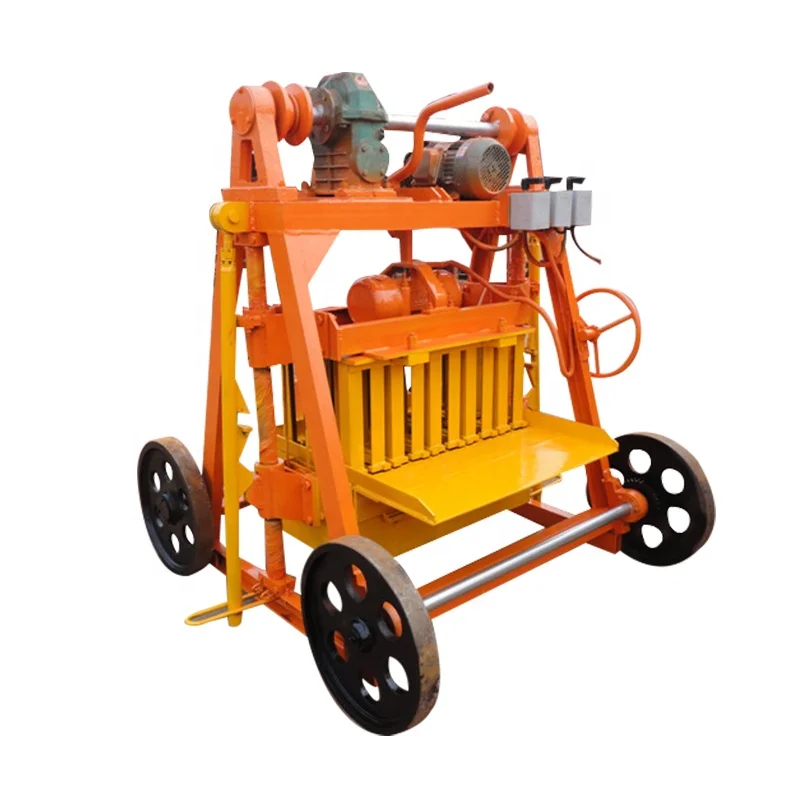
Matched Line Integration — Every QMJ4-45 unit ships with pallet flow, curing layout, and raw feed timing calculated together, so the press never waits on upstream or downstream stations.
Technical Specifications
| Parameter | Value |
|---|---|
| Model | QMJ4-45 |
| Product Type | Mobile Egg Laying Block Making Machine |
| Molding Capacity | 4 pcs/mold |
| Vibration Frequency | 2400 r/m |
| Vibration Method | Mold vibration |
| Molding Cycle | 45 s |
| Demold Method | Manual |
| Turning Method | Manual |
| Total Power | 6 kW |
| Power Source | Diesel/Petrol engine |
| Automation Level | Manual operation |
| Pallet Requirement | None (egg laying type) |
| Productivity (400×200×200mm hollow block) | 3000 pcs/day (8 h, 4 pcs/mould, 40–45 s cycle) |
| Productivity (400×150×200mm hollow block) | 3500 pcs/day (8 h, 5 pcs/mould, 40–45 s cycle) |
| Productivity (400×120×200mm hollow block) | 4500 pcs/day (8 h, 6 pcs/mould, 40–45 s cycle) |
| Warranty | One year |
Application Suitability
| Application | Material or Output |
|---|---|
| On-site hollow block production for contractors | Crushed stone, sand, cement, water |
| Remote construction site block manufacturing | Local aggregate with cement binder |
| Small-scale paving brick runs | Fine aggregate and cement mix |
| Temporary housing project supply | Multicellular brick and standard brick formats |
Why "4000 Blocks a Day" Rarely Means What the Brochure Says
The quoted daily output assumes a specific block format, mould cavity count, and cycle time — change any one of those and the number shifts dramatically.
Many buyers see a headline productivity figure on a mobile block machine production line and plan their entire project schedule around it. Then they arrive on site, fit a different mould, and realise the cycle stretches longer or the mould holds fewer cavities than the baseline assumed. I have watched crews on Southeast Asian job sites lose half a shift simply because the daily target was built around a 400×120×200mm block while the local market only buys 400×200×200mm hollow blocks. The machine ran fine; the expectation was wrong. [NEED_CITE: block format assumptions in mobile block maker quotations]
How the Egg Laying Design Removes Pallet Logistics
The QMJ4-45 places each freshly pressed block directly onto the ground and moves forward on its own wheels. No pallets travel through the press, so there is no pallet return conveyor, no pallet cleaning station, and no pallet inventory to manage. For a contractor setting up a mobile block machine production line on a remote job site, this removes an entire material handling loop that would otherwise demand forklifts, rack space, and extra labour.
Where Line Timing Decides Your Actual Throughput
A press that finishes a cycle every 45 seconds needs a mixer discharging fresh batch on the same rhythm and a flat, cured section of floor ready to receive the next row. When the mixer falls behind, the operator stands idle; when the floor space runs out, blocks stack on top of each other before they gain enough green strength. [NEED_CITE: mobile block production line synchronization requirements] I learned this the hard way pairing an egg layer with a batch mixer that took three minutes per charge — the press sat empty two-thirds of the time, and daily output dropped far below what the mould cavity count suggested.
Reading the Specs That Actually Shape Block Quality
Vibration frequency at 2400 r/m acts through the mould, not the table, which means the energy concentrates on the block sitting inside the cavity rather than dispersing across a heavy steel platen. This mould vibration approach works well with stiff, low-slump mixes that rely on high-frequency shaking to settle around coarse aggregate. The 6 kW total power budget covers both the vibration motor and the small hydraulic pack that assists demoulding. Because the power source is a diesel or petrol engine, the machine operates independently of grid electricity, which matters on sites where voltage fluctuation would otherwise trip a sensitive motor starter. [NEED_CITE: diesel engine reliability on remote construction sites]
What Happens When Upstream Feed Cannot Keep Pace
A mobile block machine production line that pairs the QMJ4-45 with an undersized mixer forces the operator to wait between cycles. Each minute of idle time compounds across an eight-hour shift, and the daily tally falls well short of the quoted figure. Worse, an inconsistent mix arriving late can cause partial fills in the mould, producing blocks with thin walls that crumble during demoulding. I have seen entire batches scrapped because the raw material feeder was calibrated for a different aggregate gradation than what the local quarry actually delivered.
Why Buyers Source the Line Here
The QMJ4-45 is never quoted as a standalone press. Pallet flow is irrelevant for this egg layer, but mixer discharge rate, curing area layout, and raw feed configuration are specified as one matched system so the operator never waits on any station.
Capacity calculations are stated per block format — 3000 pcs/day for 400×200×200mm, not a vague headline number — so buyers know exactly what to expect before the machine ships.
Mould options cover the hollow block sizes that the buyer’s local market actually purchases, with custom drawings available for formats outside the standard list.
Voltage and engine type are confirmed before production begins, preventing the situation where a machine arrives on site and cannot start because the local frequency does not match the motor nameplate.
Operator training covers not just the press but the mixing rhythm and curing sequence, which is where most output losses actually occur.
Documentation & Verification
- Line layout drawing showing mixer-to-press timing for your chosen block format
- Mould drawing and format list confirming cavity count per block size
- Factory test record run on your target aggregate before dispatch
- Voltage and engine type confirmation sheet signed before production
- Operation manual covering mixing ratios and ground preparation steps
Installation, Commissioning & Support
- Flat concrete ground at least 15 m long required for continuous egg laying runs with the QMJ4-45
- Diesel engine arrives pre-filled; first oil change after initial 50-hour break-in period
- Mould change involves unbolting four locating pins and can be completed during a lunch break
- Spare vibration motor and belt kit shipped with the machine for first-year coverage
- Operator training covers 45-second cycle pacing and raw feed timing
Before You Request a Quote
Tell us which hollow block sizes your local market actually buys and the daily volume you need to sustain. Share the aggregate gradation available from your nearest quarry so we can confirm mix compatibility with the mould vibration system. Confirm whether your site has any grid power at all, or if the diesel engine will be the sole power source for the entire mobile block machine production line.
Frequently Asked Questions
Q: How is the daily output figure calculated for this machine?
A: Output depends on the block format and mould cavity count. For a 400×200×200mm hollow block the mould holds four cavities and produces around 3000 pieces over an eight-hour shift at a 40–45 second cycle. Switching to a 400×120×200mm mould with six cavities raises that to approximately 4500 pieces. Always confirm which format the quoted figure assumes.
Q: Can the machine switch between diesel and electric power?
A: The standard configuration uses a diesel or petrol engine for sites without grid electricity. An electric motor option is available if your site has stable power. Voltage and frequency must be confirmed before production so the motor matches your local supply standard.
Q: What ground conditions are needed for egg laying operation?
A: The surface must be flat, hard, and clean — a cured concrete slab or compacted hardstanding works. Soft soil causes blocks to tilt before they gain green strength. The area needs enough length for a full day’s production since blocks remain in place until curing is complete.
Q: How long does a mould change take on the QMJ4-45?
A: An experienced operator can swap moulds during a standard break by releasing the locating pins and lifting the old mould clear. Additional mould formats can be ordered separately and shipped later, provided the cavity dimensions fit within the machine’s mould frame envelope.
Q: Does the machine work with locally sourced aggregate?
A: The mould vibration system handles a range of aggregate gradations, but the mix must be stiff and low-slump for egg laying. We ask buyers to share their local aggregate sieve analysis so we can confirm compatibility and adjust the vibration intensity if needed before the machine leaves the factory.


