
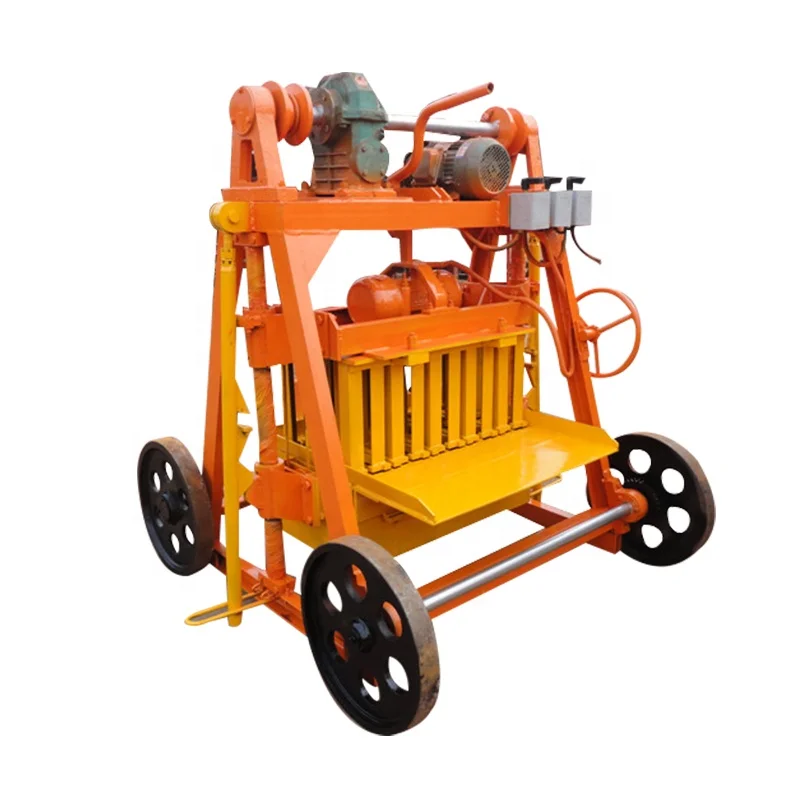
Matching system design — the QMJ4-45 is specified as one line, not a press alone; we map the pan mixer capacity and curing area to the egg-laying cycle so the machine never waits empty for the next batch.
Technical Specifications
| Parameter | Value |
|---|---|
| Model | QMJ4-45 |
| Product Type | Mobile Egg-Laying Block Making Machine |
| Molding Capacity | 4 pcs/mold for 400×200×200 mm hollow block |
| Vibration Frequency | 2400 r/min |
| Productivity | 3000 pcs/day based on 400×200×200 mm hollow block in 8 hours |
| Forming Method | Mold vibration with twice-vibration core |
| Demold / Turning Method | Manual |
| Total Power | 6 kW |
| Power Source | Diesel / Petrol engine |
| Molding Cycle | 40-45 s |
| Pallet Requirement | Not required (egg-laying type) |
| Automation Level | Manual operation |
Application Suitability
| Application | Material or Output |
|---|---|
| On-site hollow block production without fixed plant | Concrete mix from crushed stone, sand, cement |
| Development and housing project sites | 400×120×200 mm blocks up to 6 pcs/mould |
| First-time block plant with minimal infrastructure | Multicellular and standard bricks |
| Remote job sites without grid electricity | Diesel-powered mobile line layout |
Why "3000 Blocks a Day" Means Nothing Without the Rest of the Line
The QMJ4-45 output is only as real as the mixer feeding it and the curing space receiving it.
I have watched an egg-laying press sit idle because the pan mixer could not discharge fast enough, leaving three cycles empty in a row. The press cadence is 40-45 seconds; if your batcher takes longer than that to deliver the next mix, the mobile egg-laying block making machine production line is effectively running at half speed [NEED_CITE: cycle time synchronization between mixer discharge and press feed]. The daily output figures assume a continuous feed and an 8-hour shift — strip either assumption and the number changes.
Mapping the Upstream Feed to the Press Cadence
The twice-vibration molding core needs a consistent, well-graded mix arriving every 40-45 seconds. A pan mixer matched to the QMJ4-45 must discharge one full batch within that window, or the operator is standing around. We size the mixer drum and the raw material conveyor as one unit with the press, not as separate purchases that may or may not talk to each other. When the mobile egg-laying block making machine production line is specified this way, the diesel engine never idles through an empty cycle.
Curing Area Layout Dictated by Egg-Laying Pattern
Because this machine lays blocks directly on the ground without pallets, the curing zone is the ground itself. That means your site must have a flat, compacted concrete or hard-packed area large enough to hold an entire day’s output — up to 3000 pieces based on 400×200×200 mm blocks — without forklifts driving over freshly set units [NEED_CITE: ground-bearing requirements for egg-laying block curing zones]. The layout of the mobile egg-laying block making machine production line must account for a walking path the machine follows each cycle and a separate access route for water spraying during curing.
Reading the Specs That Actually Matter on Site
The twice-vibration molding core replaces the older single-pass vibration, meaning the mold shakes the concrete in two stages to drive air pockets out and pack aggregate tighter. At 2400 r/min, this gives noticeably higher block density in hollow formats where wall thickness is thin and weak spots show up fast. The 6 kW total power draw is low enough that a portable generator or small diesel engine handles it without a dedicated transformer, which matters on remote sites where the mobile egg-laying block making machine production line operates far from the grid. Manual demold and turning mean the operator controls each release — this is not a drawback but a design choice that keeps the machine simple enough to run without trained technicians, provided the upstream mix is consistent.
What Happens When the Line Is Not Specified Together
A buyer who orders the press alone and sources the mixer locally often ends up with a batcher that takes 60 seconds per discharge against the press’s 45-second cycle. The gap fills with idle time that compounds across an 8-hour shift. Curing without a planned water-spraying route means outer blocks dry faster than inner ones, causing uneven strength across the same day’s batch [NEED_CITE: differential curing rates in open-air egg-laying block yards]. These are not machine faults — they are line-specification faults, and they surface only after the first week of production.
What a Matched-Line Supplier Does Differently
We treat the QMJ4-45 as one station in a mobile egg-laying block making machine production line, not a standalone invoice item. The mixer capacity is calculated against the 40-45 second cycle and the buyer’s local aggregate grading. The curing area footprint is drawn based on the specific block format ordered, not a generic site plan. Engine or electric motor options are confirmed against the buyer’s site power availability before production starts. Mould selection is matched to the formats the local market actually buys, not just what the catalog lists.
Documentation & Verification
- Factory test record on the buyer’s chosen hollow block format before dispatch
- Line layout drawing showing mixer, press path and curing zone dimensions
- Mould drawing with format list and cycle time per block type
- Engine or motor specification sheet matched to confirmed power source
- Operation manual covering twice-vibration core maintenance intervals
Installation, Commissioning & Support
- Flat compacted ground required — no foundation pour, matching the egg-laying design
- Diesel engine commissioning includes fuel-line bleed and cold-start procedure on site
- Manual demold training covers release timing to avoid corner damage on thin-wall blocks
- Twice-vibration core bearing inspection schedule set at first service interval
- Spare mould plate and vibration shaft seal shipped with initial dispatch
- Curing water-spraying pattern drawn to match the machine’s daily walking path
What We Need to Size Your Line Correctly
To spec the QMJ4-45 as part of a working line, send the target block format and wall thickness, the local aggregate type and grading you will use, and whether grid power is available or a diesel setup is required. Also confirm the site area available for the curing zone so we can calculate whether an 8-hour shift fits or the walking path needs to loop.
Frequently Asked Questions
Q: How is the daily output figure calculated for the QMJ4-45?
A: The 3000 pieces per day rating is based on producing 400×200×200 mm hollow blocks over an 8-hour shift, assuming continuous material feed. Different block formats change the count — for example, the 400×120×200 mm mould holds 6 pieces and yields up to 4500 pieces in the same period, provided the mixer keeps pace.
Q: What mixing equipment does the QMJ4-45 need upstream?
A: A pan mixer sized to discharge one full batch within the 40-45 second press cycle keeps the line moving without idle gaps. We calculate the mixer drum volume and conveyor feed rate against the buyer’s specific mix design so the mobile egg-laying block making machine production line runs at stated capacity.
Q: How does egg-laying affect the curing area layout?
A: Blocks are placed directly on the ground, so the curing zone must be a flat, compacted surface large enough to hold a full day’s output. The machine’s walking path and forklift access routes must be planned so freshly laid blocks are not driven over during curing.
Q: Can the machine run on local aggregate and cement?
A: Yes — the mix design is adjusted to the buyer’s available crushed stone, sand, and cement ratio. We configure the vibration intensity and mold clearance around that specific blend rather than a default setting, so block strength stays consistent across batches.
Q: What supporting equipment completes the mobile line?
A: Beyond the press, the line typically includes a pan mixer, raw material feeder, water supply for curing, and a designated flat curing area. We layout each station so cycle times align and the QMJ4-45 is never waiting for the next batch.


