
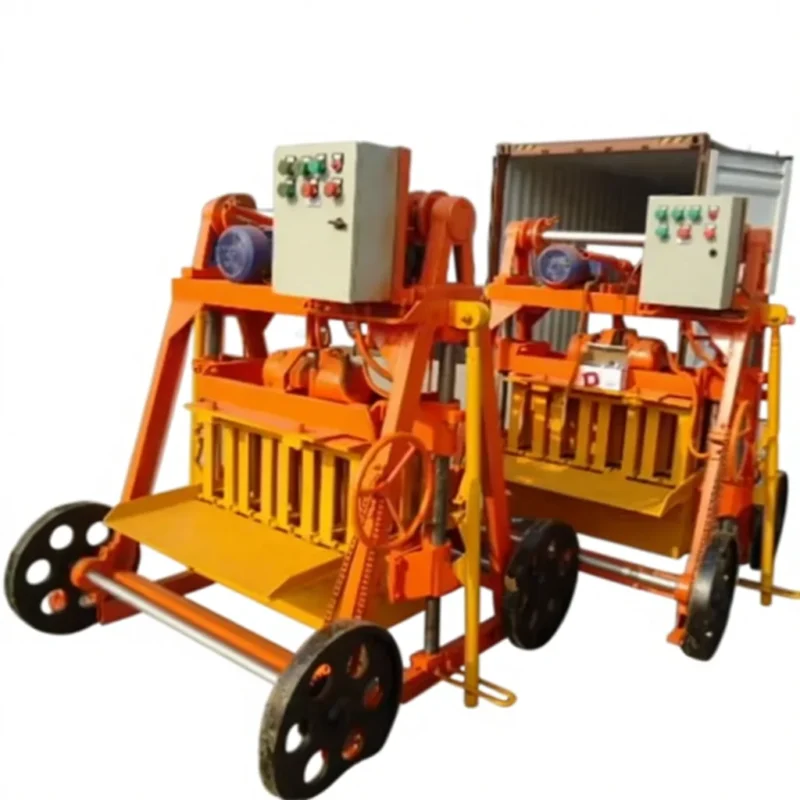
Pallet-Free Line Design — the QMJ4-45 mobile block machine production line is specified as a complete on-site system where mixing output, molding cycle and curing area are balanced so the press never waits and blocks are never stacked by hand.
Technical Specifications
| Parameter | Value |
|---|---|
| Model | QMJ4-45 |
| Product Type | Mobile Egg-laying Concrete Block Making Machine |
| Machine Power | 7.4 kW |
| Molding Cycle | 45 s |
| Output Capacity | 2400 pcs / 8 h (basis: 400×200×200 mm hollow block, 4 pcs/mould) |
| Output Capacity (Alt.) | 3200 pcs / 8 h (basis: 400×150×200 mm block, 5 pcs/mould) |
| Throughput | 300 pcs/h (400×200×200 mm) / 400 pcs/h (400×150×200 mm) |
| Raw Materials | Concrete, sand, cement, fly ash, lime, gypsum |
| Machine Weight | 1 T |
| Overall Dimensions (L×W×H) | 1550 × 1335 × 1580 mm |
| Pallet Size | No pallets required (egg-laying type) |
| Voltage | Configurable to buyer’s local supply (basis to be confirmed) |
| Control Mode | Manual force control + jog control |
| Guidance System | Four-pole orientation with ultralong orientation bearing |
| Mould Change | Interchangeable moulds for road blocks, curb stones, hollow bricks |
| Electrical & Hydraulic Components | Imported electrical appliances, sealing parts and hydraulic components |
| Automation Level | Semi-automatic |
| Assembly State | Fully assembled for mobile on-site operation |
Application Suitability
| Application | Material or Output |
|---|---|
| On-site housing project production | Hollow and solid blocks from local crushed stone and cement |
| Rural infrastructure contracting | Curb stones and road blocks from fly ash and sand mixes |
| First plant setup by entrepreneurs | Interlocking bricks and porous bricks using available aggregate |
| Remote site supply by distributors | Multiple block formats from one machine without pallet inventory |
Why the Press Is Never Left Waiting in a Mobile Block Machine Production Line
The 45-second molding cycle sets the tempo — upstream mixing and material feeding must deliver a fresh batch every 45 seconds or the QMJ4-45 sits idle.
I have watched a mobile egg-laying block machine supporting equipment setup stall because the pan mixer could not discharge fast enough. The press operator hit the jog button, waited, hit it again. By midday the crew was hand-feeding half-mixed material just to keep moving, and block density varied across every row laid on the ground. When the line is planned as a whole — feeder capacity matched to mixer discharge, mixer discharge matched to the 45-second press cycle — the bottleneck disappears [NEED_CITE: line balancing principles for small-scale block production]. Without that calculation, the rated output of 2400 pcs / 8 h (basis: 400×200×200 mm hollow block, 4 pcs/mould) becomes a number that only appears on paper.
How the Stations Connect Around a Pallet-Free Press
A mobile block machine production line built around the QMJ4-45 removes three stations that a fixed plant requires: pallet feeding, pallet return and pallet storage. That simplification is the reason contractors choose egg-laying machines for project sites. The trade-off is that raw material feeding and mixing become the only upstream stations, and their output must be precisely timed. A typical setup pairs a small batch mixer positioned within wheelbarrow distance of the press hopper, with one operator managing the feed rhythm.
Ground Preparation and Curing Area Planning
Since blocks are laid directly on the ground, the production surface must be level, compacted and large enough to hold a full shift’s output before blocks are moved to the curing zone. For a daily run of 2400 pcs / 8 h (basis: 400×200×200 mm hollow block, 4 pcs/mould), the laying area needs to accommodate that volume without the machine doubling back over freshly placed blocks. Curing begins immediately on the ground, so water access and covering materials must be staged along the production path, not brought in after the shift ends [NEED_CITE: on-site concrete block curing methods in tropical climates].
What the Specs Actually Mean on the Job Site
The 7.4 kW machine power covers both the vibration motor and the hydraulic system within a single compact frame weighing 1 T. This power rating is typical for egg-laying machines that produce four to five blocks per cycle, and it determines the generator capacity needed on sites without grid power. The four-pole guidance system with ultralong orientation bearing keeps the press head aligned with the mould through every cycle — when alignment drifts, block height becomes inconsistent and the next row of blocks will not sit flat. Mould interchangeability across hollow blocks, road blocks and curb stones means one QMJ4-45 can serve several product formats on the same site, but each format change requires the operator to physically swap the mould and adjust the feed volume. The imported electrical and hydraulic sealing components are specified for environments where dust and moisture degrade standard parts quickly, which is a common issue on open-air construction sites.
The Hidden Cost of Under-Sizing the Mixer
When the mixer upstream of the QMJ4-45 is too small, the 45-second cycle stretches into two or three minutes of waiting. That lost time compounds across an eight-hour shift, and the daily output drops well below the rated figure. Beyond lost volume, inconsistent feed timing forces the operator to rush the next cycle, which reduces vibration compaction and produces weaker blocks. I have seen crews blame the press for low strength when the real problem was a pan mixer running at half the required batch weight [NEED_CITE: impact of batch consistency on concrete block compressive strength]. The line only performs when every station is sized to the same cycle.
Why This Machine Is Sourced as Part of a Line
Block machinery is our single focus, so the QMJ4-45 is never quoted as a standalone press — the mixer, feeder and curing plan are included from the first proposal. Configuration is set against your actual mix design and local aggregate, not a catalogue default. Mould design covers the formats your market sells, with custom drawings available. Automation level starts at semi-automatic, so you can begin with manual pallet handling on other lines and keep the mobile unit as a flexible addition. Installation support includes operator training on cycle timing and mould changes specific to the QMJ4-45.
Documentation & Verification
- Line layout showing mixer-to-press distance and material flow for the QMJ4-45 cycle
- Capacity calculation sheet stating block format assumed for daily output
- Mould drawing and format list with dimensions for each interchangeable mould
- Voltage and control language confirmation signed before dispatch
- Factory test record on buyer-specified raw material sample
- Packing photographs showing dismantling state for container loading
Installation, Commissioning & Support
- Level compacted ground area sized to hold 2400 blocks before curing relocation
- Power supply matching confirmed voltage and frequency with dedicated 7.4 kW circuit
- Machine arrives fully assembled; only mould installation required before first run
- First-cycle commissioning with operator training on 45-second feed rhythm
- Spare sealing parts and hydraulic wear components shipped with initial order
- Daily bearing lubrication schedule tied to four-pole guidance system maintenance
What We Need to Plan Your Line
Send us your target block format, daily output requirement and the type of aggregate available at your project site. Confirm the local voltage and frequency so the electrical system is built correctly before the QMJ4-45 leaves the factory. If you already have a mixer or feeding equipment on site, share the model and batch capacity so we can verify the cycle match.
Frequently Asked Questions
Q: What supporting equipment is needed around the QMJ4-45 to run a complete line?
A: The QMJ4-45 requires a batch mixer sized to discharge a full charge within 45 seconds, a raw material feeder for consistent aggregate proportioning, and a prepared ground area for block laying and curing. No pallets, pallet feeders or pallet return conveyors are needed since this is an egg-laying mobile block machine production line.
Q: How is capacity calculated per block format and why does the figure change?
A: Capacity depends on how many blocks fit in one mould. With 400×200×200 mm hollow blocks the mould produces 4 pcs per 45-second cycle, yielding 2400 pcs / 8 h. A 400×150×200 mm mould holds 5 pcs per cycle, raising output to 3200 pcs / 8 h. Always check which format the quoted number assumes.
Q: What ground preparation and curing area does the mobile line require?
A: The production surface must be flat, compacted and large enough to hold the full shift output without the machine crossing freshly laid blocks. Curing starts immediately on the ground, so water access and covering materials should be staged along the production path before the shift begins.
Q: How must upstream mixing match the 45-second molding cycle?
A: The mixer must complete one batch and discharge it into the press hopper within 45 seconds. If the batch takes longer, the press idles and daily output drops. We size the mixer capacity and position it relative to the QMJ4-45 so the feed rhythm stays unbroken throughout the shift.
Q: What voltage and frequency confirmation is needed before shipment?
A: The QMJ4-45 electrical system is built to match the buyer’s local supply. We require written confirmation of voltage, frequency and phase before production begins, because rewiring a 7.4 kW motor and control panel on site delays commissioning and risks component damage.


