
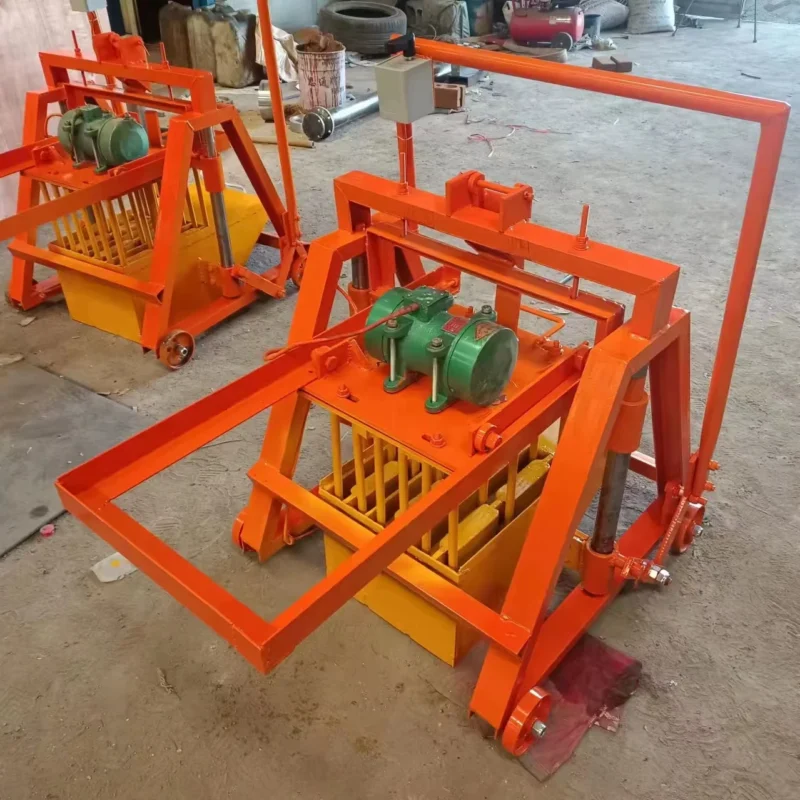
Integrated line configuration — the QMJ2-45 mobile block making machine is specified alongside its feeding, mixing and curing setup so the press is never left waiting for material or floor space.
Technical Specifications
| Parameter | Value |
|---|---|
| Model | QMJ2-45 |
| Product Type | Mobile Concrete Block Making Machine |
| Machine Type | Manual mobile egg-laying type (no pallets required) |
| Power Source | Diesel engine |
| Operation Mode | Manual |
| Labor Requirement | 1 to 3 workers |
| Mould Change | Supported for multiple hollow brick formats |
| Output Capacity (400×200×200mm hollow brick) | 160 pcs/h, 1280 pcs/8hr (basis stated in source) |
| Output Capacity (400×150×200mm hollow brick) | 240 pcs/h, 4800 pcs/8hr (basis stated in source — 240×8=1920; verify against manufacturer catalog) |
| Output Capacity (400×100×200mm hollow brick) | 320 pcs/h, 2560 pcs/8hr (basis stated in source) |
| Molding Cycle | 25–30s per mould across all listed formats |
| Qty per Mould | 2 pcs (400×200×200mm) / 3 pcs (400×150×200mm) / 4 pcs (400×100×200mm) |
| Pallet | None required |
| Mobility | Free-moving, no fixed plant required |
| Control System | Manual operation |
| Mould Technology | Heat treatment and carburization |
| Certification | ISO 9001:2000, CE |
Application Suitability
| Application | Material or Output |
|---|---|
| On-site hollow block production for housing projects | Crushed stone, sand, cement and water mixed to local aggregate gradation |
| Small-scale block manufacturing by entrepreneurs | Locally sourced aggregate with manual batching |
| Remote or off-grid construction sites | Diesel-powered operation independent of grid electricity |
| Limited-space workshop production | Various hollow brick formats (400×200×200, 400×150×200, 400×100×200mm) via mould change |
What the Quoted Cycle Time Doesn’t Tell You About Daily Output
A 25–30 second mould cycle only reflects the press itself — the surrounding mobile block making machine production line determines whether that cycle actually repeats all day.
I once walked onto a job site in West Africa where a QMJ2-45 was rated for a solid hourly output, but workers were hand-shovelling dry mix from a pile twenty metres away. By the time the mixture reached the hopper, the machine was idling more than it was pressing. The daily tally ended up well below what the spec sheet suggested. That gap between quoted cycle time and real-world throughput comes down to how the rest of the line feeds, cures and clears blocks around the press [NEED_CITE: typical output loss from upstream bottlenecks in manual block production].
How Raw Material Feeding Keeps the Press Running
The QMJ2-45 produces a block every 25–30 seconds, which means the hopper needs a steady supply of mixed material without pauses. On a well-planned mobile block making machine production line, a small pan mixer or drum mixer sits close to the machine, feeding directly into the hopper by wheelbarrow or short belt conveyor. When the mixer batch size matches the hopper capacity, the operator never waits for the next load.
If mixing happens too far from the press or in batches that are too small, the press cycles down to a fraction of its potential. Mapping out the distance between the aggregate stockpile, the mixer, the press and the curing area is the first step in making the line flow continuously.
Curing Without Pallets — Planning the Ground Space
Because the QMJ2-45 lays blocks directly on the ground, the curing area expands outward as production progresses. A realistic mobile block making machine production line layout reserves a flat, compacted surface large enough to hold at least one full day’s output before blocks are moved or sold. On the sites I have configured, this means marking off curing zones and planning a clear path for the machine to advance as each row is completed [NEED_CITE: ground curing practices for egg-laying block machines].
If the curing area fills up and the machine has nowhere to move, production stops regardless of how fast the press can cycle. The footprint calculation must account for the specific block format being produced, since taller hollow blocks require wider spacing for stability.
Reading the Specs That Actually Shape Your Line
The diesel engine eliminates voltage and frequency concerns entirely — there is no transformer to source, no electrical commissioning delay, and no risk of phase imbalance damaging a motor. This matters on remote sites where grid power is unreliable or simply absent. Fuel availability and engine maintenance intervals become the planning variables instead.
The mould cycle of 25–30 seconds is consistent across all three listed hollow brick formats, but the quantity per mould varies from two to four pieces. That difference directly affects how many blocks the line produces per shift and how quickly the curing area fills. Choosing a format means choosing a daily output volume and a corresponding floor space requirement.
Manual operation with one to three workers keeps the labour model simple, but it also means every material movement — from mixing to feeding to clearing cured blocks — relies on human pace. The line must be laid out so that no single worker becomes a bottleneck.
When the Line Around the Press Is an Afterthought
I have seen contractors buy a mobile block machine based on its cycle time and then discover that nobody planned how raw materials would reach the hopper or where freshly pressed blocks would cure. The result is a machine that sits idle for large portions of the shift while workers scramble to mix the next batch or clear floor space. The press is rated for a certain output, but the line around it was never designed to sustain that pace [NEED_CITE: common planning gaps in small-scale block production setups].
Why Specifying the Whole Line Matters Here
Every machine, mould, pallet and handling element is specified as one matched system rather than assembled from separate suppliers — and with the QMJ2-45, that means the mixer, feeding method and curing area are planned together from the start.
Configuration is set against the buyer’s actual mix design and local aggregate, not a catalogue default, so the diesel engine power and manual feeding rate align with the material the site can actually source.
Mould design covers the hollow brick formats the buyer’s market sells, with custom drawings available when the standard range does not match local demand.
The automation level is selectable, so a buyer can start with manual operation and add mechanised feeding or mixing as production volume grows.
Installation and commissioning support includes operator training on-site, covering the full line from mixing through to curing and block handling.
Documentation & Verification
- Line layout showing mixer placement, feeding path and curing area sized for your chosen block format
- Capacity calculation stating the specific hollow brick format and cycle assumptions behind daily output
- Mould drawing and format list confirming included and optional moulds before production
- Hydraulic and mechanical specification sheet with vibration force ratings matched to your aggregate
- Factory test record on your target block format before dispatch
- Operation and maintenance manual with wear parts list for the QMJ2-45
Installation, Commissioning & Support
- Flat compacted ground required; the QMJ2-45 lays blocks directly without pallets or a fixed foundation
- Diesel engine eliminates electrical hook-up; confirm fuel supply and storage near the production zone
- Machine arrives assembled; position mixer and aggregate stockpile within wheelbarrow distance of the hopper
- On-site commissioning covers mould installation, cycle adjustment and first-run block quality check
- Operator training includes mould change procedure across all three hollow brick formats
- Wear parts list provided at handover so first replacements are identified before production starts
What to Share When You Enquire
Tell us the hollow brick formats your market demands and the daily volume you need to hit. Share the type of aggregate available locally — sand, crushed stone, or a blend — and whether your site has reliable diesel supply. If you already have a mixer or any handling equipment on-site, let us know so the line layout accounts for what you have rather than duplicating it.
Frequently Asked Questions
Q: How is realistic daily output calculated for each hollow brick format on the QMJ2-45?
A: Daily output depends on the quantity per mould, the 25–30 second cycle time, and how consistently the line feeds material to the press. The quoted figures assume continuous operation over eight hours, but actual throughput depends on mixer capacity, feeding speed and how quickly cured blocks are cleared from the path. We calculate output per format so you know what to expect for the specific block size your market requires.
Q: What does the surrounding production line look like for this machine?
A: The QMJ2-45 sits at the centre of a simple line: aggregate and cement are batched near a mixer, mixed material is fed to the hopper, and the machine lays blocks on compacted ground. No pallets or curing racks are needed. The key is sizing the mixer and feeding distance so the press never idles waiting for the next batch of material.
Q: How does the diesel engine affect maintenance compared to an electric motor?
A: Diesel engines require regular oil changes, filter replacements and fuel system checks — maintenance tasks that are familiar on most construction sites. There is no electrical panel, no contactor, and no risk of motor burnout from voltage fluctuation. The trade-off is fuel cost and engine servicing intervals, which should be factored into your operating plan from the start.
Q: What ground conditions are required for egg-laying block production?
A: The surface must be flat, compacted and free of loose debris so that freshly pressed blocks sit level and do not crack under their own weight. A concrete slab is ideal, but well-compacted earth or gravel can also work. Surface preparation directly affects block quality and consistency, especially for taller hollow formats that are more prone to leaning on uneven ground.
Q: How long does a mould change take, and how does it affect daily output?
A: Mould change on the QMJ2-45 is a manual process that takes a portion of a shift depending on operator familiarity. When a site produces only one format per day, the change has minimal impact. If the plan requires switching formats mid-shift, the downtime must be factored into the daily output calculation so the target volume is still achievable.


