
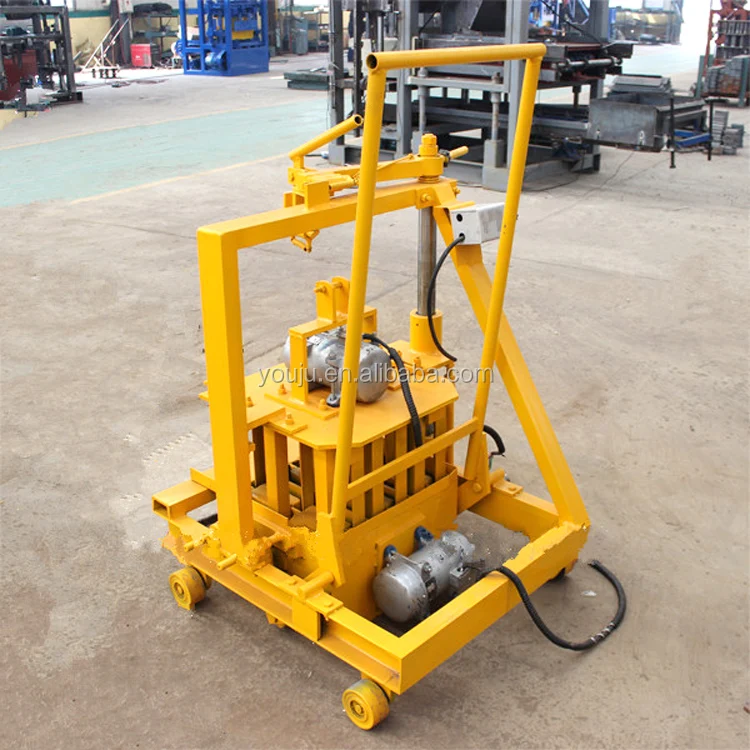
QMJ2-45 Mobile Block Making Machine for Hollow Blocks – Production Line
Single-Line Planning — the QMJ2-45 is specified as the centre of a matched mobile block line where mixing, feeding and curing are sized to its 25–30 s cycle time, not quoted as an isolated press.
Technical Specifications
| Parameter | Value |
|---|---|
| Model | QMJ2-45 |
| Product Type | Mobile Block Making Machine |
| Machine Type | Mobile, egg-laying |
| Pallet Requirement | No pallets required |
| Block Formats Produced | Hollow brick |
| Cycle Time | 25–30 s per mould |
| Output Capacity (400×200×200 mm hollow brick) | 2 pcs/mould, 160 pcs/hour, 1280 pcs/8hr shift |
| Output Capacity (400×100×200 mm hollow brick) | 4 pcs/mould, 320 pcs/hour, 2560 pcs/8hr shift |
| Output Capacity (400×150×200 mm hollow brick) | 3 pcs/mould, 240 pcs/hour (basis not stated in source) |
| Labour Requirement | 1 to 3 workers |
| Power Source | Electric engine |
| Mould Change | Manual |
| Mobility | Free-moving, no fixed plant required |
| Automation Level | Manual / semi-automatic |
| Certification | ISO 9001, CE |
Application Suitability
| Application | Material or Output |
|---|---|
| On-site hollow block production for small-scale contractors | Crushed stone, sand and cement mixes laid directly on ground |
| Rural building projects without fixed block plant | Hollow brick 400×200×200 mm and 400×100×200 mm formats |
| Development and housing projects with limited curing yard | Daily output of 1280 to 2560 hollow bricks per 8-hour shift |
| Entrepreneurs starting a first block operation | Low-capital setup with 1 to 3 workers and manual mould change |
| Existing producers adding hollow brick formats | Supplementary egg-laying production alongside fixed plant |
What "1280 Blocks per Shift" Leaves Out of a mobile block making machine production line
The quoted number only holds when the mixer keeps up, the curing yard has room and the local aggregate actually compacts under static pressure.
I once watched a QMJ-class egg-laying machine arrive at a Middle East site where the spec sheet promised steady output through the shift. What the spec did not account for was the high-clay sand the contractor was using locally. The static pressure on this class of machine is modest, and that clay-rich mix refused to consolidate properly, so block strength dropped sharply and the crew spent half the shift pulling cracked pieces off the ground [NEED_CITE: aggregate clay content limits for static-pressure block machines]. When we talk about a mobile block making machine production line, the conversation has to start with what sand, what cement and what curing yard the buyer actually has on the day the container arrives, not with the number on the brochure.
How the line is built around the press
A mobile block making machine production line is only as fast as its slowest station, and on a pallet-free egg-laying layout the bottleneck is almost never the press itself. The QMJ2-45 cycles a mould every 25 to 30 seconds, which means a small pan mixer or drum mixer has to deliver a fresh batch to the operator roughly every few minutes throughout the shift. If the mixer is undersized or the aggregate is still being shovel-fed from a stockpile twenty metres away, the press sits idle and the shift output collapses well below the figures in the table above.
Curing yard and water supply have to match the shift
The 400×200×200 mm hollow brick output is quoted at 1280 pieces per 8-hour shift, and every one of those blocks stays exactly where the machine laid it on the ground. That means the curing yard has to be long enough and flat enough to accept a full shift of production, with room for walkways and the next day’s run alongside [NEED_CITE: curing yard sizing for egg-laying block operations]. Water supply is the other half of the same problem; hollow blocks in hot climates need several wetting cycles a day to reach usable strength, and a site with only a single hose and a small tank will see surface cracking before the blocks are three days old.
Reading the spec table the way a plant owner reads it
Cycle time of 25 to 30 seconds per mould sounds straightforward, but it only translates into the listed hourly output when the operator can move the machine forward, drop the next mould and clear the previous block without waiting. On the 400×100×200 mm hollow brick the machine produces four pieces per mould at a stated 320 per hour, which is a reasonable figure for a crew that has already worked together. The 400×150×200 mm line shows 240 per hour in the source data, though the cycle time that produces that figure is not stated, so a buyer planning around that format should ask for a confirmed time study before signing off on daily targets. Power source is listed as an electric engine; voltage and frequency are not stated in the current documentation and must be confirmed against the buyer’s site supply before the machine ships, because a 50 Hz motor on a 60 Hz grid will run the vibration cycle at the wrong speed from day one.
What happens when the supporting stations are an afterthought
I have seen pallet-free mobile lines arrive on site with the press working exactly as it did in the factory test, only for the contractor to discover that no small-batch mixer was included in the shipment and no curing plan existed beyond "we will water them when we can." The result is not a broken machine; it is a site where the mobile block making machine production line runs for two hours, runs out of mix, and then the crew spends the rest of the shift stacking blocks by hand because the curing area was never laid out in advance [NEED_CITE: hidden cost of unspecified supporting stations in mobile block quotations]. Labour that was supposed to be one to three workers quietly becomes five or six, and the per-block cost the buyer budgeted for is gone before the first week is out.
Why this line is planned here and not assembled from separate quotes
Block machinery is the single focus of the supplier behind the QMJ2-45, which means the press, the mould and the supporting equipment are specified as one matched system rather than collected from unrelated vendors. Configuration is set against the buyer’s actual mix design and local aggregate, not against a catalogue default that assumes clean river sand. Moulds for the hollow brick formats the buyer’s market actually sells are designed and supplied with drawings, and custom formats can be added to the same machine as demand shifts. Automation level is selectable, so a buyer starting with manual pallet-free operation can move to a semi-automatic feed arrangement later without replacing the press. Installation support includes on-site commissioning and operator training that covers the specific mix and cycle rhythm of that site.
Documentation & Verification
- Line layout drawing showing mixer position, QMJ2-45 travel path and curing yard sized to the stated 8-hour output.
- Capacity calculation stating the exact hollow brick format, cycle time and shift length assumed for each figure.
- Voltage, frequency and electric motor rating confirmed in writing before dispatch.
- Mould format list and mould drawing for each hollow brick size required by the buyer’s market.
- Factory test record run on the buyer’s nominated aggregate and target block format.
Installation, Commissioning & Support
- Flat, compacted ground along the full travel path of the QMJ2-45 to prevent block cracking on laying.
- Power supply matched to the confirmed electric motor rating with a dedicated circuit breaker for the vibration and travel motors.
- Mixer positioned within a few metres of the press so one worker can keep the mould fed at a 25–30 second cycle.
- First-day commissioning covers mix adjustment, static pressure setting and cycle rhythm for the buyer’s local aggregate.
- Operator training for one to three workers on mould change, travel and end-of-shift machine cleaning.
- Spare mould and wear parts list issued at dispatch so first replacement is on hand before the originals wear through.
Before You Request a Quotation
To size a mobile block making machine production line around the QMJ2-45, send the hollow brick formats your market actually buys, the daily volume you need to hit and the sand or aggregate you plan to use on site. Include your local voltage and frequency so the electric drive is wound correctly before the machine leaves the factory, and mention whether you already have a small mixer or need one matched to the press cycle. If your curing yard is constrained, say so upfront; the line layout can be adjusted around the space you have rather than the space the catalogue assumes.
Frequently Asked Questions
Q: How is daily output calculated for each hollow brick format, and what shift length is assumed?
A: The figures in the spec table assume an 8-hour shift and a 25–30 second mould cycle with no idle time between presses. The 1280-piece number applies specifically to the 400×200×200 mm hollow brick at two pieces per mould; other formats scale by mould cavity count. Real daily output depends on mixer feed rate, crew rhythm and curing yard availability.
Q: What mixer capacity is needed so the QMJ2-45 is not left waiting?
A: A small pan or drum mixer sized to deliver a fresh batch every few minutes is normally sufficient for the 25–30 second cycle. The exact capacity depends on the hollow brick format and the bulk density of the buyer’s aggregate, and should be confirmed when the line layout is drawn rather than guessed from catalogue figures.
Q: How much curing yard is required for the stated 8-hour output?
A: Every block the QMJ2-45 lays stays on the ground where it was formed, so the yard must hold a full shift of production plus walkways. For the 400×200×200 mm format at 1280 pieces per shift, the area required depends on block spacing and stacking height; plan the layout before the machine arrives.
Q: What voltage and frequency must be confirmed before the machine ships?
A: The QMJ2-45 uses an electric drive, but voltage and frequency are not stated in the current documentation and vary by export market. The buyer must confirm the site supply in writing so the motor and vibration cycle are wound and timed correctly for the destination grid.
Q: Which supporting stations are included in the line quotation and which are buyer-supplied?
A: The quotation covers the QMJ2-45 press, the moulds for the agreed hollow brick formats and the documentation for line layout. Mixer, raw material feed arrangement, curing yard preparation and water supply are normally buyer-supplied unless specifically included in the proposal after site discussion.


